
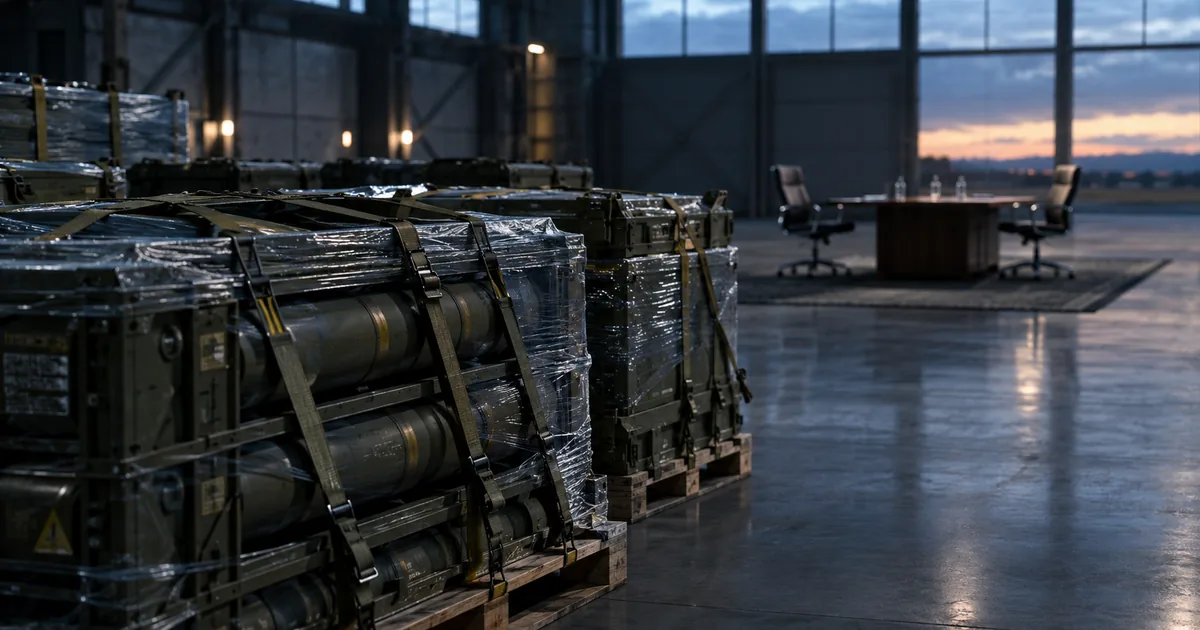
Standing beside Xi Jinping this week, President Trump described a stalled $14 billion weapons package for Taiwan as “a very good negotiating chip.” His Secretary of State spent the same stretch of days telling reporters the delay has nothing to do with China at all. Both men work for the same administration, and only one of them can be describing what is actually happening.
The gap between those two explanations is the most consequential thing to come out of a summit that most coverage filed under pageantry. Reporters counted the pandas, the state dinner and the two-month extension of a trade truce, and concluded the week was light on substance. It was not. The substance was a security commitment being publicly repriced as a bargaining asset, in front of the government it was meant to reassure.
Here is the sequence, which nobody has laid end to end.
| When | The official explanation | Who gave it |
|---|---|---|
| May 2026 | Package paused after the Beijing summit; no reason given publicly | Acting Navy Secretary Hung Cao, in Senate testimony |
| June 2026 | Not paused at all, merely “under review” | Secretary of State Marco Rubio |
| September 24 | Delayed because US weapons production is stretched thin. “This is not about Taiwan in specific” | Rubio, to reporters at the UN General Assembly |
| September 24 | Being held as “a very good negotiating chip” with Beijing | President Trump, alongside Xi |
Read down that right-hand column. An industrial-base problem and a bargaining chip are not two ways of saying the same thing. If the missiles genuinely cannot be built fast enough, then Beijing has nothing to offer that would speed up a production line, and the package is not leverage. If it is leverage, then Rubio’s explanation is decoration. The administration is running both stories at once because each one is aimed at a different audience: the industrial-base version is for Taipei and for Congress, and the negotiating-chip version is for Xi.
The Assurance That Was Supposed to Make This Impossible
There is a reason this particular contradiction matters more than the usual mixed messaging. On July 14, 1982, an American envoy delivered six oral assurances to Taiwan’s president on Ronald Reagan’s behalf. Two of them are directly on point, and the declassified cables are public: the United States had not agreed to set a date for ending arms sales to Taiwan, and it had not agreed to consult Beijing about them.
That second one is not a vague sentiment. It is a specific promise about a specific behaviour, and the behaviour it prohibits is discussing Taiwan’s weapons with China. Trump did it on camera. Foreign Policy reported in May that the package, which includes missiles, anti-drone systems and air defences, had been halted as Washington recalibrated toward Beijing. What changed this week is that the quiet part acquired a price tag and a microphone. Fox News noted the alarm the remark triggered among people who track how far this policy could shift.
Rubio’s counter-narrative deserves its own moment. Arms sales, he told reporters in New York, involve “balancing our industrial capacity and our military industrial base,” and then: “when we sell something, that means we don’t have it anymore.” As a general observation about defence procurement, unremarkable. As an account of why this package stopped in May and is still stopped in September, it asks us to believe the president invented a bargaining chip out of a supply-chain constraint, for fun, while standing next to the person he claims to be bargaining with.
Taipei has responded with the composure of a capital that cannot afford to look rattled. Officials say the remarks caused some unnecessary concern but that they do not believe US policy has changed, and Taiwanese opinion has stayed notably calm. On Friday the government also rejected Xi’s characterisation of the island’s future as a distortion of the facts. Correct public posture. Not evidence that nothing happened.
What happened is a change in how American commitments are priced, and that is where the second-order damage lives. A guarantee works because nobody bothers to test it. The moment one is publicly described as tradeable, every other country holding an American security assurance has to re-run the arithmetic on what theirs would fetch, and every government that might want to buy one learns the going rate. That calculation does not reverse when the package eventually ships. It has already been made, in Seoul and Tokyo and Manila and Warsaw, by people who watched the same press availability.
Our position: the industrial-base explanation is not credible and should stop being repeated as though it were a competing theory of equal weight. The president said what the pause is for, plainly, in public, next to Xi. When an administration offers two incompatible accounts of one decision, the version from the person who makes the decision is the operative one and the other is press management. Congress should make the administration state in writing whether Taiwan’s arms are on the table in trade talks with Beijing, because a 44-year-old commitment says they cannot be, and an assurance delivered orally in 1982 is worth whatever the current occupant of the office decides it is.
We covered this package in May, when the story was that Trump was waffling and Taipei was in limbo. Four months on, the waffle has hardened into a position and the limbo has a stated purpose. That is not drift. That is policy, arrived at without anyone having to defend it as policy.