
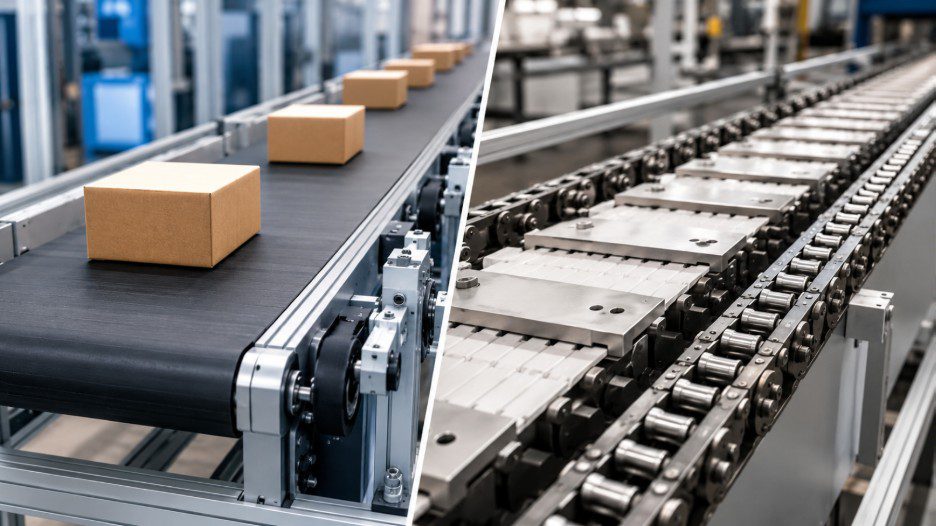
Selecting the appropriate conveyor system may have a direct impact on your production efficiency, maintenance costs, and long-term operational performance. Nonetheless, a comparison of various conveying forms is sometimes not a simple task.
Although both belt and chain conveyors can be used to transport materials between a given point and another, each is optimal in different conditions. Thus, the incorrect choice can result in unwarranted downtime, increased operating costs, or machines that do not suit your business requirements.
Knowing the functionality of each system will help you invest in equipment that assists you in your workflow and does not hinder it.
This article explains the key differences between belt conveyors and chain conveyors to help you make a more informed decision.
1. Belt Conveyors Are Designed For Smooth and Versatile Material Handling
Belt conveyors are usually preferred when your production line needs a consistent flow of products without much vibration. They use a continuous belt that is stretched over pulleys, which enables products to move freely between one station and another. Consequently, they are highly applicable in manufacturing conditions where the handling of a product is of great importance.
In addition, contemporary conveyor systems come in modular formats that can be adjusted to various layouts and production specifications. This flexibility enables manufacturers to add conveyors to new and existing automation systems with fewer adjustments.
Belt conveyors are commonly used for transporting:
- Packaged products
- Electronic components
- Medical devices
- Plastic parts
- Consumer goods
- Lightweight assemblies
Moreover, they produce less noise compared to chain conveyors, and they usually have fewer moving parts. As a result, companies tend to have reduced maintenance requirements and a more productive daily operation.
2. Chain Conveyors Offer Greater Strength For Heavy Loads
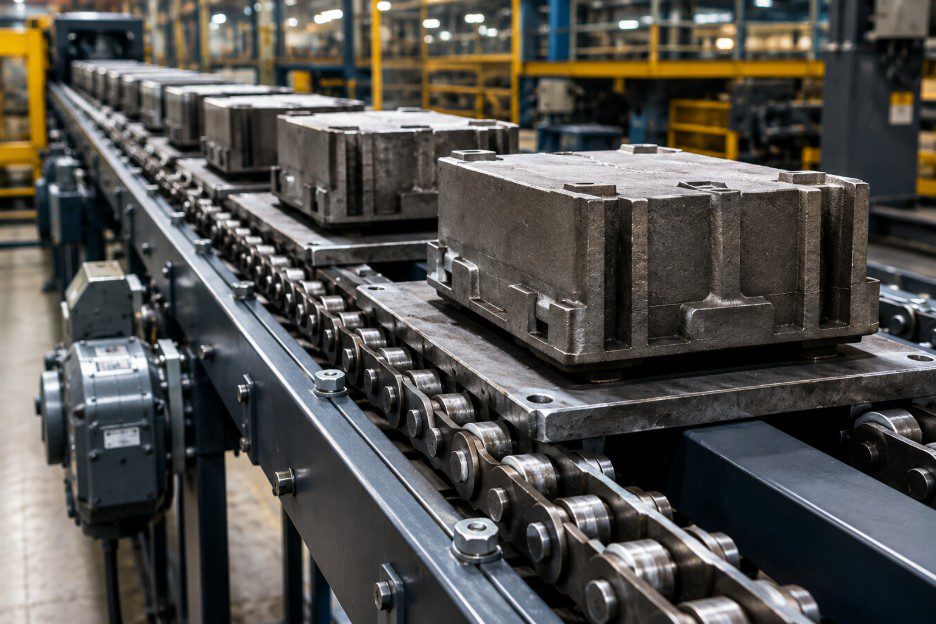
Although belt conveyors excel in many production environments, chain conveyors are specifically designed for applications involving heavy, bulky, or high-temperature materials. Such systems do not use a continuous belt but rather one or more chains to transport products along a specified route.
Since chains have outstanding pulling capabilities, they have the ability to carry a load that would excessively strain regular conveyor belts. Hence, chain conveyor systems are frequently used in industries that handle heavy or rough loads on a regular basis.
Steel products, automotive components, heavy pallets, industrial machinery, and foundry materials are some of the products normally conveyed through chain conveyors.
Belt conveyors, on the other hand, are more applicable in the transportation of consumer goods, electronic components, pharmaceutical products, packaged goods, and food products that demand smooth and stable handling.
Moreover, chain conveyors are effective in harsh conditions where oil, heat, or abrasives material can quickly wear down conventional belts. However, they generally produce more vibration and noise, making them less suitable for transporting delicate products.
3. Maintenance, Efficiency, and Operating Costs Differ Significantly
In addition to carrying capacity, the maintenance costs can affect the overall ownership cost. Consequently, it is as important to assess the current service demands as it is to compare the buying prices.
Belt conveyors usually feature fewer wear components. As the system functions using an uninterrupted belt, the level of lubrication needed is also lower, and regular check-ups are typically easier. As a result, many manufacturers experience reduced maintenance downtime.
Chain conveyors, on the other hand, require more regular servicing. Chains require correct lubrication and tension adjustment, as well as periodic replacement due to wear. Chain performance can deteriorate without regular maintenance, and this can result in unexpected interruptions.
In general, belt conveyors tend to have fewer maintenance needs, less noise production, and improved energy efficiency. They also offer more efficient product handling, and thus they are best suited to delicate or precision-manufactured products.
In contrast, chain conveyors have more wear components and require more frequent maintenance, but they excel in demanding applications that involve heavy or rugged materials.
Moreover, recent modular belt conveyor systems usually have an energy-saving drive technology to make sure that the consumption of electricity is minimized without affecting the throughput.
As a result, it is often viewed as a significant benefit by companies that want to reduce the cost of operations.
4. Right Choice Depends On Your Production Requirements
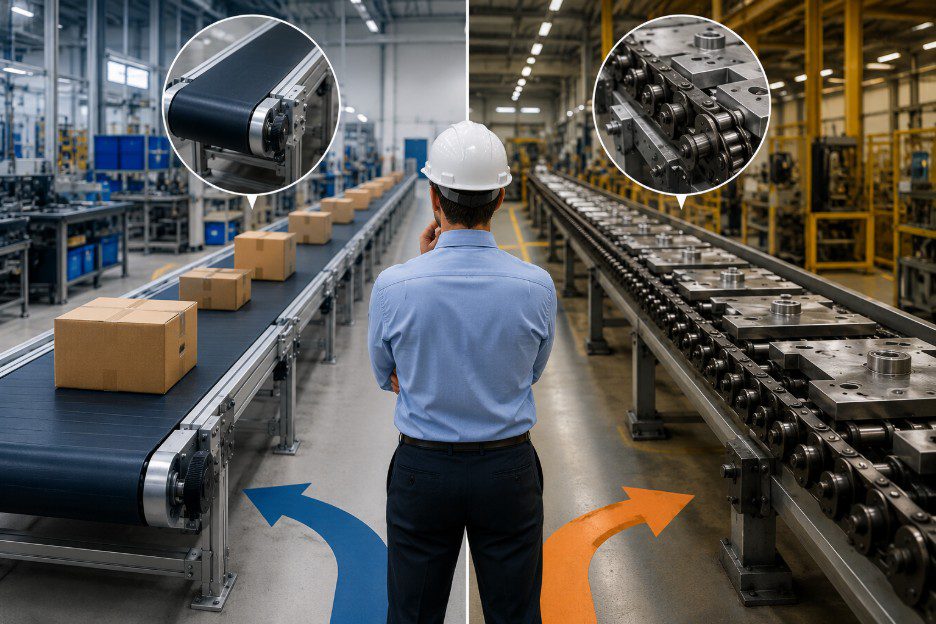
Rather than asking which conveyor is better, it is more useful to determine which system best supports your specific application.
If your operation involves lightweight products, automated assembly, precision manufacturing, or clean production environments, belt conveyors typically provide a better solution. Their smooth transportation, quiet operation, and flexible configurations make them suitable for industries such as electronics, medical manufacturing, packaging, and consumer products.
Conversely, if your facility regularly handles heavy pallets, steel components, industrial machinery, or abrasive materials, chain conveyors deliver the durability and strength needed for those demanding conditions.
Before making a decision, consider factors such as:
- Product weight
- Product dimensions
- Production speed
- Facility layout
- Maintenance capabilities
- Future expansion plans
- Operating environment
Evaluating these factors early helps ensure your conveyor system supports both current production goals and long-term operational growth.
Conclusion
Both belt conveyors and chain conveyors play essential roles in modern material handling, but each serves a different purpose. Belt conveyors offer smooth, efficient, and versatile product transportation, making them an excellent choice for many automated manufacturing environments.
In contrast, chain conveyors provide the strength required for heavy-duty industrial applications where durability takes priority.
By carefully assessing your products, production processes, and operational requirements, you can choose the conveyor system that delivers the best combination of performance, efficiency, and long-term value.