
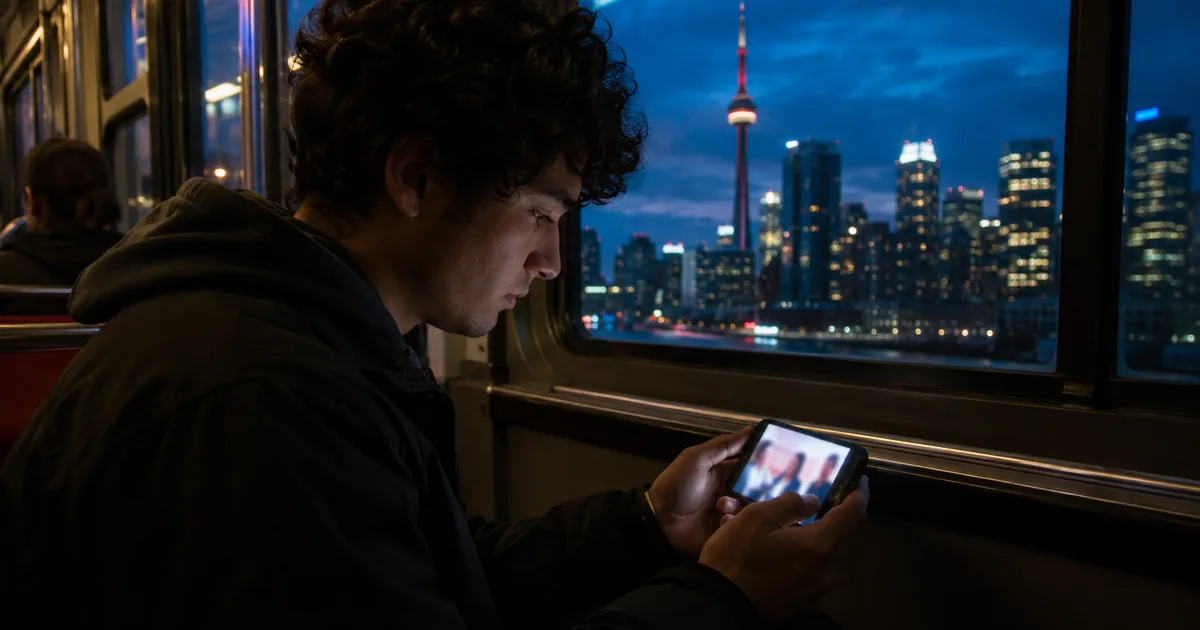
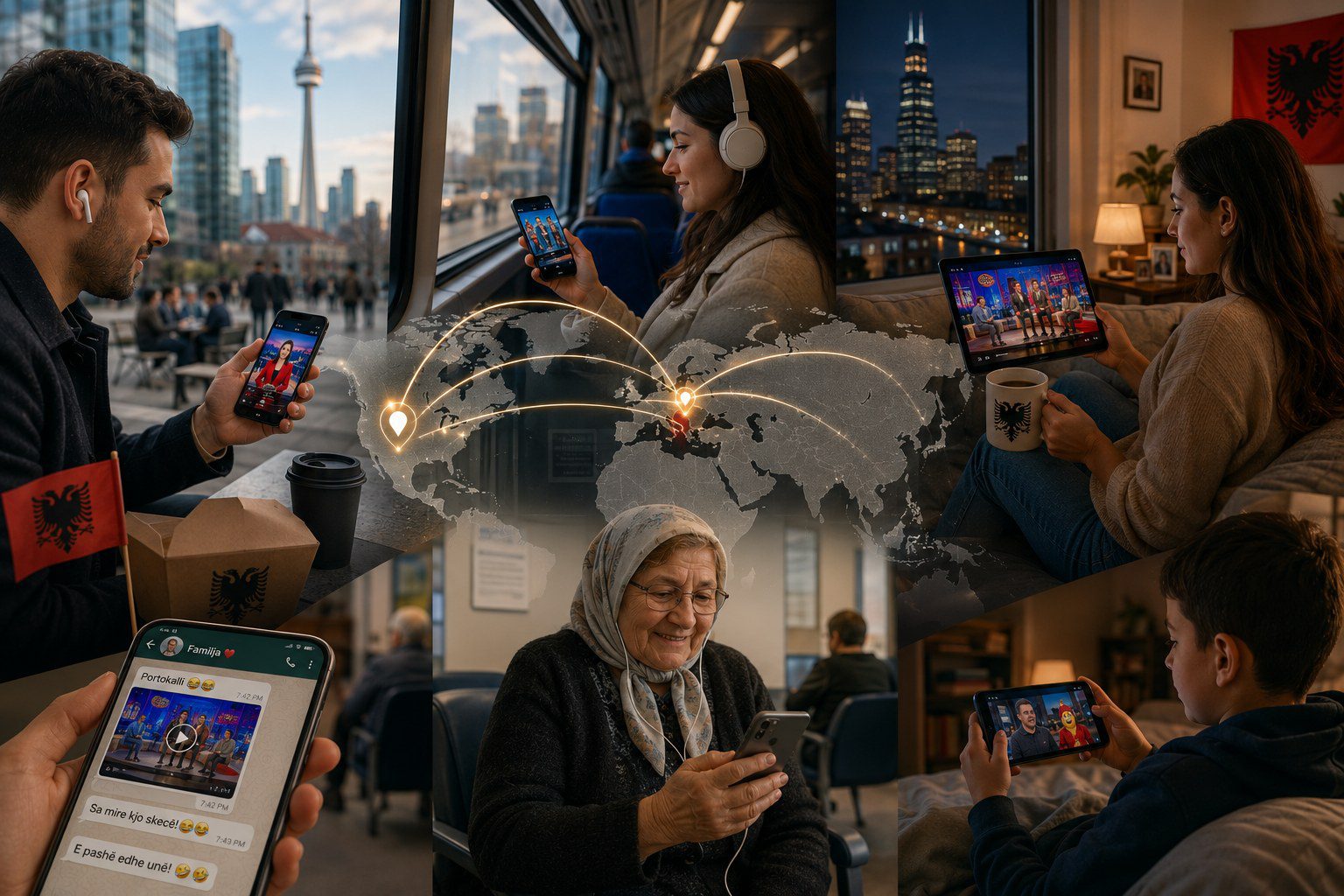
Ardit glances at his phone during his lunch break in downtown Toronto, catching up on the morning news from Tirana while his coworkers scroll through their own feeds. Three thousand miles away, his cousin Lira watches the same broadcast from her apartment in Chicago, pausing it to text their grandmother about a segment on their hometown. Neither planned this moment of connection, but both knew exactly where to find the familiar voices that make distance feel smaller.
There are an estimated 750,000 to one million people of Albanian heritage living across the United States and Canada, a figure that includes ethnic Albanians from Kosovo, North Macedonia, and Montenegro alongside those born in Albania itself. The census puts the number lower — around 224,000 in the US and just over 41,000 in Canada — but community organizations consistently put the real total much higher, for the obvious reason that second- and third-generation Americans don’t always tick the Albanian box on a form.
That second and third generation is where the real challenge sits.
The Quiet Revolution in Albanian Living Rooms
Albanian families have quietly revolutionized how they consume media from home. The ritual remains the same: Sunday dinners still pause for the evening news, and Portokalli clips still get shared in family group chats. What changed is when and where these moments happen.
Second-generation Albanian-Americans find themselves checking their phones (TV shqip live mobil) during their commute, catching morning shows their parents watched growing up. The content bridges generational gaps in ways that feel effortless—a shared laugh at a comedy sketch becomes a text exchange, a news story sparks a phone call home.
This isn’t about replacing family time around the television. It’s about extending those moments throughout the day, creating pockets of connection that fit into North American schedules while preserving Albanian rhythms of life.
When Geography Stops Mattering
Geography becomes irrelevant when the TV shqip app travels in everyone’s pocket.
Families create new traditions around shared viewing, even when they’re not sharing the same room. Group chats explode with commentary during live broadcasts. Screenshots of funny moments get passed through family networks faster than traditional social media spreads them.
The technology enables something deeper than convenience. It preserves the spontaneous cultural moments that happen when Albanian media plays in the background of daily life—the sudden recognition of a song, the surprise at seeing a familiar face from home, the comfort of hearing the language spoken naturally rather than translated.
What Gets Lost Between Generations
Research on immigrant language patterns is consistent on one point: second-generation immigrants are more likely to lose their heritage language than to remain bilingual, and the shift is happening faster than it did in earlier waves of immigration. English takes over at school, at work, in friendships, and Albanian, if it survives at all, gets confined to conversations with grandparents and the occasional family dinner.
This isn’t unique to Albanian families. But it does mean that the question of how a language stays alive in a diaspora household is a real and pressing one, not a sentimental concern. Television has always been part of the answer. Hearing Albanian spoken naturally, at normal speed, with its idioms intact, does something that a language app cannot replicate.
The Cultural Weight of Accessibility
For most of the diaspora’s history, Albanian TV meant one television in one room, at one time. The family gathered around it, or they didn’t. What the smartphone changed is not the content — it’s the availability. 91% of Americans now own a smartphone, and for Albanian diaspora families, that means Albanian programming can follow a person through their day rather than waiting for them at home, according to Pew Research Center.
A parent catches the morning news during a commute. A teenager watches a clip from Çka ka shpija on a lunch break and sends it to a cousin in Prishtina. A grandmother in Hamilton watches her Sunday variety show from a waiting room. TVALB, the leading provider of Albanian television and entertainment in the United States and Canada, built its mobile access around exactly this reality. The viewing habits of diaspora families don’t fit neatly into prime-time schedules, they happen in fragments, across time zones, on whatever device is at hand.
The Cultural Weight of Small Moments
The argument for mobile access to Albanian TV is not really a technology argument. It’s a language argument. Regular, casual exposure to Albanian — news, comedy, talk shows, music — keeps the language active in ways that formal effort rarely does. A teenager who wouldn’t sit through a language class will watch a funny clip from Portokalli. A child who resists practicing Albanian with a parent will absorb vocabulary from a show running in the background.
This is how languages survive in diaspora conditions: not through deliberate preservation, but through repeated, low-stakes contact. Mobile access turns that contact from something that happens once in the evening to something that can happen throughout the day — during a commute, a break, a quiet hour before bed.
For the third generation, especially, that availability matters. By the time grandchildren arrive, the language is already under pressure from all directions. The question is not whether Albanian will be perfectly maintained, but whether it will stay present enough to remain part of a family’s shared reference — the jokes that land, the phrases that mean something, the shows that connect people across different time zones and different levels of fluency.
The phone doesn’t solve that problem, but it keeps the door open.