
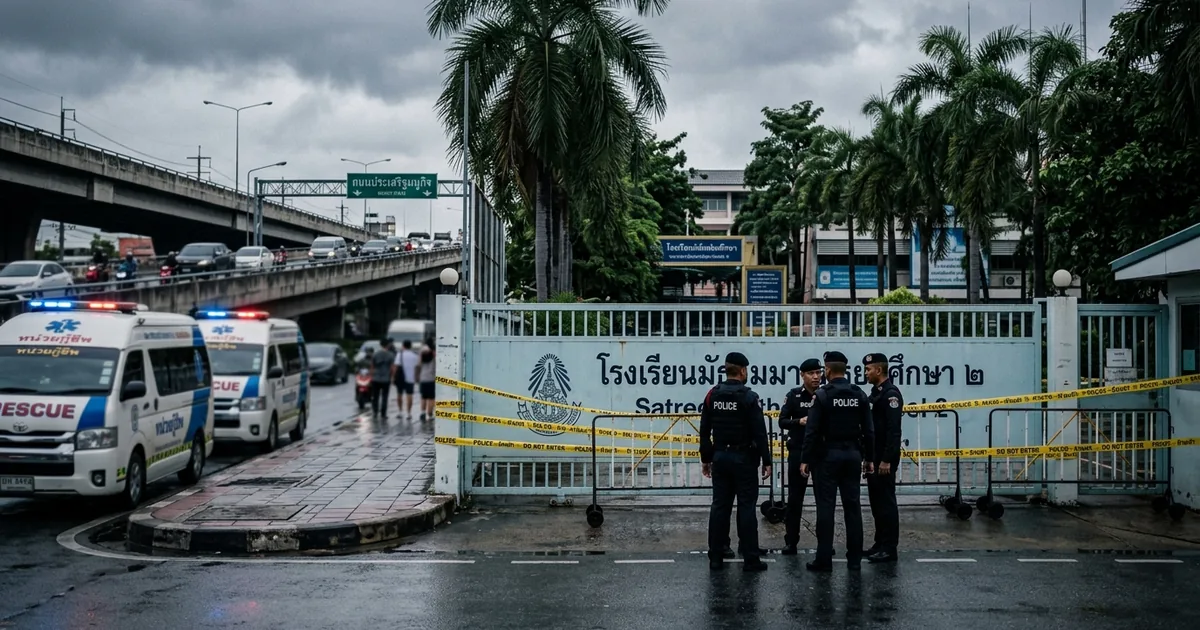
A teenager walked into Debsirin Nonthaburi School on Friday carrying a handgun that belonged to his grandfather, and by the time police reached him at least six people inside the building were dead.
He had already killed both grandparents at their home, police said, which means the weapon and the first two victims came from the same address.
That detail is the story. Thailand has spent nearly four years promising to fix how guns move through households after the worst massacre in its modern history, and the one reform that actually passed made it easier to keep a gun legally rather than harder for the wrong person to reach one.
What Police Have Confirmed
The attack happened in Bang Kruai district in Nonthaburi province, just north of Bangkok, at a secondary school of roughly 3,000 students on a busy highway. CNN reported that three students and three teachers were killed and more than a dozen others wounded, with several in critical condition. Most of the injured are between 12 and 17 years old.
The toll moved all day. Al Jazeera put the confirmed number at five before police revised it upward, and the first accounts saying the gunman had killed himself turned out to be wrong. Police later said he survived and remains in critical condition, which matters for more than the arithmetic. A living suspect means there will eventually be testimony about where that handgun was kept and who knew a teenager could get to it.
Treat every number here as provisional. Casualty counts in the first day of a mass shooting almost always move.
Thailand Has Roughly 10 Million Guns and Almost No Screening
The reflex outside Asia is to file this under American exceptionalism and move on. Thailand does not support that reading. The country holds an estimated 10.3 million civilian firearms, about 15 for every 100 people, and researchers put roughly 40 percent of them outside the registration system entirely. It has the second-highest rate of gun homicide in Southeast Asia, behind the Philippines.
The legal framework is not permissive on paper. A Thai national over 20 applies through a district office, passes a criminal background check, and states a qualifying reason: self-defense, sport, or occupational need. What the framework does not require is a psychological evaluation, and it says nothing at all about storage or about who else lives in the applicant’s house.
Reported firearms offenses climbed from around 24,000 cases in 2018 to more than 87,000 by 2022. East Asia Forum has traced that curve to a domestic market that expanded faster than any enforcement capacity built to watch it.
The Reform Thailand Chose Was a Registry, Not a Gate
On October 6, 2022, a former police officer killed 37 people at a childcare center in Nong Bua Lamphu province, 24 of them children, in what remains the deadliest attack by a single perpetrator in modern Thai history. The prime minister ordered a gun crackdown within days. Proposals circulated for mandatory psychological screening and tighter background checks.
Here is what became policy: the cabinet approved an amnesty giving owners of unregistered firearms 180 days to record them with the state without facing charges. A year later, as VOA documented, the screening proposals had gone nowhere.
Look at what that trade actually accomplished. Registration tells the state a gun exists. It tells the state nothing about who in the household can pick it up on a Friday morning. A registered handgun in a grandfather’s drawer is exactly as available to a 16-year-old as an unregistered one, and Thailand spent its post-massacre political capital converting the second category into the first.
That is the structural failure behind Friday. Not an absence of gun laws, and not an absence of outrage in 2022. A government facing a demand to restrict access answered with paperwork, because paperwork was the version the firearms trade and its allies in the security services could live with. Every element of the reform package that would have touched an applicant’s fitness or an owner’s storage obligations died quietly.
The Question the Suspect Can Answer
Thai authorities now have something they rarely get after an attack like this: a suspect who is alive. In 2022 the perpetrator killed himself, and so did the gunman in the 2020 Nakhon Ratchasima shootings. Investigations in both cases ended at the shooter, which is convenient for a system that would rather not examine the chain that put a weapon in his hands.
This time there is a person who can be asked where the gun was stored, whether it was locked, whether anyone in the family had raised a concern, and whether the registration paperwork his grandfather filed made a single practical difference. Those answers are the only mechanism by which a storage law gets written.
Thailand’s parliament has heard this argument before and let it lapse. The difference now is that the country has just watched a household weapon travel from a bedroom to a classroom in the space of one morning, with the registered owner as the first casualty. Whether that is finally specific enough to move a bill is the thing worth watching over the next several weeks, and the honest expectation, based on 2022, is that the news cycle will move faster than the legislature does.