
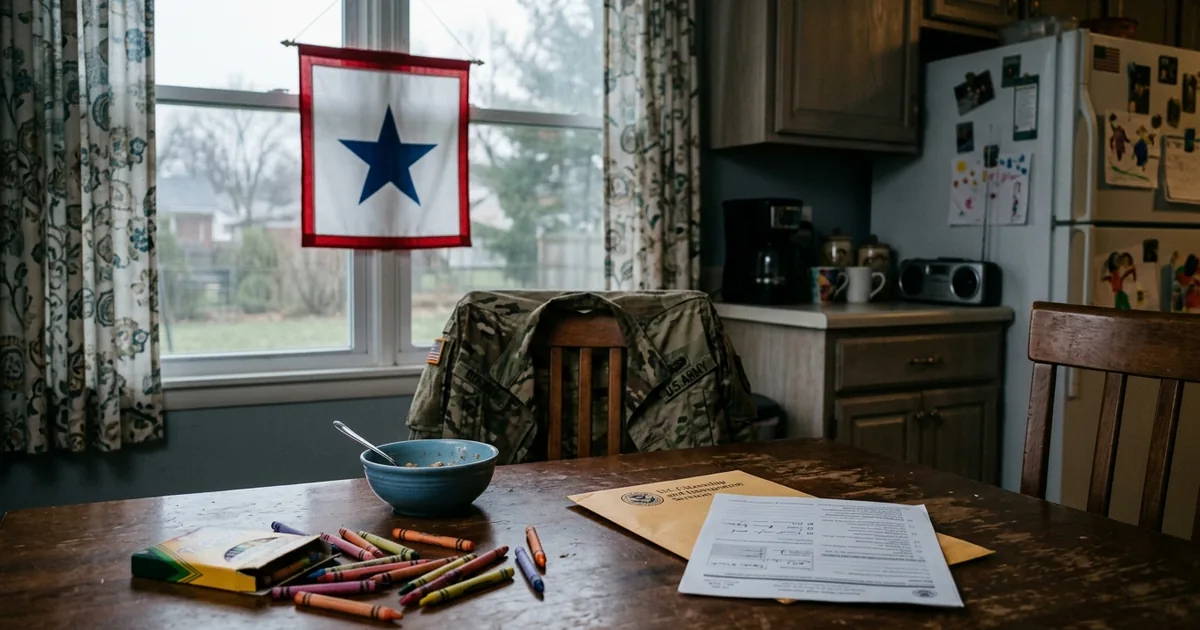
You do not need to repeal a protection if you can simply take twelve months to grant it.
That is the mechanism behind the numbers in an Associated Press investigation published this week, which found that more than 50 parents and spouses of active-duty American troops have been detained by immigration authorities since January 2025, at least six of them deported and one more leaving the country on her own.
For roughly two decades, both parties treated the immediate family of a deployed service member as off the table. That consensus has not been voted away. It has been processed away.
The Number Nobody Announced
Parole in place is the immigration tool at the center of this. It is a discretionary grant that lets the undocumented spouse, parent, or child of a service member stay in the country legally while adjusting status, and its original justification had nothing to do with generosity. The Pentagon wanted it because a soldier worrying about whether his wife will be gone when he lands is a soldier who is not focused on the deployment.
According to USCIS data cited in the AP’s reporting, the average wait for military parole in place has more than doubled under the current administration, to roughly twelve months. No repeal was announced. No rule was published. The benefit still formally exists, and applicants are still formally eligible, and in the meantime every one of them spends a year as a person ICE can lawfully arrest.
That gap is the entire policy. An enforcement agency operating against removal targets does not need a family member to be ineligible for relief. It only needs them to be undocumented on the morning the agents arrive, and a twelve-month adjudication queue guarantees a steady supply of exactly that.
PBS NewsHour carried the AP findings alongside the broader tally: between January 20, 2025 and January 26, 2026, immigration authorities detained 125 military veterans, moved 34 of them into removal proceedings, and arrested more than 150 immediate family members of service members and veterans. At least eight relatives of active-duty troops remain in federal custody now. The administration is also reported to be preparing to end parole in place outright, which would formalize a condition that has already arrived in practice.
What This Costs the Force
The readiness argument is not a rhetorical flourish that advocates bolted on afterward. It is the reason the program exists, and Military.com’s coverage documents what its erosion is doing: deployments delayed, service members burning leave to manage detention hearings, troops abroad with no caretaker for their children and no partner at home.
The timing sharpens it. The United States is at war in Iran. This site covered the dignified transfer at Dover for four service members killed in that conflict in July, and there is a straight line between that ceremony and this policy that nobody in the administration seems eager to draw. The country is asking a volunteer force to deploy into an active shooting war while detaining the people that force comes home to.
There is also a recruiting dimension that will take years to show up in the data and will not be reversible when it does. A meaningful share of the enlisted ranks comes from mixed-status families. Word travels through those communities faster than any recruiting campaign can counter, and the message currently traveling is that a uniform does not protect your mother.
Discretionary Benefits Were Always Built on Sand
The deeper lesson here is structural and it extends well past military families. Parole in place was never statute. It was an exercise of executive discretion, sustained by the norm that some categories of people were simply not enforcement targets. Norms of that kind are cheap to maintain and cost nothing to abandon, and they leave no litigation trail when they go, because declining to act quickly is not a reviewable action.
We have watched the same pattern elsewhere in this enforcement wave. LNC reported in July on a Colombian father killed during an ICE operation in Maine whom the agency said was not the target and who had a pending legal pathway. The through line is not that the rules changed. It is that the informal understandings around the rules, the ones that decided who was practically safe, were withdrawn without anything replacing them.
Members of Congress in both chambers have introduced bills to write protection for military and Gold Star families into law rather than leaving it to agency grace. That is the correct response and it is unlikely to move in this Congress. Which leaves an uncomfortable question for the people currently defending the enforcement surge on readiness-neutral grounds: if the family of a deployed soldier cannot be carved out, who exactly did anyone imagine the carve-outs were for?
The AP’s number will grow. The reporting relies on cases that surfaced, and the families most exposed to this are the ones least likely to call a journalist while a relative is in custody and a status application is pending. Fifty-plus is the floor.