
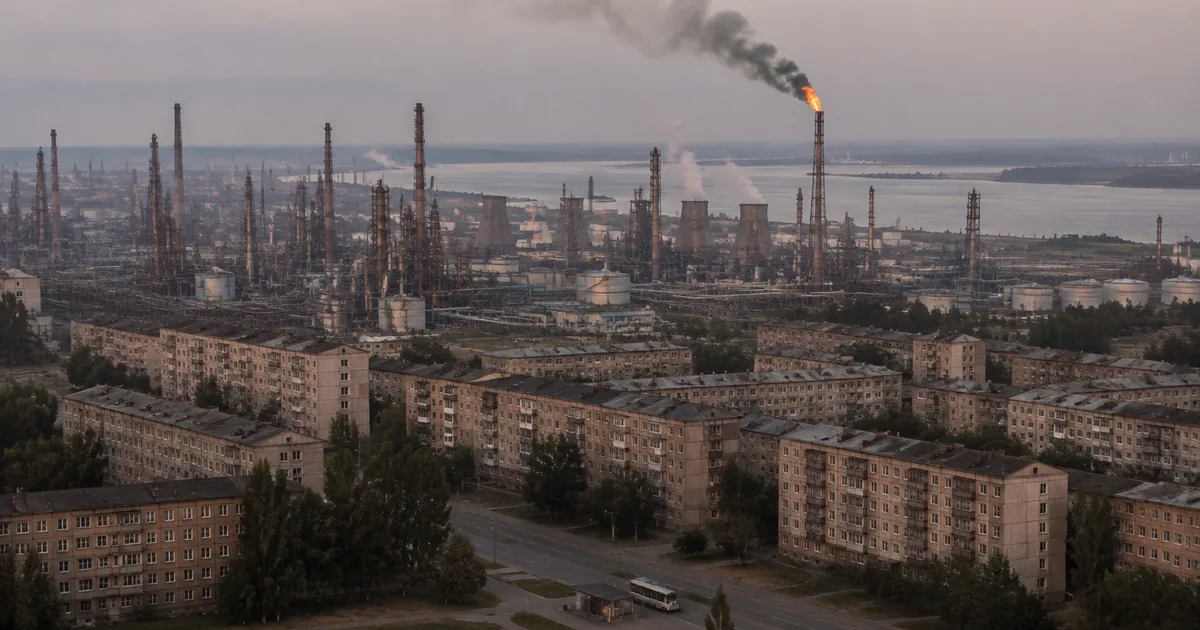
Ukrainian drones hit the Russian city of Nizhnekamsk before dawn on Monday, killing at least 13 people and wounding dozens more in a place that exists, by Soviet design, because the petrochemical plants exist.
That detail is missing from most of the coverage running today, and it is the part that explains why Kyiv’s oil campaign was always going to arrive at a morning like this one.
What Tatarstan Has Confirmed So Far
Radmir Belyayev, the mayor of Nizhnekamsk, said drones struck both industrial and civilian sites and put the initial toll at 12 dead and 39 injured while the attack was still underway, according to reporting carried by RTÉ from the Reuters wire. That number moved through the morning. The Associated Press account distributed by NPR raised it to 13 killed, including a child, and 48 wounded. The Moscow Times reported that more than 70 people sought medical attention. Thirteen is the figure Russian authorities have settled on as of Monday morning, and toll counts this early in an industrial fire tend to move again.
Rustam Minnikhanov, the head of the Republic of Tatarstan, declared a period of mourning. His press service described the target set as “industrial and civilian facilities,” which is an unusually direct admission from a Russian regional government that the two categories were not cleanly separated.
Ukraine did not hide from it. Kyiv’s military confirmed hitting the Taneco refinery overnight and said a fire was recorded at the facility. Russia’s defense ministry claimed it shot down 456 Ukrainian drones across Russia and annexed Crimea in the same window, a number it offers without ever saying how many got through. Volodymyr Zelensky, speaking more broadly about the campaign, said Ukraine delivers “entirely justified responses” and that “Russia’s war will be felt more and more at their own home, in Russia.”
Nizhnekamsk sits roughly 1,200 kilometers, about 750 miles, east of the Ukrainian border. Whatever else Monday demonstrated, it demonstrated range.
A City That Exists Because the Plants Do
Here is the geometry almost nobody is writing about.
Nizhnekamsk is not a city that happens to contain a refinery. It was founded in 1961 as a workers’ settlement, built from nothing to house the labor force assembling the Nizhnekamskneftekhim petrochemical complex after Soviet planners decided in 1956 to put a full-cycle synthetic rubber operation on the Lower Kama River. The population, now around 241,000, is there because the plants are there. Nizhnekamskneftekhim is still described as the city-forming enterprise. Tatneft’s Taneco refinery, one of the most technologically advanced in Russia, sits in the same industrial cluster.
Russia has roughly 300 of these single-industry towns, home to close to 13 million people, as the Pulitzer Center has mapped in detail. The Soviet development model deliberately collapsed the distance between the plant and the people who run it, because that was efficient, and because nobody planning a monotown in 1961 was modeling a drone flying 750 miles to find it.
The consequence is that Ukraine’s refinery campaign does not have a version of itself that scales cleanly. Every additional kilometer of range opens up more of Russia’s refining base, and Russia’s refining base was built with apartment blocks attached. You can target the crude unit with real precision and still be aiming into a residential district, because the residential district was constructed for the crude unit. That is not a story about Ukrainian carelessness or Ukrainian intent. It is a story about a targeting set whose civilian proximity was locked in six decades ago by people optimizing for something else entirely.
Which means the honest framing of Monday is not “a strike went wrong.” It is that the campaign’s success condition and its civilian risk are the same variable, and they have been rising together all summer.
The Campaign Is Working, and That Is Exactly the Problem
Kyiv’s logic for the long-range oil war has never been secret. Starve the refining sector, starve the fuel supply, starve the revenue, and Putin runs out of room. By early July, Ukraine’s General Staff assessed it had disabled 43 percent of Russia’s projected refining capacity, with cumulative losses to the industry since August 2025 estimated at $13.5 billion, figures Kyiv Post laid out in its analysis of the 40-day oil campaign. Reuters reported in mid-July that nearly 40 percent of that capacity was unlikely to come back within two months even if the strikes stopped entirely. They have not stopped. We covered the drone attack on the Moscow-region oil depot at Noginsk in July, and Taneco itself was hit once already, in June.
Russians have felt it: rationing, queues, export bans, regional shortages. That was the point. Zelensky has said plainly that the mechanism is domestic Russian pain converted into diplomatic pressure.
But a strategy that names felt pain inside Russia as its operating principle does not contain a natural stopping line at “only industrial pain.” Once the theory of victory is that the war has to reach ordinary Russians before the Kremlin moves, the difference between a burning refinery and a mourning declaration in a city of 241,000 becomes a matter of scale, not of category. Ukraine is fighting a war of national survival against an invasion that has run more than four years, and the moral asymmetry of that is not in question here. The strategic question is narrower and harder: what does Kyiv do when the most effective tool it has developed keeps producing the images Moscow most wants to show the world?
Both Sides Are Killing More Civilians, Not Fewer
The same overnight window is a small study in the current shape of this war. While Nizhnekamsk counted its dead, Russia fired 126 drones at Ukraine and shelled the Kharkiv region village of Bugaivka, killing five civilians. Last week Russian ballistic missiles killed 17 people in Kyiv in an attack that pushed Ukraine’s Patriot interceptor stocks to their limit. Diplomacy is stalled, and both governments have responded by extending their reach rather than their restraint.
That is the trend line worth watching, more than any single day’s toll. Kyiv fires record drone volumes; Moscow fires record missile salvos; each escalation is justified as the answer to the last one, and the civilian numbers on both sides climb in step. Zelensky’s own framing on Monday, that every Russian strike will be met with a response, is the clearest possible statement of a system that has no built-in exit.
Watch what Washington does with this. An administration that has spent months pressing for a negotiated settlement now has an American-supported campaign producing dead Russian civilians in a republic 750 miles from the front, and the Kremlin will spend the week making sure nobody misses it. The bodies in Nizhnekamsk will be argued about as a war crime, as a legitimate strike on a military-industrial target, and as leverage, probably all three before Friday. The one thing they will not do is change the underlying arithmetic, which is that Russia’s oil complex and Russia’s company towns are the same address, and Ukraine has now proven it can reach both.