
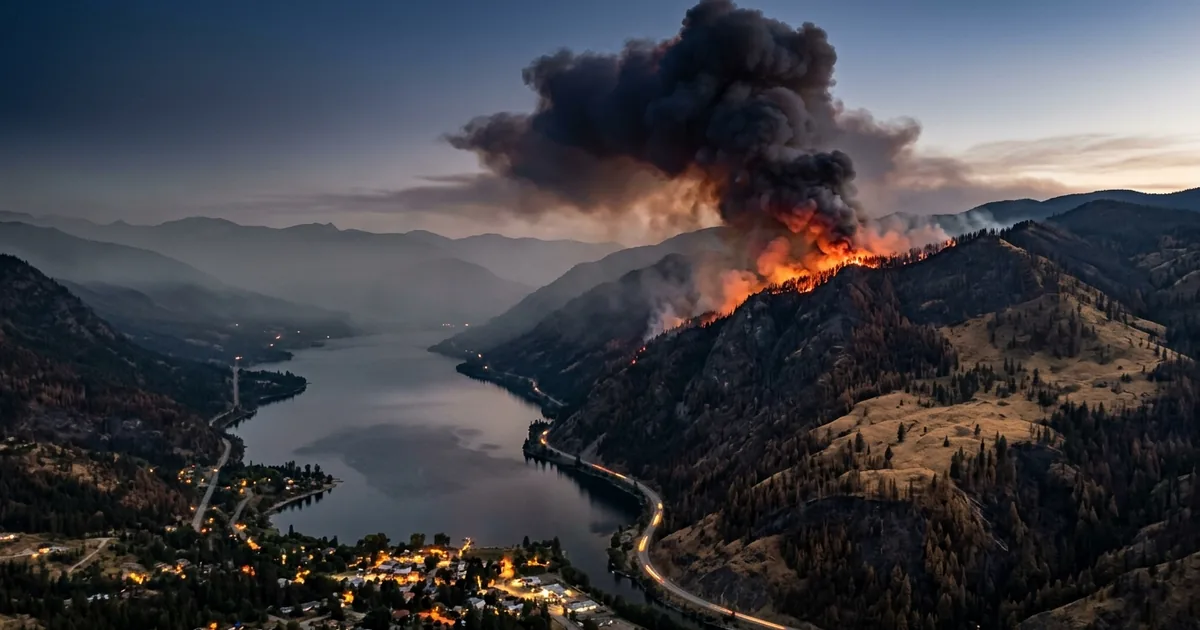
Premier David Eby called the weekend growth of the Bald Range wildfire “a remarkable escalation in fire activity,” which is the careful way of saying a fire above Okanagan Lake got hot enough to build its own thunderstorm and throw its own lightning.
British Columbia declared a provincewide state of emergency on Saturday, pushed more than 20,000 people out of two lakeside communities, and is now investigating the death of an 80-year-old woman who tried to leave and did not make it.
A Fire That Started Generating Its Own Weather
The Bald Range fire started Friday night west of Okanagan Lake. By Saturday it had burned roughly 9,500 hectares, about 23,500 acres. By Sunday the estimate had climbed past 13,600 hectares, better than 33,600 acres, meaning the fire had grown by close to half its own size inside a single day.
That kind of run is not just wind. When a fire column gets tall and hot enough, it condenses its own moisture at altitude and forms a pyrocumulonimbus cloud, a fire-generated thunderhead that can produce downdrafts and dry lightning. The downdrafts shove flame in directions the forecast did not predict. The lightning starts new fires ahead of the one you are already fighting. Eby said plainly that this blaze had begun making its own weather system, and that is the detail that explains the overnight evacuation order rather than a morning one. Crews were not managing a fire line. They were managing something that had started writing its own conditions.
British Columbia had more than 100 fires burning at the same time, with nearly half of them classified as out of control, in what Al Jazeera described in its account of the evacuation orders as hot, windy conditions layered on top of a prolonged drought. About 1,500 firefighters are deployed across the province. The province is carrying 39 evacuation orders and 49 alerts at once.
Meadow Valley
An 80-year-old woman from Meadow Valley died Friday night while leaving her home with a family member as the fire moved. The RCMP believe her death was a result of the wildfire, and the BC Coroners Service is investigating. Global News reported the details of her death while fleeing the Bald Range fire on Sunday.
She is, so far, the only confirmed fatality. She is also the entire argument for why the province moved when it did.
A State of Emergency Is a Logistics Tool, Not a Firefighting One
There is a common misreading of provincial and state emergency declarations, which is that they somehow summon more water bombers. They do not. What Eby’s declaration actually unlocked, as Emergency Management Minister Kelly Greene described when British Columbia declared the provincewide emergency, is the authority to restrict travel and to secure accommodations for evacuees that would otherwise be unavailable.
Read that second power carefully, because it is the one that matters in the Okanagan in August. This is wine country and lake country at the exact peak of tourist season. Every motel room, rental unit and campsite between Kelowna and Penticton was already spoken for by people on vacation when 20,000 residents needed somewhere to sleep on a few hours’ notice. Without the declaration, the province is a customer competing for inventory. With it, the province can commandeer the beds.
That is what a state of emergency is for in a wildland-urban interface: it is a housing instrument and a traffic instrument. The fire does not care. The 20,000 people displaced by it care a great deal.
The Interface Problem Nobody Wants to Price
Summerland is home to about 12,000 people. Roughly 8,000 more live in and around Peachland just up the lake. Both sit in exactly the kind of terrain that has become the defining risk of North American fire seasons: steep, forested slopes above a valley floor, with residential development pushed up into the trees because the view is worth money and the land was cheaper than the flats.
British Columbia has now run this scenario repeatedly. Lytton burned to the ground in 2021. West Kelowna, less than 30 kilometres from Peachland, faced mass evacuation in 2023. The province keeps proving it can move tens of thousands of people quickly, which is a genuine and underrated competence. What it has not done, and what almost no jurisdiction on this continent has done, is confront the underlying math: the housing stock keeps expanding into the fuel, the fuel keeps drying out earlier each year, and the emergency response keeps getting better at the evacuation rather than at the prevention. Getting very good at moving people out of harm’s way is not the same thing as reducing harm. It is a hedge against the failure to.
What Reaches the American Side
For readers in Washington, Idaho and Oregon, the immediate export from this fire is smoke, and the timing is bad. The Pacific Northwest has already spent this month under degraded air, something we covered when smoke pushed air-quality readings across Portland and Seattle earlier in August. A hundred-plus fires burning 300 kilometres north of the border, half of them uncontrolled, with pyroconvective columns lofting particulate high into the atmosphere where the winds carry it fast and far, is not a Canadian weather story. It is a shared airshed.
NBC News noted in its report on the 20,000 evacuations that the fires destroyed homes as they moved. The structure count will take days to firm up, because assessment teams cannot enter an area that is still burning.
The forecast is the thing to watch this week. The Bald Range fire is drawing energy from drought-cured fuel and daytime heating, and a fire that has demonstrated it can manufacture its own convection is a fire that will keep doing it as long as the ingredients hold. Cooler, wetter air would change that overnight. Nothing in the current pattern suggests it is coming.