
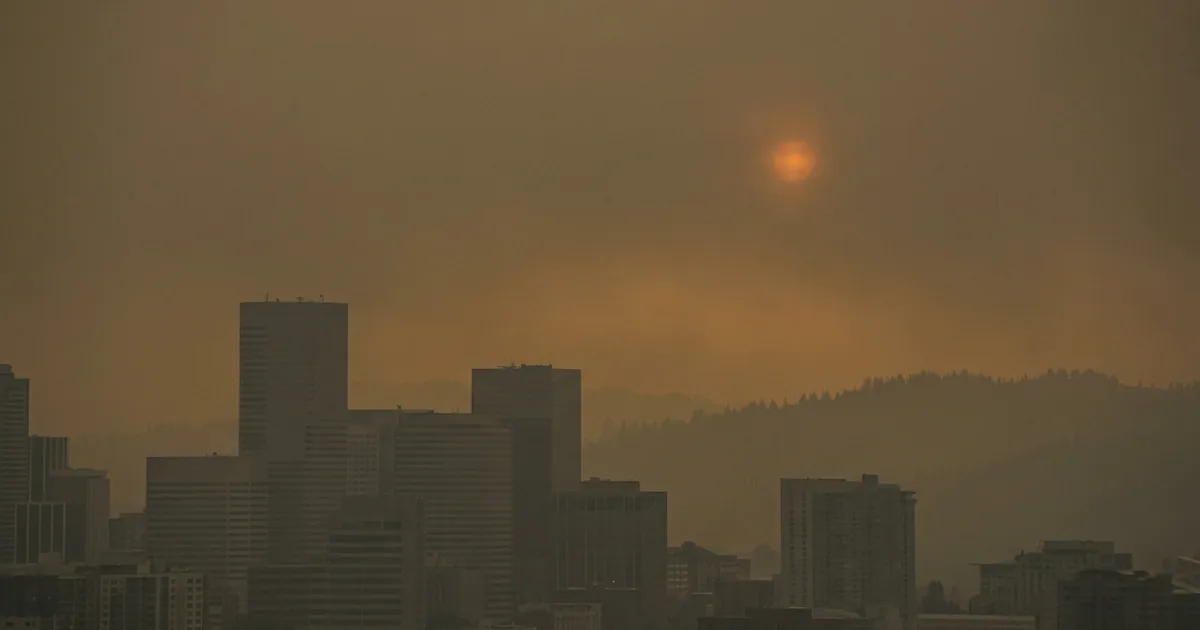
Roughly 50 large uncontained wildfires are burning across the Pacific Northwest, about 30 of them in central and eastern Oregon, and the smoke is not staying where the fires are.
Air quality advisories now cover most of the region, and by Wednesday the plume was forecast to reach Portland, Seattle, Boise and Salt Lake City, cities that in most cases are hundreds of miles from anything actually on fire.
The Numbers, by Place
The worst readings are in the interior. Prineville, Oregon measured hazardous on Tuesday morning, the top category on the index. Central and eastern Oregon sat at unhealthy. Monitors at Pendleton, Walla Walla, La Grande, Baker City, Ontario, John Day and Burns all registered unhealthy readings.
Western Oregon, including most of the Willamette Valley, landed at unhealthy for sensitive groups, which is the category people most reliably misread. Oregon Public Broadcasting reported officials urging residents to limit outdoor activity with advisories in effect for most of the Pacific Northwest through at least Wednesday, and KLCC reported nearly the entire state under advisory. Weather.com’s forecast put Seattle and Portland squarely under it.
“Unhealthy for Sensitive Groups” Does Not Mean “Fine for You”
This is the practical part, and the category names actively work against people understanding it.
The Air Quality Index is a scale, not a switch. The orange band, 101 to 150, gets labeled unhealthy for sensitive groups, and most people read that as a clearance for everyone else. It is not. It means people with asthma, COPD, heart disease, diabetes, older adults, pregnant people and children will feel measurable effects, and that a healthy adult doing something strenuous outdoors is also inhaling fine particulate at levels that produce symptoms. Wildfire smoke’s active ingredient is PM2.5, particles small enough to cross from lung tissue into the bloodstream. The documented effects are not limited to coughing. They include cardiovascular ones.
The practical guidance is boring and it works. Keep windows closed during the worst hours. Run air conditioning on recirculate. If you have a portable HEPA unit, put it in the bedroom rather than the living room, because you spend more consecutive hours there. Move workouts indoors. An N95 does help outdoors; a cloth or surgical mask does essentially nothing against particles this small. Check a monitor rather than looking out the window, because visibility and PM2.5 do not track each other cleanly and haze that looks mild can carry a bad number.
The People With the Least Choice Are Outdoors Right Now
Advisories are written as personal guidance, which quietly assumes the reader has the authority to act on them. A lot of people in eastern Oregon and eastern Washington do not.
Agricultural work in the Columbia Basin does not pause because a monitor in Pendleton reads unhealthy. Neither does construction, roofing, landscaping, warehouse loading dock work, or the delivery economy. Oregon and Washington are among the few states with wildfire smoke rules for outdoor workers that trigger protections at specified AQI thresholds, which puts them ahead of most of the country and still depends entirely on whether an individual employer complies and whether a worker feels able to raise it. Idaho and Utah, both now in the plume’s forecast path, have no comparable standard.
Then there is the indoor half of the problem. Filtering smoke out of a home requires either central air with a decent filter or a portable HEPA unit, and both are things you either already own or cannot suddenly acquire on a Wednesday. Older housing stock in the interior often has neither. Summer school programs, day camps and youth sports are the other pressure point, because those decisions get made by individual program directors reading the same confusing orange label everyone else is.
Distance Is Not Protection, and That Is Now the Normal Pattern
The part worth sitting with is geographic. Spokane has been the center of the region’s fire news this week: 640 homes lost in two days with zero containment on three fires, followed by an arson arrest in the Old Trails Fire. Those are the stories with images attached, and they are about a few thousand people.
The smoke story is about several million, and it produces no images. That asymmetry shapes how the country responds. Emergency systems, insurance, and political attention are all built around the perimeter of a fire, because that is where the visible loss happens. The health burden is distributed across an area the perimeter model was never designed to account for, and it lands hardest on people who work outdoors, people without air conditioning, and people already managing a respiratory condition. None of them get an evacuation order, and none of them show up in the damage assessment.
We saw the same dynamic run east in July, when Canadian wildfire smoke put roughly 100 million Americans under advisories across the Midwest and Northeast without a single acre burning in those states. Two events, opposite corners of the continent, same structure: the fire is a regional emergency and the smoke is a continental one.
Advisories run through at least Wednesday, and the forecast depends on wind rather than on containment. That is the uncomfortable summary of a Pacific Northwest August now. Whether the air in Portland is breathable on Thursday has almost nothing to do with how the firefight in Prineville is going.