
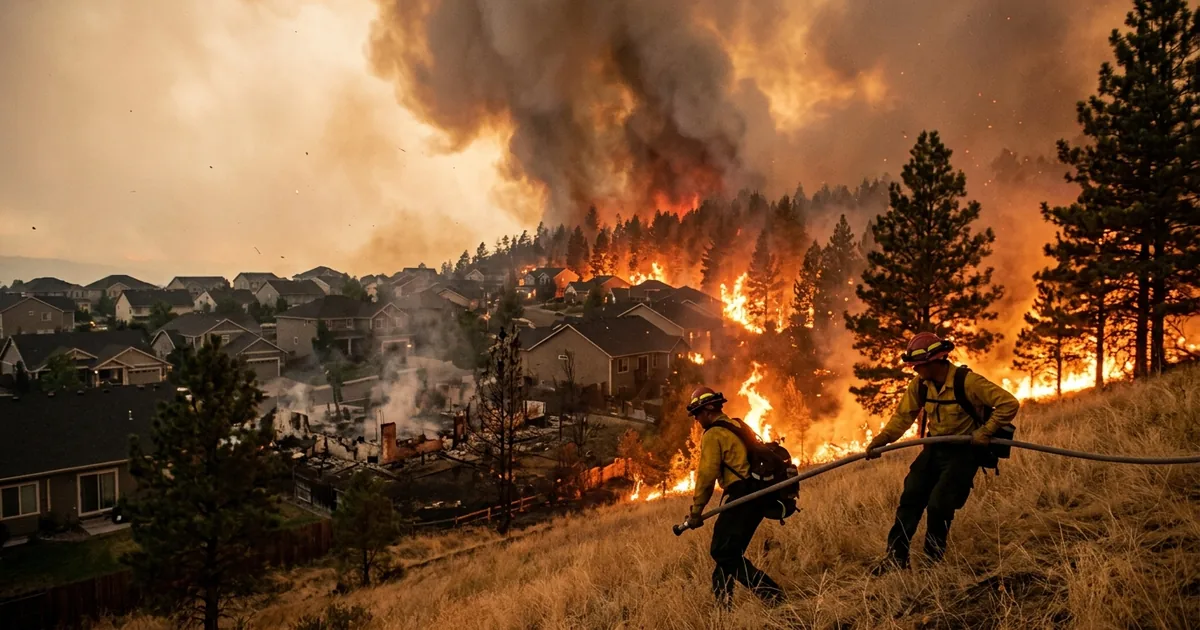
Three wildfires that did not exist Saturday morning had destroyed roughly 640 structures around Washington’s second-largest city by Sunday night, and every one of them was still listed at zero percent containment. The number worth paying attention to is not the acreage, which is unremarkable by Western standards, but the ratio of destruction to ground burned.
Three Fires, One Afternoon
The Old Trails Fire broke out Saturday morning northwest of Spokane and did most of the damage. Spokane County Fire District 3 Chief Cody Rohrbach told the Spokesman-Review that Old Trails alone destroyed 640 structures, with officials calling it the top-priority fire in the country and warning that the potential for lives to be lost had not passed. Two more blazes, Autumn Lane and Fairview, ignited the same day.
By Sunday evening the three had covered roughly 8,000 acres between them, split about 3,619 for Old Trails, 3,347 for Autumn Lane and 1,056 for Fairview. Not one of them had a containment line worth reporting. Crews had shifted most of their effort to Autumn Lane, the only one of the three still spreading aggressively, while very large air tankers and Super Scoopers worked the perimeter.
Here is the part that should travel beyond Spokane. Eight thousand acres is a small fire. California loses that much ground on a slow Tuesday and nobody outside the county notices. A 640-structure loss on 3,600 acres means the Old Trails Fire spent nearly its entire life burning through places where people keep their belongings, not through backcountry timber. That is a different kind of event wearing the same word.
Nobody Agrees on How Many People Left
The evacuation figures moved all weekend and still do not reconcile. The Associated Press count, carried by PBS NewsHour, put it at 5,000 homes under evacuation orders across eastern Washington. CBS News reported that at least 60,000 people were told to go, quoting a local official calling this the worst natural disaster the region has faced, while NBC News framed the same weekend as tens of thousands evacuating with more than 600 structures lost.
Those numbers cannot all describe the same thing, and the gap is not a media failure so much as a symptom. Evacuation zones in a wind-driven urban-edge fire get drawn, expanded and redrawn hourly, and the agencies doing the drawing are counting different units: households in one release, residents in another, parcels in a third. If you live there, the only number that matters is the one on your own address, and much of north Spokane got Level 3, which reads: “Leave NOW! This may be your only notice.”
No deaths or injuries had been confirmed as of Sunday. Officials were careful to say that is a preliminary figure, not a reassurance, because nobody has walked most of the burn scar yet.
The Fire Went Into the City
Old Trails crossed the river and moved into Spokane proper. That single detail is the story, and it is the one most of the national coverage buried under acreage counts.
American wildfire policy is still organized around a mental model in which fire is a rural, federal, forested problem, managed by agencies whose budgets and mandates stop at the treeline. The losses have not worked that way for years. They happen in the wildland-urban interface, the belt where subdivisions push into cured grass and ponderosa, where a hundred-yard ember cast lands on a cedar fence instead of a duff layer. Spokane sits inside that belt on three sides. So does Boise. So does Reno, and Colorado Springs, and a long list of interior West cities that grew outward fast during a run of wetter decades that has ended.
The ignition conditions were not exotic. Extreme heat, strong wind and exceptionally dry fuels, which is the same combination that has been parked over the interior West repeatedly this summer, including the heat dome that sat on 80 million Americans in July. The unusual element was where the fuel happened to be.
There is also a scale comparison worth making. When France ran the largest peacetime evacuation in its history to clear the Bordeaux wildfires last week, the response was treated as a national mobilization with the state at the center of it. Spokane’s response was assembled from a county fire district, a state proclamation and whatever aviation resources could be pried loose from a fire season already running hot everywhere else.
What the Emergency Declaration Actually Buys
Governor Bob Ferguson declared a statewide emergency, activated the National Guard and imposed a burn ban across Washington through September 30. He also went to Spokane.
Read the proclamation for what it does rather than what it signals. It unlocks state mobilization authority, lets agencies spend ahead of appropriation, expedites mutual aid and clears the path for a federal assistance request. What it does not do is create engines, crews or air tankers that are not already in the state. In a season where dozens of fires are burning across the West at once, an emergency declaration is fundamentally a claim on a queue. Being designated the nation’s top-priority fire is not a compliment. It means Spokane got to the front of a line that everyone else is also standing in.
The burn ban through September 30 is the quiet admission inside the announcement. Ferguson is not treating this as a two-week incident. He is telling the state to plan for two more months of the conditions that produced it.
What Comes Next
Weather is the whole forecast. If the wind stays down, crews get containment lines around Autumn Lane and the number of destroyed structures stops climbing near where it is. If it comes back, the perimeter that incident command described as holding stops holding, and Spokane finds out how much of its northern edge is defensible.
The harder question arrives in about a month, when the assessment teams finish counting and someone asks how many of those 640 structures sat in a mapped high-hazard zone with no defensible space requirement attached to the permit. Cities in the interior West keep answering that question after the fire instead of before it. Spokane will get its turn.