
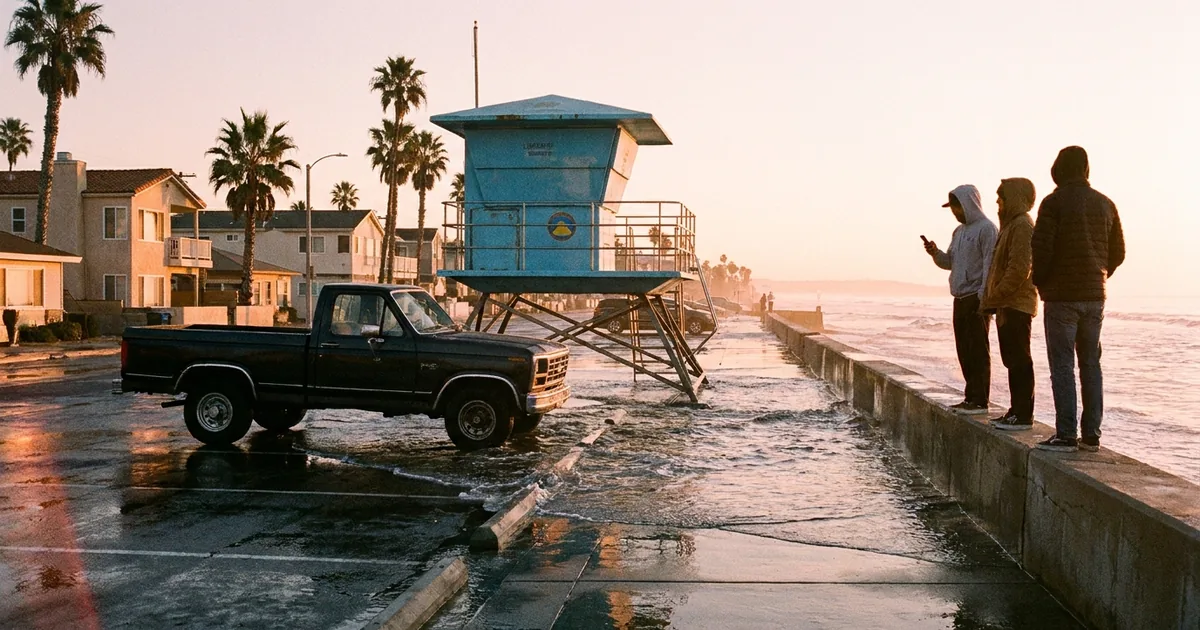
The NOAA tide gauge at San Diego read 8.14 feet at 8:54 a.m. on Sunday against a predicted 6.68, about an inch under the station’s all-time high of 8.24 feet set on November 25, 2015. The predicted highs climb every morning through Tuesday, which is why the National Weather Service upgraded Orange and San Diego counties to a Coastal Flood Warning at 1:28 a.m. Monday.
The coverage repeats “up to eight feet” and “king tides” without saying where that lands against the record, or why a tide table built on the moon’s schedule is off by a foot and a half. We pulled NOAA’s six-minute gauge readings and the station datums ourselves. The arithmetic is below, and the moon is only half of it.
- San Diego, station 9410170. Sunday: 8.14 feet at 8:54 a.m. against 6.68 predicted, 1.46 feet over. Record: 8.24 feet, November 25, 2015. Tuesday’s predicted high is 7.10 at 9:51 a.m.; add Sunday’s 1.46 and the gauge reads 8.56, nearly four inches past the record. Monday’s 6.97 at 9:18 a.m. would already clear it at 8.43.
- La Jolla, station 9410230, Scripps Pier. Sunday: 7.66 against 6.14 predicted, 1.52 over. Record: 7.81 feet, also November 25, 2015. Tuesday’s prediction is 6.59; at Sunday’s gap, 8.11.
- Los Angeles, station 9410660, Outer Harbor. Sunday: 7.71 against 6.36 predicted, 1.35 over. Record: 7.92 feet, January 10, 2005. Tuesday’s prediction is 6.80; at Sunday’s gap, 8.15.
The gap is not a constant. Swell, wind and pressure move it hour to hour, and the warning for San Diego and Orange counties puts it at “1.5 to 1.7 feet above astronomical tide predictions.” Run the same sums at 1.5 and every one of those stations beats its record by Tuesday morning.
What the Warning Actually Says
The Coastal Flood Warning from the weather service’s San Diego office runs until 1 p.m. Thursday and does not hedge: “Significant coastal flooding expected. Numerous roads may be closed. Low lying property including homes, businesses, and some critical infrastructure will be inundated.” High tides come in the late morning each day.
North of there, the Los Angeles office has Los Angeles, Ventura, Santa Barbara and San Luis Obispo county beaches under an advisory through Thursday afternoon. Its forecast is that “high tides will likely reach 7.5-8.0 feet (MLLW) each late morning, which is 1.0 to 1.5 feet above astronomical projections,” with the highest Monday through Wednesday, and it names what gets wet: beach parking lots, bike paths, harbor walkways, and “moderate to significant beach erosion.” The 7-foot king tide warnings in the local press come from the same bulletin.
Why the Tables Are Off by a Foot and a Half
A tide table is the moon’s promise, with a little help from the sun. It knows nothing about the temperature of the water, and this fall the water is the story.
An El Niño-driven coastal Kelvin wave, a pulse of warm water that lifts sea level along the coast, was forecast to arrive in California in October and to add six to twelve inches for months. Dillon Amaya, a marine scientist at North Carolina State, said in September that “the Bay Area is already experiencing elevated sea states. This coastal trapped wave will only add to that.” Three or four more are expected through the winter, with sea levels not back to normal until spring 2027. The 2015 records in the list above were set during the last big El Niño. Same mechanism, same month.
On top of that sits Vance, a Category 2 hurricane off Acapulco on Saturday that the National Hurricane Center had down to a weakening 65 mph tropical storm by 3 a.m. Monday, still sending long-period swell north. The San Francisco office says its tide numbers “include up to 1.0 ft of surge.” A king tide on a normal ocean is a nuisance for a few hours. A king tide on an ocean already running a foot high is how a 2015 record falls on a Tuesday morning in October.
We think the headlines undersell this. The news is not one big tide. It is a baseline that will sit a foot or more above the tables for months, which is roughly the sea level the state’s 2050 planning documents describe, arriving early for a rehearsal. Every coastal city from Imperial Beach to Malibu should treat this week as the drill it is, and local coverage should print the gauge readings next to the records, because NOAA posts both for free and the comparison is the whole story.
San Diego’s next predicted high is 9:51 a.m. Tuesday. By lunchtime we will know whether 2015 still holds.