
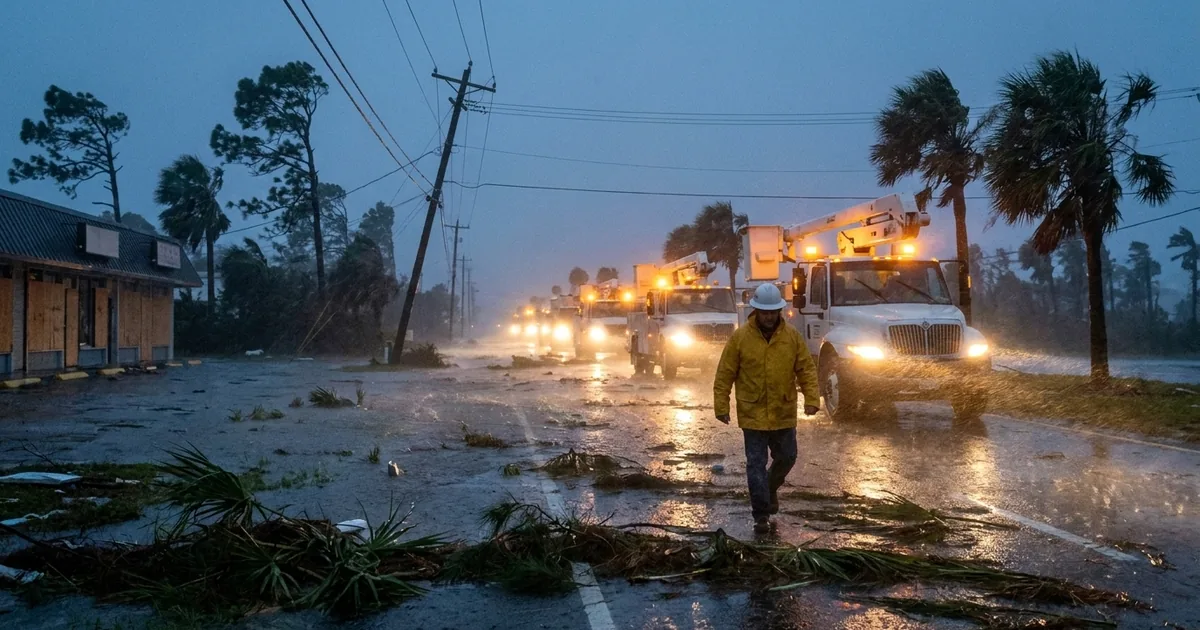
Hurricane Isaias came ashore near Destin, Florida, at 8:30 p.m. Central time Friday with 105 mph winds. It is the first Atlantic hurricane to make landfall in the United States since Milton, two years ago to the day, and the federal paperwork that arrived with it is narrower than the announcements sound.
What was announced
President Trump approved emergency declarations for Florida and Alabama on Friday. FEMA says they let it “identify, mobilize and provide at its discretion, equipment and resources necessary to alleviate the impacts of the emergency.”
What the text says
“Emergency protective measures, limited to direct federal assistance, will be provided at 75% federal funding.” That one sentence governs every county on both lists.
Tonight’s coverage is wind speeds and surge gauges, and it should be. The declarations got a line or two where they were mentioned at all. We read both, then pulled the one Florida received before Milton. They are different documents.
What Happened at Landfall
The National Hurricane Center logged the landfall from Doppler radar. The center crossed the coast near Destin, about 40 miles east of Pensacola, with a central pressure of 971 millibars. A station near Santa Rosa Sound recorded a 116 mph gust. A federal tide gauge at Panama City Beach read 5.6 feet above the average high-tide line.
Isaias had been stronger. It peaked Friday as a Category 3 with 120 mph winds and lost a step before the beach. The surge forecast still ran 6 to 9 feet from the Alabama line to Grayton Beach.
More than 471,000 customers in Florida and Alabama had lost power by 10:15 p.m. Eastern. Okaloosa and Walton counties had ordered evacuations. Alabama Gov. Kay Ivey had ordered visitors out of Baldwin County and Dauphin Island, and declared a state emergency in 40 counties.
The storm is moving north at 19 mph. Forecasters expect it to cross Alabama into the Tennessee Valley over the weekend and lose its tropical structure Saturday, while still dropping 4 to 8 inches of rain and as much as 15 near the coast. The next full advisory was due at 10 p.m. Central. Damage and casualty counts will not exist until daylight.
Isaias became a hurricane on Wednesday night. It was, as we wrote Thursday, the latest first hurricane of any Atlantic season since 1905. By Friday morning it was a Category 3 in the northern Gulf.
A strong El Niño kept the Atlantic quiet all summer. Quiet seasons build habits, in budgets and in staffing and in how fast paper moves.
Two Declarations, One Sentence
Florida’s declaration names 27 counties across the Panhandle and the Big Bend. Alabama’s names three, Baldwin, Escambia and Mobile, plus the Poarch Band of Creek Indians. That is three of the 40 counties in Ivey’s own emergency order.
Both carry the sentence in the right-hand column above. It matters because FEMA’s public assistance program pays out two ways. One is financial: Washington reimburses a state, county or city for 75 percent of what it spends on its own emergency work. The other is direct federal assistance, which the Congressional Research Service describes as “federal supplies, personnel.”
“Limited to” means the second without the first. Federal teams and equipment can come in, with Washington covering three-quarters of that bill. A sheriff’s overtime, a county’s shelter costs and a city’s road clearing are not reimbursable under these declarations as written.
What Florida Got Before Milton
Two days before Milton hit in October 2024, the Biden administration’s pre-landfall declaration split Florida into two tiers. We counted the counties in each release.
| Term | Milton, Oct. 7, 2024 | Isaias, Oct. 9, 2026 |
|---|---|---|
| Florida counties named | 51 | 27 |
| Counties that can be reimbursed for their own emergency costs | 37 | 0 |
| Counties limited to direct federal assistance | 14 | 27 |
| Federal cost share | 75% | 75% |
| Alabama counties named | None | 3, plus one tribe, all limited to direct assistance |
In 2024 the limited tier went to the edge of the map, 14 North Florida counties such as Alachua, Baker and Union that sat north of Milton’s track. The 37 counties across central and south Florida, where the storm was headed, got the fuller version before the wind arrived. In 2026 the limited tier went to everyone, including Okaloosa County, where the center of Isaias came ashore.
Declarations get amended, and counties get added. The larger money, reimbursement for local governments and cash aid for households, comes through a different instrument: a major disaster declaration, which each governor has to request and the president has to sign. Read as a term sheet, Friday’s paper gives Florida and Alabama federal crews now and leaves the cash behind a second signature.
The 34-Day Wait for the Second Signature
That second signature has been slow. An Associated Press analysis published in September 2025 found that governors waited an average of almost 34 days for Trump to approve a major disaster declaration in this term, across more than two dozen approvals. The average was 24 days in his first term and about three weeks over the prior decade. The range ran from one day, after the Texas flash floods of July 2025, to 67 days for a Michigan ice storm.
The White House answer at the time came from spokeswoman Abigail Jackson: “President Trump provides a more thorough review of disaster declaration requests than any Administration has before him.”
We think the Texas number settles that. This White House can approve a major disaster declaration in a day when it chooses to, so a month is a choice. The damage assessments begin at daylight. Once they are in, a Category 2 landfall that the government’s own radar recorded should not sit in a queue. When Gov. Ron DeSantis and Ivey file their requests, the answer should come in days. The direct-assistance limit on the counties under the eyewall should be lifted before then, so that they stand where 37 Florida counties stood ahead of Milton.
The Agency Behind the Paper
FEMA’s pre-landfall statement says incident management teams are in Alabama and Florida, that urban search and rescue teams are “positioned throughout the region,” and that “additional FEMA personnel are ready to deploy.” It gives no number for any of them. There is not a single headcount in the release.
That absence lands on a particular day. Friday was the deadline U.S. District Judge Susan Illston set for the Department of Homeland Security and the unions that sued it to agree on how to undo FEMA staff cuts she ruled unlawful in September, or to tell her what they still dispute. We argued then that the ruling was a win on the law, not a rescue for hurricane season. We found no public account of what the two sides filed before the storm arrived.
On Wednesday the president told reporters he “hadn’t heard about a hurricane.” By Friday afternoon he had called off his trip to Saturday’s Georgia-Alabama game in Tuscaloosa, writing that first responders should stay “focused on that storm,” and he had signed both declarations.
Daylight on Saturday brings the first damage assessments across the Panhandle and south Alabama. The governors’ requests follow those. Isaias took two days to go from the season’s first hurricane to a landfall. The count that matters next starts the hour DeSantis and Ivey file.