
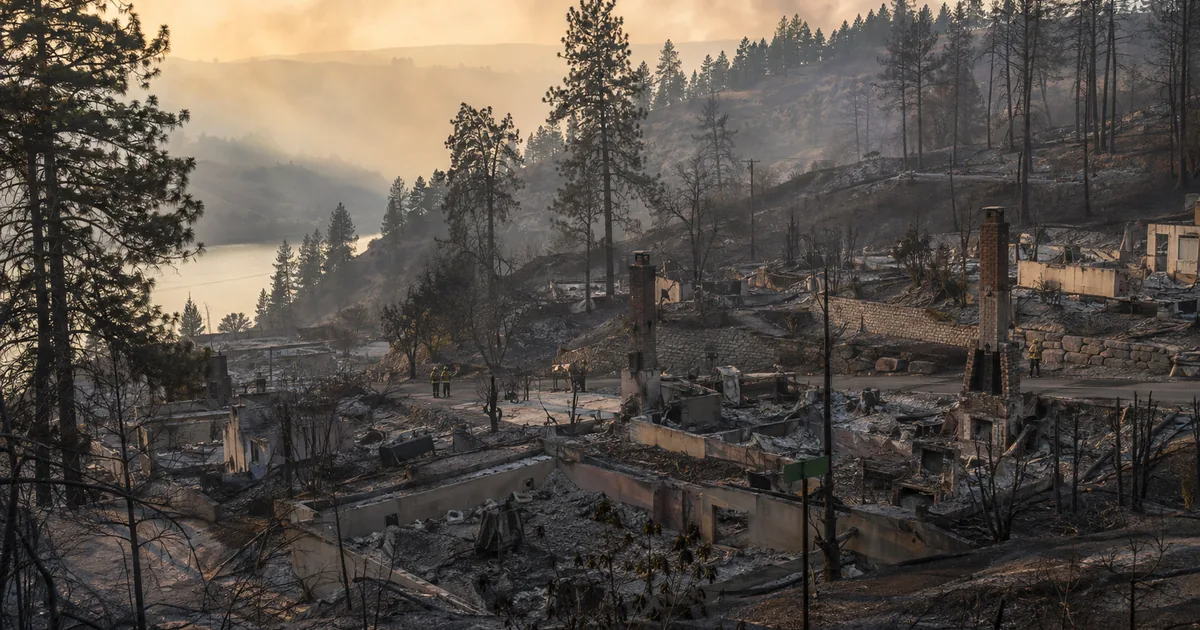
An Airway Heights police officer found Aaron Farinacci roughly a mile and a half from where the Old Trails Fire started on Saturday morning, questioned him, wrote down his contact information, and let him go. Two days later, after that fire had grown into the most destructive in Washington state history, Spokane County detectives arrested him on a charge of first degree arson.
That sequence is the actual story here, and most of the coverage is sprinting past it to get to the booking photo.
The Tip Worked. Nobody Had Grounds to Hold Him.
The civilian half of this case functioned close to perfectly. A resident near the intersection of Euclid Road and Old Trails Road noticed a man crouched along the roadside around 10 a.m. Saturday, thought it was odd, and kept turning it over. Driving home later, the same resident spotted him again and called the Airway Heights Police Department. KOMO News reported that an officer located the man about 1.5 miles from where the fire began, spoke with him, took down his information, and released him.
He was carrying waterproof matches and a butane lighter, ABC News reported.
Sheriff John Nowels gave the credit where it belonged. “As it happens in so many critical cases, it was citizens who were paying attention to their surroundings, being aware and willing to step up and say something that led to the relatively quick apprehension of Mr. Farinacci,” he said.
Both things are true at the same time. The public did its job, and the man walked. Sitting with why that happened is more useful than being angry about it.
Probable Cause Is Built Backward, and on Saturday There Was Almost Nothing to Build From
Here is the uncomfortable mechanic underneath this case. At 10 a.m. Saturday, an officer standing on a rural road outside Airway Heights had a nervous man, a lighter, and a box of matches. Matches are not illegal. Being near a fire is not illegal. Looking anxious when a police officer approaches you is not evidence of anything. First degree arson in Washington requires proof that a person knowingly and maliciously set a fire, and at that moment there was barely a fire to attach the intent to.
The evidence that made an arrest possible did not exist yet. It had to be produced by the fire itself: burn pattern analysis, an origin point narrowed by investigators, a reconstructed timeline, physical evidence, and the corroborating weight of a witness who had put a specific man in a specific place before anything was burning. Detectives spent the next two days assembling it.
This is the part that reads as failure and mostly is not. It is the legal system working at the speed the legal system works, colliding with a fire moving at the speed of a 44 mph wind gust.
What Those Two Days Cost
The gap between the roadside stop and the arrest is measured in structures.
The Old Trails Fire was reported around noon Saturday and ran northeast, jumping the Spokane River and pushing into city neighborhoods. The Spokesman-Review reported that Old Trails alone had destroyed 640 structures by Sunday, calling it the top fire in the nation at that point. Across the three fires now grouped as the Spokane Complex, Old Trails, Fairview, and Autumn Lane, NBC News counted more than 700 structures lost and roughly 65,000 people evacuated, with the complex burning past 10,000 acres at zero percent containment.
We covered the destruction itself as the count passed 640 homes with none of the three fires contained. What has changed since is not the scale. It is the category. This stopped being a natural disaster story on Monday at 5 p.m.
Fire Incident Commander Tom Clemo put the scale plainly: “It’s unprecedented in this community. Frankly, it’s unprecedented in many areas of this country.”
No deaths have been confirmed, which given 65,000 people moved out of the path of an urban firestorm is the single most remarkable number in this event. Officials have credited the speed and size of the evacuation. They have also been careful not to call that figure final while the fire is still open.
A Prior Conviction That Legally Meant Nothing on Saturday
Nowels disclosed that Farinacci has a previous felony manslaughter conviction in Arizona. That detail is doing enormous work in the public conversation and it did no work at all at the roadside.
An officer running a name on Saturday morning would have seen a record. A record is not probable cause for a crime that has not yet been established. This is a feature of the system rather than a bug in it, and it is worth naming clearly, because the alternative people reach for in the aftermath of a disaster is a world where a prior conviction is itself grounds to detain. That world is not one where fewer buildings burn. It is one where the threshold for taking someone’s liberty is their past instead of the evidence in front of you.
The frustration is legitimate. The fix people reach for when they feel it usually is not.
The Charge Is a Floor
Farinacci, 37, of Spokane, was arrested at his home without incident around 5 p.m. Monday and is being held on $1 million bail. Spokane County prosecutor Preston McCollam said his first court appearance would come Tuesday.
Nowels was explicit that first degree arson is what probable cause supported at this stage and that the case could change as investigators gather more. That is not hedging. It is a signal. Charges in an event this size tend to move in one direction as the damage assessment closes, and Washington has statutory paths that escalate sharply if a death is eventually tied to the fire. The number that has not been finalized is the one that determines what Farinacci is ultimately charged with.
There is also a quieter unresolved thread. The National Interagency Fire Center has listed all three Spokane Complex fires as suspected human caused. One arrest has been made. Whether Fairview and Autumn Lane were sparked by a downed line, a dragging chain, a discarded cigarette, or something deliberate is still open, and the answer determines whether Monday’s arrest closes the criminal story or opens the first chapter of it.
Meanwhile the fire that produced the charge is still burning, and containment is still zero. The prosecution and the emergency are running on the same clock.