
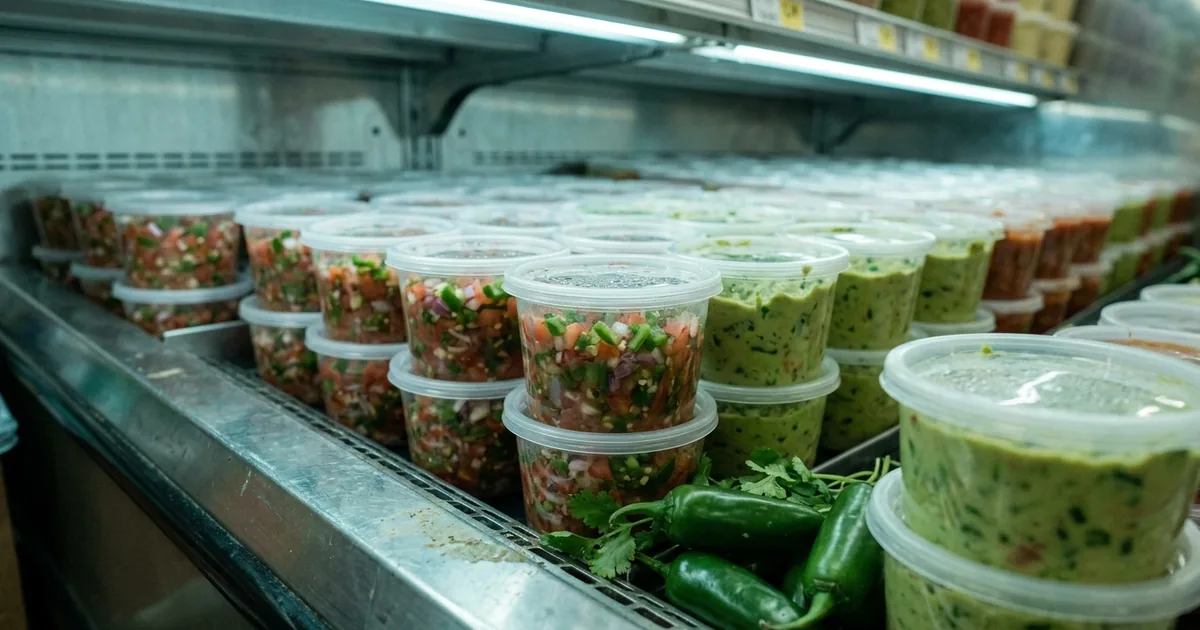
If you are scanning the news for a jalapeño recall, you are probably checking your salsa, which means you will walk right past the Kroger roast beef sandwich and the Trader Joe’s shrimp salad that are also on the list.
Taylor Fresh Foods pulled 20 products from seven national chains after a salmonella outbreak that has sickened 345 people was traced to a single pepper grower in Sinaloa, Mexico, and the recalled food carries use-by dates running as late as August 16.
The Recall Is Not Shaped Like the Headline
The company’s own recall notice, last updated August 9, lists products distributed to 26 states through Walmart, Target, Kroger, Whole Foods, Trader Joe’s, Stop & Shop and Hannaford. Most of the coverage since has described it as a salsa and guacamole recall. Roughly half of it is.
The other half is where the risk actually hides. Kroger’s Private Selection Spicy Roast Beef Sandwich is on the list. So is a Spicy Jarlsberg Dip, a Spicy Pimento Cheese Dip, a Rice and Bean Burrito sold at Hannaford, a 20-ounce Taco Dip at Target, and Trader Joe’s Fiesta Style Salad Shrimp. A shopper who hears “recalled jalapeños” and checks the salsa tub has done the reasonable thing and still missed most of the products in their refrigerator that qualify.
Taylor Fresh Foods says it is no longer sourcing from the grower in question and is filling orders through alternative suppliers. The company also says it is not aware of any illnesses linked to its own products, which is a meaningful distinction: this is a contaminated commodity bought from a distributor, not a failure inside a Taylor Farms plant.
The Illnesses Stopped in July. The Recalls Did Not.
Here is the detail the product lists bury. According to the CDC’s outbreak notice, the 345 confirmed cases of Salmonella Javiana began between June 19 and July 20. The last person known to have been sickened by these peppers got sick roughly three weeks before this recall notice went up.
That gap is not negligence. It is the ordinary structural lag of American foodborne-illness investigation, and it recurs in nearly identical shape every time. Someone eats a contaminated pepper and gets sick a day or two later. If they see a doctor at all, a stool sample reaches a state lab, gets sequenced, and lands in a national database where it may eventually match other cases. Only once a cluster is large enough do investigators begin interviewing patients about meals eaten weeks earlier, then work backward through restaurant and distributor invoices to a farm.
Each step costs days. The predictable result is a system that names the source of an outbreak well after the contaminated food has mostly been eaten, then spends the following week chasing whatever remains into every product it was diced into. The August recalls are not evidence that this outbreak is growing. They are the cleanup arriving after something that peaked in early July.
How One Farm Reaches a Shrimp Salad
This was the third widening of the same contamination event in under a week, and the sequence shows how a single grower becomes a national recall.
Foodservice went first. Investigators found that 177 of the 191 outbreak patients they interviewed, about 93 percent, had eaten at a Mexican-style restaurant beforehand, and Chipotle Mexican Grill and QDOBA both stopped serving the affected peppers. On August 8 the USDA’s Food Safety and Inspection Service issued a public health alert covering meat and poultry products containing the same recalled jalapeños across roughly ten chains in 22 states. The packaged refrigerated case came last.
A jalapeño is a cheap commodity input. It gets bought in volume through consolidated distributors, diced, and folded into products where it occupies one line of an ingredient statement and carries no independent identity. Once the pepper is in the dip, no label tells a shopper which farm it came from. That is why containment moves in these widening rings: regulators cannot recall the pepper itself, so they have to find and recall everything the pepper became.
It also explains the two different state counts running through the coverage. The illnesses span 27 states. Taylor Farms distributed into 26. Those are two maps of the same contamination, one drawn by who got sick and one by who got shipped to, and they do not overlap neatly.
The Company That Fought the Last Federal Finding
There is a reason this particular company name should register with anyone who followed the summer’s food safety news. Three weeks ago LNC reported that the FDA walked back a cyclospora test on Taylor Farms lettuce as a false positive, and that Taylor Farms had spent $2.2 million on super PACs and secured a White House meeting while contesting the agency’s finding. The same company separately recalled iceberg lettuce sourced from central Mexico on July 17 over cyclospora concerns, a recall it still maintains an information hub for.
This month’s recall is a different situation, and it is worth saying so plainly. The contamination originated with a supplier, no illnesses have been tied to Taylor Farms products, and the company acted once Coast Citrus Distributors did. This is the easy case. Pulling someone else’s contaminated ingredient costs a company very little, and doing it quickly is exactly right.
What the contrast illuminates is how sharply the incentives shift when a federal finding points inward instead of upstream. A company with the political access to challenge an FDA result on its own lettuce has every reason to spend that capital when its own facility is implicated, and almost none when the fault sits at a farm in Sinaloa. July and August are not inconsistent. They are what the same set of interests looks like under two different sets of facts.
What the Numbers Do and Do Not Say
Thirty-six people have been hospitalized and no one has died, which makes this serious rather than catastrophic. The case map is also strikingly lopsided: Minnesota and Colorado account for roughly two-thirds of confirmed cases at about 110 apiece, a distribution that reflects which state labs sequence aggressively at least as much as where the peppers were shipped.
The detail deserving more attention than it has gotten sits in the CDC’s genetic analysis. Most samples in this outbreak respond normally to standard antibiotics, but the agency’s investigation update notes a small number of exceptions, including samples whose resistance profiles would narrow the treatment options available if those patients developed a serious infection. In an outbreak where most healthy adults recover without antibiotics at all, that is a footnote. In a nursing home, it would not be.
If Something on the List Is in Your Fridge
Check the use-by date first. Taylor Fresh Foods says consumers holding any recalled product should discard it immediately rather than eat it, and that refunds are available at the place of purchase. Cooking is not a fix worth gambling on here.
Salmonella symptoms typically appear between six hours and six days after exposure and include diarrhea, fever and abdominal cramps. Most people recover without treatment. Infants, adults over 65 and people with weakened immune systems are the ones who end up hospitalized, and they are why these notices still matter after the case count has stopped climbing.
The Part That Will Happen Again
Taylor Farms’ recall page carries a section on traceability promising that each product can be traced back to its original source, which is true, and which is precisely what allowed the company to identify and pull these 20 items. Traceability worked. It simply worked at the speed the system permits, which is measured in weeks, against a perishable product measured in days.
The peppers stopped making people sick in July. The notices were still going out in August, and more may follow as other processors work through what they bought from Coast Citrus. Until traceability operates at the level of the individual ingredient rather than the finished package, every commodity contamination will keep this shape: a slow identification, a fast product already eaten, and a recall that arrives to collect the remainder.