
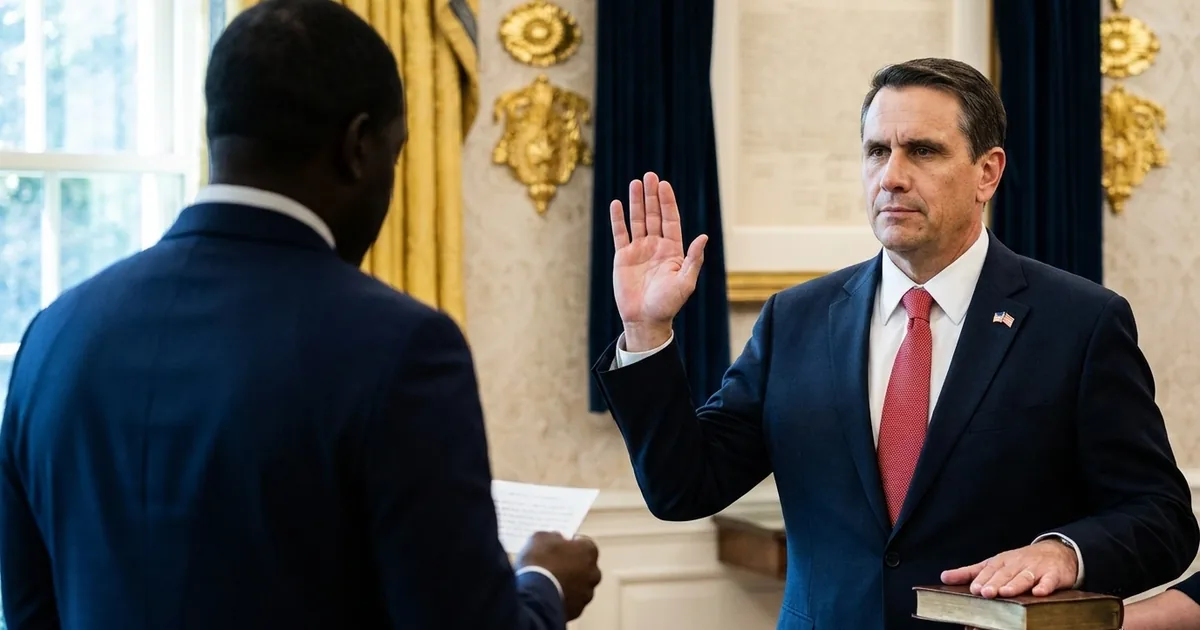
Todd Blanche was sworn in as attorney general at the White House on Monday, two days after the Senate confirmed him 50 to 49 in a vote gaveled through after four in the morning.
The oath was administered by Emil Bove, who sat beside Blanche at the defense table during Donald Trump’s Manhattan criminal trial and now holds a federal appeals judgeship, which is a reasonably complete summary of what has happened to the distance between the president’s personal legal team and the institutions built to check him.
PBS News reported that Blanche went from the ceremony to Justice Department headquarters, where employees lined the entrance and cheered him in. He has been running the building since April 2 anyway, when Trump fired Pam Bondi over her handling of the Epstein files and, according to NBC News reporting at the time, over her failure to investigate and prosecute enough of his political opponents. LNC covered that handover when Trump’s personal lawyer took over the Justice Department in the spring. Monday only made the arrangement permanent.
The question circulating since Saturday is whether this is the most corrupt attorney general the country has had. It is a fair question and it has an answer, but not the one the phrase usually implies.
The Concession Everyone Could See
Blanche’s nomination stalled in July over one document and unstuck itself over a different one.
The document that stalled it was the Anti-Weaponization Fund, a $1.776 billion pot of money created by attorney general order on May 18 to pay Trump allies who claimed they had been targeted by the previous administration. Republican holdouts wanted it dead, and they wanted it dead in writing. On the evening of August 3, Blanche gave them exactly that: an order rescinding the fund, with CBS News reporting the text stated flatly that “there is no Fund.” Bill Cassidy announced his support days later, and the path to 50 votes opened.
The document that survived is the one that matters. A settlement dated May 19, entered in Trump’s $10 billion suit against the IRS and the Treasury, bars the federal government from investigating, reviewing or prosecuting Trump, his sons and the businesses they run for anything done before that date. The Hill reported that the language is “barred and forever precluded,” and that its reach is not limited to taxes. Blanche’s rescission order narrowed it at the margin, clarifying that the shield operates only retroactively and leaves future filings exposed. Time reported that the retroactive half is where the money is, including a long-running audit of Trump’s Chicago skyscraper that could carry a bill north of $100 million.
So the Senate extracted the fund and left the shield. LNC watched that trade take shape as Cornyn and Tillis worked the tax-immunity question in late July, and the shape it took is the story. A slush fund is visible, appropriable and easy to attack on a floor speech. A settlement filed in a district court is a quiet instrument that does its work for years. One of those two things was traded away for a cabinet seat. It was not the one that protects the president.
Measured Against Daugherty and Mitchell
American history offers two serious benchmarks for a corrupt attorney general, and both are instructive here.
Harry Daugherty ran the department for Warren Harding and resigned in March 1924 after refusing to hand over records to a Senate investigation. He was tried twice in 1927 on charges of defrauding the government. Both juries hung. John Mitchell ran it for Richard Nixon, was convicted in 1975 of conspiracy, obstruction of justice and perjury, and served 19 months, which makes him the only attorney general to go to federal prison.
Notice what both men have in common. They corrupted the office covertly, they were caught by investigators the department itself could not fully control, and the institution survived them by punishing them. The scandal was the deviation, and the correction was the proof that the system worked.
That is not the structure of what happened on Monday. Nothing here is hidden. The immunity settlement is a public filing. The fund had an order number. Blanche testified before the Senate Judiciary Committee that presidential direction of Justice Department investigations, including investigations of the president’s political enemies, is the president’s “right” and “his duty,” and then 50 senators confirmed him. Whether he is the most corrupt attorney general in the country’s history is a judgment history will make. What is already true is that he is the first one to have the conduct itemized in public, opposed by a bar association, and ratified by a floor vote anyway. Daugherty and Mitchell had to lie about it.
What the Senate Voted On
The record was not ambiguous by August.
On July 13, U.S. District Judge Kathleen Williams voided the IRS settlement outright, finding that the litigation was collusive and filed in bad faith, that the government never meaningfully contested a suit the president controlled on both sides, and that the whole exercise was an attempt to use a federal court to launder immunity into legitimacy. She described Blanche’s May 19 congressional testimony as at best misleading and at worst disingenuous. Then she referred him to the New York bar. LNC covered the sanctions ruling and the bad-faith findings when it landed, and ABC News reported the referrals of Trump’s attorneys for potential discipline the same week.
The same day, the New York City Bar Association formally opposed the nomination, concluding that his record shows “a lack of commitment to the integrity, independence, and impartiality the office requires.” Its report counted roughly 16,000 departures from the department on his watch, including 4,000 lawyers, and noted a grievance complaint filed by more than 100 retired federal judges.
There is also the matter of the senators. In February, a District of Columbia grand jury refused prosecutors’ request to indict Mark Kelly and Elissa Slotkin on seditious conspiracy charges over a 90 second video telling service members to refuse illegal orders, a case CNBC reported collapsed at the grand jury stage. Grand juries indict almost everything put in front of them. This one declined.
Lisa Murkowski cited that pattern in announcing her no vote, saying that politicization of the department did not begin with this administration but has accelerated under it, and listing the Epstein files, the sweeping immunity protections and the targeting of sitting senators among her reasons. Susan Collins was blunter and narrower: Blanche is a capable lawyer who has taken several actions that further eroded the department’s independence. Two Republicans. That was the entire internal resistance.
What Is Still Moving
Three things are unresolved, and they will define the tenure faster than any confirmation speech.
The immunity settlement is already void by court order and now faces a separate challenge from outside plaintiffs, which The Hill reported was filed in early August. Whether an agreement a judge called collusive can keep binding the United States is a live question with a real chance of ending badly for the department. The fund is rescinded but not abolished, and a former department lawyer told CBS there are several ways it comes back. And the theory Blanche stated under oath, that the president is entitled to direct investigations of his own enemies, is now the department’s operating premise rather than an accusation against it.
The confirmation is done. The rest of it is in front of judges, which is the only place left where any of this gets tested.