
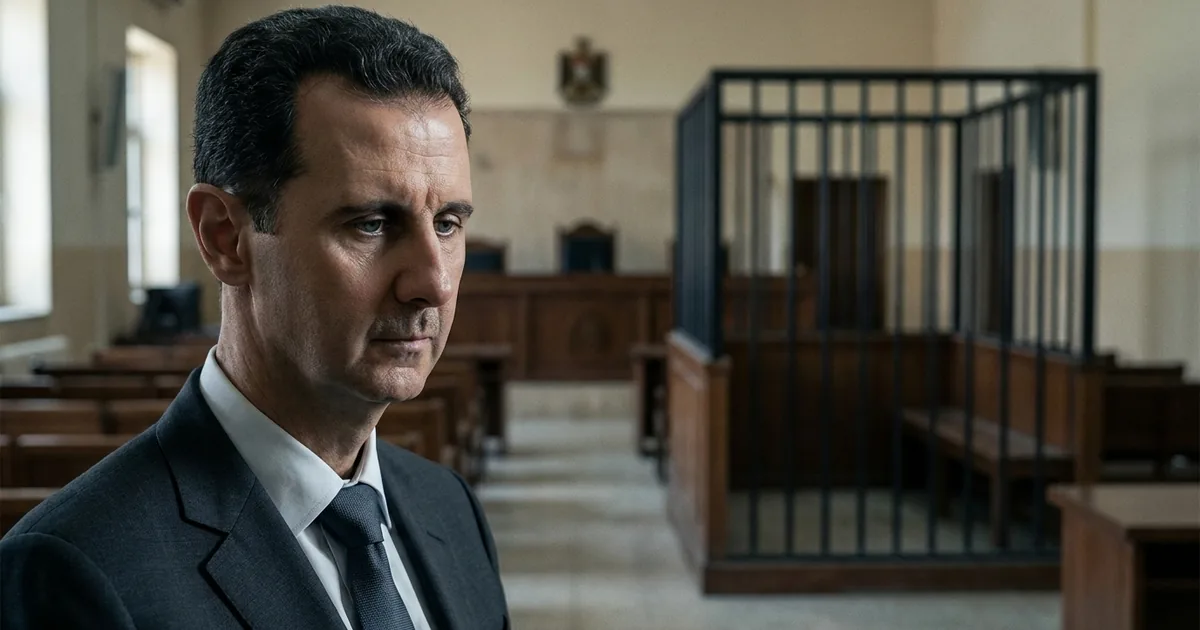
A criminal court in Damascus sentenced Bashar al-Assad to death on Tuesday for crimes against humanity, and the only defendant it can actually reach is his cousin.
Assad has been in Moscow since December 2024, his brother Maher is there with him, and the man who stood in the courtroom cage in a prisoner’s uniform was Atef Najib, the provincial security chief who ran the crackdown that started the war.
That split is the entire story. All three men received death sentences on Tuesday, as Al Jazeera reported from the courtroom, but only one of them was in the building. The verdict against Assad is a document. The verdict against Najib is an execution order.
What the Court Found
The convictions are specific in a way that matters. Middle East Eye reported that the court convicted Assad of premeditated murder of multiple people including children, along with torture, arbitrary detention, and crimes against humanity. Najib was convicted of murder, the intentional killing of children under 15, and torture leading to death. Maher al-Assad was convicted of premeditated murder and torture. The court further ordered that both brothers be pursued internationally.
Judge Fakhr al-Din al-Aryan grounded the finding against Assad in command responsibility rather than in any single order he signed. Witness testimony, the judge said, established Assad as “the highest decision-maker” who “used state institutions to facilitate” the crimes. That is the legal theory that makes a head of state convictable for what a security apparatus does over 14 years, and it is the theory Syria will have to rely on in every case that follows this one.
The Sentence That Can Be Carried Out
Najib is not a supporting figure in this trial. He is the reason there was a war to prosecute.
As head of political security in Deraa province in March 2011, Najib ran the response to a handful of schoolchildren who wrote anti-government graffiti on a wall. The crackdown that followed turned a local protest into a national uprising and then into a conflict that killed roughly half a million people. Trying him first, in person, with the country watching, is not an accident of who happened to be in custody. It is a claim about where the war began and who owns it.
It is also the only part of Tuesday that carries physical consequences. Syria’s transitional authorities can execute Atef Najib. They cannot touch the man the judge called the highest decision-maker.
Moscow Already Gave Its Answer
Anyone reading the Assad sentence as a live threat has not been following the extradition file.
Interim President Ahmed al-Sharaa raised Assad’s return directly with Vladimir Putin on his first trip to Moscow in October 2025, and Euronews reported at the time that pressing for the extradition of the Kremlin’s longtime ally was on his agenda for the meeting. What came back was a statement that Moscow was “understanding” of Damascus’s desire to pursue transitional justice, which in the diplomatic register is a refusal with the edges sanded off. Russia granted Assad asylum after he fled the capital as opposition fighters closed on Damascus in December 2024. Russia has spent years defending the principle that it does not hand people to courts it does not recognize. A verdict from one of those courts does not change that arithmetic.
So the sentence will sit where it was filed. Assad has no reason to appeal it, and appealing would concede the court’s authority over him in the first place.
Why Damascus Kept the Case
The consequential decision this week was not the sentence. It was the venue.
Syria is not a member of the International Criminal Court, and pushing Assad’s case to The Hague would have required a UN Security Council referral that Russia would veto on arrival. Other routes existed short of that, including the internationalized tribunal model that legal scholars have pressed for since the regime fell. Writing at Just Security, analysts have mapped the accountability gap the Najib case exposes and argued for bringing the ICC into it.
Damascus kept the case in its own criminal court, and that choice does real work. A domestic conviction establishes that the new Syrian state, not an outside body, owns the accounting for the old one. It builds usable precedent inside a judiciary that will have to process thousands of these files. It denies Assad the ability to frame his prosecution as foreign interference, which is the first move any deposed leader makes. And it gives al-Sharaa’s government evidence that its institutions function, which is not a small thing for an administration still proving it governs the country whose courts are now issuing verdicts. This is the same capital that saw explosions during Emmanuel Macron’s state visit in July. A working war crimes trial is a sovereignty argument as much as a justice one.
The trade is that a domestic court carries domestic reach. Its judgments bind no one outside Syria, and the international pursuit the court ordered depends entirely on other states deciding to act on paper Damascus cannot enforce.
What the Commission Leaves Out
There is a second limit here, and it is structural rather than practical.
Al-Sharaa established a National Commission for Transitional Justice whose mandate covers grave violations caused by the defunct regime. That phrasing carries weight. It excludes crimes attributed to other armed groups, including factions that fought the regime and factions now sitting inside the governing coalition. A transitional justice process scoped to one side of a 14-year war has a blind spot written into its charter, and the Syrians on the wrong end of that exclusion will find it quickly.
The Executioners
The people who lived inside this system have a clearer sense of its scale than any single verdict does. Al Jazeera correspondent Obaida Hitto said the ruling “is going to bring a lot of relief to the Syrian people” and would support their “healing process.” His colleague Osama bin Javaid reported something sharper from outside the capital, describing Syrians who are “looking for justice, not just for al-Assad, but for the executioners.”
That is the measure worth watching. Assad is one name. The apparatus that produced the detention centers, the disappearances, and the deaths in custody employed tens of thousands of people, and almost none of them are in Moscow. Tuesday demonstrated that Syria’s courts can convict the man at the top and the man who lit the match. The open question is whether they can work through everyone in between before the political will thins out, and whether the answer for a mid-level officer who ran a cell block ends up looking anything like the answer for Atef Najib.