
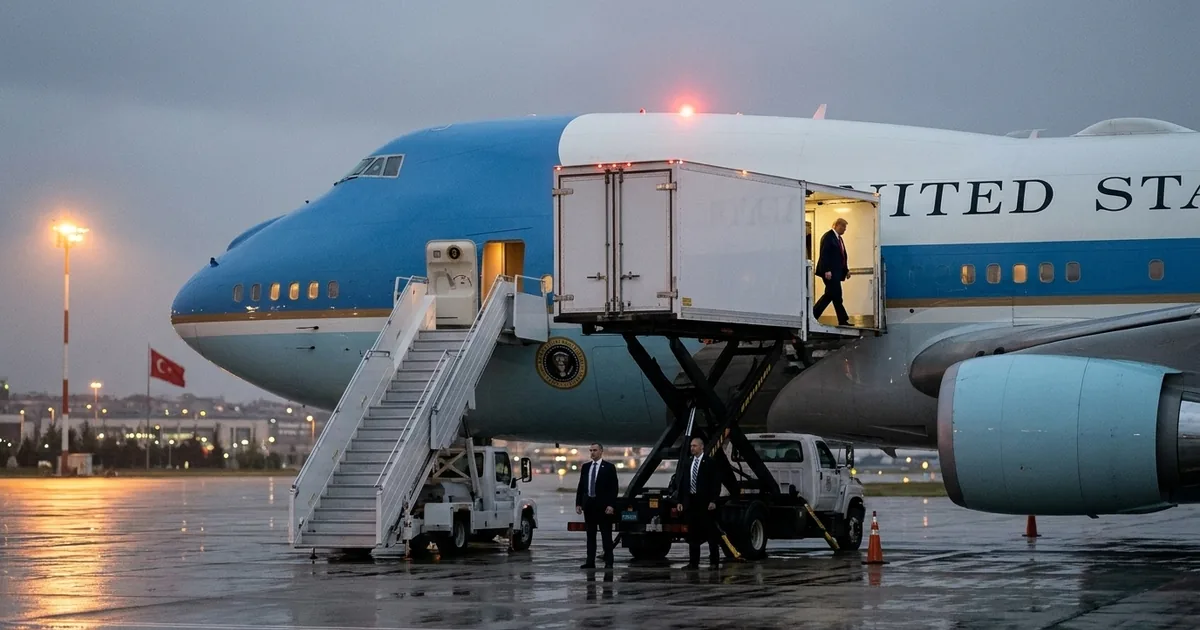
On July 8, hours after the United States resumed bombing Iran, President Donald Trump boarded Air Force One in Ankara in front of the cameras, slipped out a door on the far side, and rode away from the jet inside an airport catering truck.
The reporters and staff still on board were told to close their window shades, and then they took off in an aircraft that American intelligence believed Iran was preparing to shoot down.
They found out a month later, from a newspaper. So did the country.
What Happened on the Ramp in Ankara
The Washington Post first reported the operation on August 10, and a US official confirmed the plane swap to CNN the same day. US intelligence had picked up what officials described as a credible plot by Iran and its proxies to fire a missile at the aircraft carrying the president as he left the NATO summit in the Turkish capital. Trump had spent the previous two days on that stage declaring the ceasefire dead while US forces hit more than 80 targets inside Iran. Nobody involved was confused about the threat environment. He had helped create it that week.
So the White House built a deception. Trump went up the stairs of the legacy Boeing 747 in view of the press, then went back out an opposite door into a catering truck whose container had been raised to cabin height. The truck carried him to a Boeing C-32A, the smaller jet normally flown by the vice president. Secretary of War Pete Hegseth boarded that aircraft separately. According to aviation trackers who reconstructed the flights afterward, the C-32A left Ankara as REACH 018 with its transponders dark, invisible to the flight-tracking sites anyone can pull up on a phone.
The 747 kept the call sign Air Force One. It also kept the passengers. Politico’s Megan Messerly noted in a pool report at the time that the press cabin had been advised to keep its window shades closed, an instruction unusual enough to generate speculation that day and no answers. Asked about it, Trump told reporters they were “probably on a dangerous flight because of the sleaze bags that we have to deal with.” They laughed. He was not on the flight.
The detail that should end any argument about whether this was purely operational comes at the other end. When both planes reached RAF Mildenhall in Britain, Trump was quietly walked back aboard the 747 so he could be filmed coming down its stairs, then boarded the Qatari-gifted 747-8 for the flight home. The threat was in Ankara. The performance continued in Suffolk, for an audience of reporters who were being deceived about a flight they had already survived.
The Version That Stood for a Month
Watch what the cover story looked like while it was still holding. On July 9, the day after the flight, NBC News brought a retired Secret Service special agent onto Meet the Press NOW to explain the security thinking behind the president’s decision to fly home on the older Air Force One rather than the Qatari jet.
It is a serious segment with a credible expert, and its central premise was false. Trump had not chosen the old jet over the new one. He had used the old jet as scenery in Ankara, flown a C-32A to Britain, and then crossed the Atlantic on the Qatari 747-8 anyway. Every network, this one included, spent that news cycle analyzing a decision the president had not made, because the White House let them.
A Decoy Only Works If Somebody Is Still Inside It
Here is the part the White House would prefer to fold into the general category of presidential security, where it stops being a question and becomes a shrug.
Concealing a president’s movements is ordinary. Every administration does it, and the reporters who cover the White House understand that some of it stays off the record. That is not what happened here. A decoy is not a hiding place. A decoy is a target, and its value is measured entirely by how convincing it looks to the people aiming. The 747 was believable because it carried the call sign, the paint, the staff and the press corps that always travel with the president. The intelligence said Iran wanted to fire a missile at the plane Trump was on. The plan worked by making Iran think that plane was the one full of everyone else.
Pete Souza, chief White House photographer under President Obama, put the question in the plainest available terms.
If there was a legitimate threat that Iran would launch a missile at Air Force One, why was the White House willing to use the plane as a decoy thereby potentially sacrificing the lives of dozens of people aboard?
Those people were not only journalists. They were Air Force aircrew, communications staff, Secret Service personnel and junior White House aides who were told to sit in a darkened cabin and were not told why.
There were other options, and they were not exotic. Delay the departure. Fly the 747 out empty or on a different routing. Tell the people in the cabin what was happening and let them decide whether to fly, the way you would with any other adult being asked to absorb a risk on someone else’s behalf. Each of those choices costs the White House something: time, optics, or control of the story. Each of them was available. The one the administration picked transferred the danger to the passengers and kept the president’s schedule and his image intact, which is a specific set of priorities rather than a generic safety measure. He was not endangering everyone. He was endangering everyone but himself.
White House communications director Steven Cheung defended the operation by saying the administration uses “every tool at our disposal” against threats to the president, “including distraction and misdirection.” That is an honest description. It just quietly includes people as tools.
Clinton Ran the Same Play. He Told the Press Corps.
The precedent everyone reached for this week is Bill Clinton’s 2000 trip to Pakistan, when US officials feared his aircraft could be shot down and he arrived on an unmarked C-20 after a conspicuously presidential one landed first. Same logic, same era of threat, same tradeoff.
The difference is who the deception was pointed at. Clinton’s White House briefed the president of the White House Correspondents’ Association off the record beforehand, and the ruse became public almost immediately after it was over. The adversary was fooled. The press corps was informed, and through it, eventually, the public. In 2026 the deception ran on the passengers themselves and held for a month, and it broke because a newspaper found out, not because anyone in the building decided the people in that cabin were owed an explanation.
That is the whole distinction between an operational secret and a lie. One expires. The other has to be maintained.
The Pool Stopped Being an Independent Institution in February 2025
None of this is an accident of a chaotic travel day, and this is the part that explains the rest.
For most of a century, the rotation of reporters who fly on Air Force One and stand in the Oval Office was managed by the White House Correspondents’ Association, an independent body, on the founding principle that the people being covered should not choose who covers them. In February 2025 the White House took that function for itself and began selecting the pool directly. The seating chart followed weeks later.
Change who controls the list and you change what the people on it are. A pool the White House assembles, seats and can quietly stop inviting is not a check on the presidency. It is a group of guests whose access depends on the goodwill of the person they cover. Guests do not get briefed on operational plans. Guests do not have standing to demand to know whose target they are flying inside. And when the deception was over, no institution existed with the leverage to insist on being told, which is exactly why nobody was.
The administration did not merely withhold the truth, either. It stated the opposite: the White House said the president was aboard Air Force One while he was several miles away on a different aircraft. This is worth keeping straight when the defense arrives. Not telling the public where the president is during a live missile threat is defensible. Telling the public he is in a specific airplane, in order to keep that airplane useful as bait, is a different act, and it was aimed at Americans rather than at Tehran.
Five Days Later, the Justice Department Went After Reporters Covering the Same Fleet
On July 13, five days after the flight, the Justice Department subpoenaed four New York Times journalists, Julian Barnes, Eric Lipton, Tyler Pager and Eric Schmitt, hunting for the sources behind their reporting on security flaws in the Qatari-gifted jet now serving as Air Force One. Investigators sought third-party phone records not only for the reporters but for family members, including a spouse and one journalist’s mother. Two of the subpoenas reach back to January 1, 2026, months before the reporting they are ostensibly about. The Times moved to quash them, calling the government’s conduct bad faith.
Put the two facts next to each other. In the same five-day window, the same White House used the press corps as physical cover for the presidential aircraft and used federal prosecutors against reporters who wrote about that aircraft’s vulnerabilities. Journalists were an asset when they were useful and a target when they were informative. The through line is not hostility to the press in the abstract. It is a view of the press as an instrument, to be deployed or disciplined depending on the week.
Anyone still inclined to read the Ankara operation as an isolated security decision has to explain why the accountability only ever runs one direction.
What the Next Shade Order Will Mean
The real cost lands the next time a White House staffer walks into the press cabin and tells the pool to close the shades. That instruction used to carry an implicit assurance: something is happening, we cannot tell you what, and we are all in this together. July 8 removed the last clause. Reporters now know the request can mean they are the something that is happening.
There is a straightforward test of whether the administration understands what it did. Someone should ask whether the White House will commit to informing the people aboard a decoy aircraft, before takeoff, that this is what they are. If that question gets another line about distraction and misdirection, the answer is already clear, and everyone who boards that plane will be flying with it.