
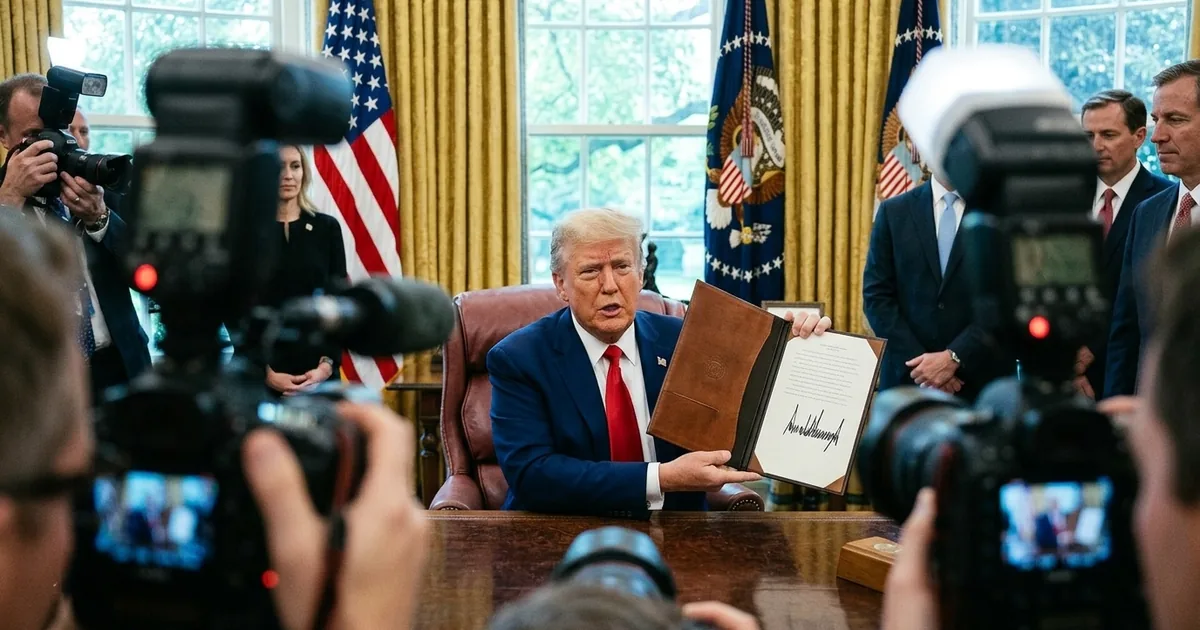
The executive order President Donald Trump signed on Monday cuts the federal childhood vaccine schedule from 17 diseases to 11, the same reduction a federal judge blocked five months ago.
It names no study, no trial and no author for the science it claims to rest on, and it arrives in a year when measles is running at a 35-year high in the United States.
What the Order Actually Says
We covered the signing itself on Monday. This is about what is inside the document, because the text is more specific than the summaries of it and in places more revealing. Read the order itself.
It names 11 diseases every child should be vaccinated against: measles, mumps, rubella, diphtheria, tetanus, pertussis, polio, Haemophilus influenzae type B, pneumococcal disease, human papillomavirus and varicella. Everything else on the current schedule falls off the federal recommendation. Hepatitis B, hepatitis A, rotavirus, influenza and COVID-19 are all absent from that list of 11.
It directs that the combined MMR shot be given as three separate single-disease shots, with a qualifier worth holding onto: “once such products are domestically available.” It says that to the maximum extent feasible, childhood immunizations should be given at separate medical visits. It gives the HHS Task Force on Safer Childhood Vaccines 90 days to bring the President a plan.
One thing the order does not do is claim vaccines cause autism. The text contains no mention of autism at all. The president made that link out loud at the signing, and decades of research have found no such connection, but the document itself stays quiet on it. That gap matters, because a policy written to survive a courtroom looks different from a policy written to satisfy a belief, and this one was clearly drafted with the courtroom in mind.
The Same Cut, Five Months Later
Here is the part most of Monday’s coverage skipped.
In January, Health Secretary Robert F. Kennedy Jr. cut the childhood schedule from 17 recommended diseases to 11. On March 16, US District Judge Brian E. Murphy blocked it, finding the change likely violated the Administrative Procedure Act, and separately finding that Kennedy’s reconstitution of the CDC’s vaccine advisory committee likely violated the Federal Advisory Committee Act. Every vote that reconstituted panel had taken was stayed. We covered that ruling when it landed.
Monday’s order reaches the same destination: 17 down to 11. Same number, same policy, different instrument.
That is the actual news here, and it is a procedural story before it is a medical one. The Administrative Procedure Act exists so that an agency cannot rewrite a rule that governs 3.6 million births a year without showing its work, taking comment, and answering the comment. A presidential directive to an agency is not a rule, and a task force plan delivered to the President in 90 days is not a rulemaking record. If the agency now arrives at 11 diseases by way of a White House instruction rather than its own advisory process, the plaintiffs get to start over, in a new posture, while the recommendation shifts underneath them. Losing in court and re-emerging in a form the court has not yet ruled on is not an accident of process. It is the process.
The Evidence It Cites Does Not Exist
The order says HHS completed a “scientific assessment.” It does not name it. There is no citation, no author, no journal, no trial registry number, nothing a pediatrician could look up before Thursday’s well-child visit. For a document rewriting what every American child receives, that absence is the whole story.
What officials have offered instead, when pressed, is Denmark, which vaccinates against roughly 10 diseases and skips routine childhood shots for flu, chickenpox, rotavirus and others. It sounds like a clean natural experiment. It is not. STAT’s review of childhood vaccination across 38 countries found that Denmark is the outlier, not the United States, and the comparison collapses on contact with the details: different disease burden, different population density and diversity, universal health coverage that catches a sick child early, and baseline vaccination rates Denmark actually sustains. Copying another country’s shorter list while keeping none of the conditions that make it survivable is not evidence-based policy. It is shopping for a precedent.
The same move showed up in the pipeline this month, when HHS wound down nearly $500 million across 22 mRNA vaccine projects at BARDA, with Kennedy asserting the data show those vaccines fail against respiratory infections. Peter Hotez, who has spent his career developing vaccines for exactly these pathogens, answered that the science in that claim runs backwards. Readers who have followed this administration’s handling of the Tylenol and autism claim will recognize the shape: assert the finding, skip the paper, dare the field to object, and treat the objection as proof of capture.
Watch the signing itself and listen for the citation. It never comes.
A Shot That Nobody Makes
Then there is the MMR instruction, which is where the order stops being ideology and starts being arithmetic.
Merck stopped producing standalone measles, mumps and rubella vaccines in 2008 and told federal advisers in 2009 it would not resume. Only two MMR products are licensed in the United States today, Merck’s M-M-R II and GSK’s PRIORIX, and both are combination shots. Bringing back three single-disease versions is not a matter of restarting a line. It means new clinical trials, reconfigured manufacturing, and three separate FDA approvals, a road measured in years.
The order’s drafters knew. That is what “once such products are domestically available” is doing in the text. So the near-term effect is not three shots instead of one. The near-term effect is a federal document telling parents that the shot their pediatrician has on the shelf is the wrong one, and that the right one is coming, from nobody, on no schedule.
That message lands on a country already slipping:
- MMR coverage among kindergartners has fallen to 92.5%, below the roughly 95% needed to hold community immunity, leaving about 286,000 unprotected children in a single school year.
- The US has confirmed more than 2,300 measles cases in 2026, the highest annual count since elimination was declared in 2000.
- Analysts now consider it highly likely the country loses measles elimination status this fall.
Modeling published last year put the cost of even a 1% national drop in MMR coverage at roughly 17,000 additional measles cases, 4,000 hospitalizations and dozens of preventable child deaths per year. The order asks for considerably more than a 1% drop, and it asks for it during an outbreak. Nobody in the room on Monday can say they were not told; the pediatric societies, as NPR reported, said it before the ink dried.
Ninety Days
The clock in the order is the thing to watch. HHS has until early November to hand the President a plan, which puts the deliverable in the same weeks that the country is expected to formally lose the measles elimination status it has held for 26 years.
The people who will pay for this are not in the argument. They are two months old, they are in Gaines County and Greenville and every county where coverage has already slipped under the line, and they do not get a comment period. The question worth putting to every official who signs off on that November plan is not whether they believe the schedule is too crowded. It is which of the six diseases they took off the list they are prepared to watch come back, and what number of hospitalized children they will accept before they call it a mistake.