
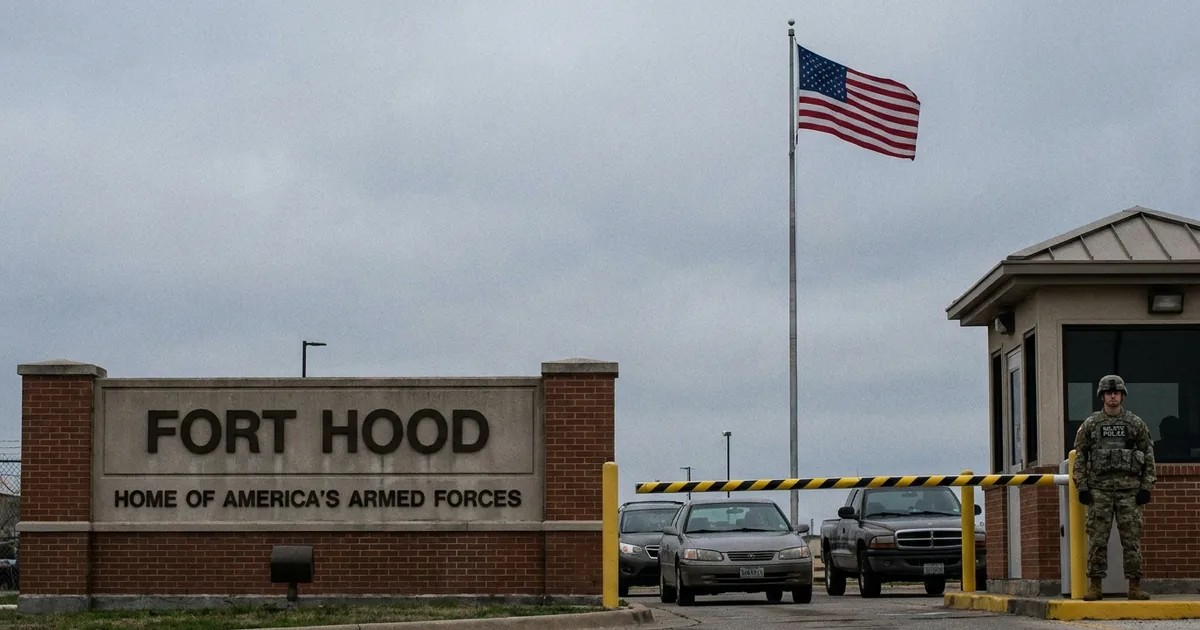
Donald Trump wrote on Truth Social on Thursday that Nidal Hasan “will die, as scheduled, by firing squad, but this event will not be streamed,” which cancels the Pentagon’s plan to put the military’s first execution since 1961 on the internet. Six days earlier a reporter had asked him whether he approved that plan, and he had answered, “Did I approve? Absolutely.” The post changed nothing the Army has written down. Army Regulation 190-55, the document that governs how the service executes a condemned soldier, has no word for broadcasting, can be waived by the Provost Marshal General or a colonel-grade delegate, and in its current edition, dated 30 October 2023, reads exactly as it did before Pete Hegseth went on camera.
We read that edition, 20 pages, and searched it for broadcast, camera, photograph, video, stream and television. None appears. What the regulation describes instead is a small room. Paragraph 2-5 lists who is “authorized to be present at the execution”: the commandant of the Disciplinary Barracks, a representative of the Provost Marshal General, the execution team, the prisoner’s counsel, “a minimum of two media representatives, selected under the direction of the OCPA from a pool” with a public affairs escort, the prisoner’s family if he asks, and “a relative (spouse, children, or parents) of a victim.” Everyone on that list is physically there, and no one under 18 may be. So the concession Trump offered Thursday, that the immediate families of the victims may watch in person, is a seat the regulation already holds for them. What he cancelled was a camera the regulation never provided for.
The regulation is just as specific about who speaks for the Army. Paragraph 2-4 says the Office of the Chief of Public Affairs “will release all information regarding executions,” publish a news release within seven days of the execution order, and issue a media advisory at least 14 days out that includes “an explanation of the media pool process.” The first word that the public would be able to watch came instead from the Defense Secretary, in an interview with Real America’s Voice, and the confirmation a day later was a one-word reply, “Correct.”, to a CBS News post on X. Exceptions have their own paperwork. The Provost Marshal General can approve waivers “consistent with controlling law and regulations,” can delegate that power in writing to a division chief at the grade of colonel or civilian equivalent, and requires a request to carry “a full analysis of the expected benefits,” a review by the activity’s senior legal officer and an endorsement from its commander. Military-law experts told Snopes the Army could waive or rewrite the rules to allow a stream, and none of the reporting we read shows that anyone started that paper before the plan was announced.
The sequence, from dated reporting, is short.
| Date (2026) | What was said or done |
|---|---|
| Oct. 5 | Pentagon spokesman Sean Parnell says on X that the Army’s firing squad will carry out Hasan’s execution. |
| Oct. 7 | Hegseth, aboard the USS Abraham Lincoln: “We’ll make sure that people are able to watch it, that it’s public.” |
| Oct. 8 | A Pentagon official tells CBS News the execution will be livestreamed; Hegseth replies “Correct.” on X; officials say details will follow. |
| Oct. 9 | Trump, asked whether he approved: “Did I approve? Absolutely.” Vance: “I don’t know that that’s actually going to happen.” |
| Oct. 10 | Trump at the White House: “There are two thoughts. Don’t show it and show it.” |
| Oct. 13 | ABC News/Washington Post/Ipsos poll closes: eight in 10 say do not livestream it. |
| Oct. 15 | Trump on Truth Social: “this event will not be streamed.” |
The poll was fielded Oct. 9 to 13 among 2,545 adults, with a margin of error of two points, and found 80% against a livestream, including 64% of Republicans and 55% of MAGA Republicans. The same poll found a 53% majority in favor of the firing squad itself, with about eight in 10 Republicans behind it. So the camera was the unpopular part, and the camera is the only part that went. The firing squad, the Fort Hood site and the Dec. 3 date all stand.
His Thursday post does not repudiate the idea. It says streaming “might have been a strong deterrent for the World to witness how America deals with Terrorists and SCUM like Hasan,” and that “many very good and well meaning people would rather not watch him die.” That is a president pulling a product because its audience tested badly, with the premise intact: a state killing as a message to be delivered to a viewership. Sen. Thom Tillis, a Republican, made the opposite case when he called the plan “beyond disgusting” and said public executions are what “oppressive dictatorships” do. Trump’s post takes the other side: the broadcast would have worked, and he is sparing the people who would rather not watch.
The decision trail is the part the post leaves alone. A U.S. official told NBC News that the livestream was Hegseth’s idea, that Army planning had been built around a lethal injection at Terre Haute and then Fort Leavenworth before he chose a firing squad at Fort Hood, and that the choice surprised Pentagon and Army officials. A White House official said Trump had not known Hasan is paralyzed. The regulation puts the method and the location in the hands of the Secretary of the Army, and the acting secretary did set the date by memo, as we reported when Trump signed off. None of the reporting we read says who would have carried the feed. AFP asked YouTube, Meta and X whether they would host it and got no answer, and TikTok pointed to its policy against depicting “the shooting of an individual.” YouTube’s published policy would not clearly have barred it, since the company says it “may age-restrict” violent footage “presented with news coverage that explains the situation and context.” So where the stream would have lived was still open on the day it was cancelled, and none of the details the Pentagon promised had been reported.
We think the sequence shows a government that treats a state killing as programming: announce first, find the authority later, retreat when the audience says no, and leave the machinery where it was. The person who owns the announcement is Hegseth, who put an execution on a friendly streaming show before, so far as anyone has reported, the Army’s public affairs chief, a platform or a waiver had been heard from. The person who owns the plan is the president, who approved it on a Friday, called it two thoughts on a Saturday and dropped it on a Thursday, two days after the poll closed. The reversal is welcome and it is no safeguard, because a post can be undone by the same hand in the same minute, and the paper underneath it still lets a colonel-grade officer sign the waiver. The Army should amend AR 190-55 to bar the recording and transmission of executions outright, with the Secretary of the Army’s signature on it, and Congress should ask the Pentagon on the record whether a waiver request was ever drafted. Until then the stream is only on hold.