
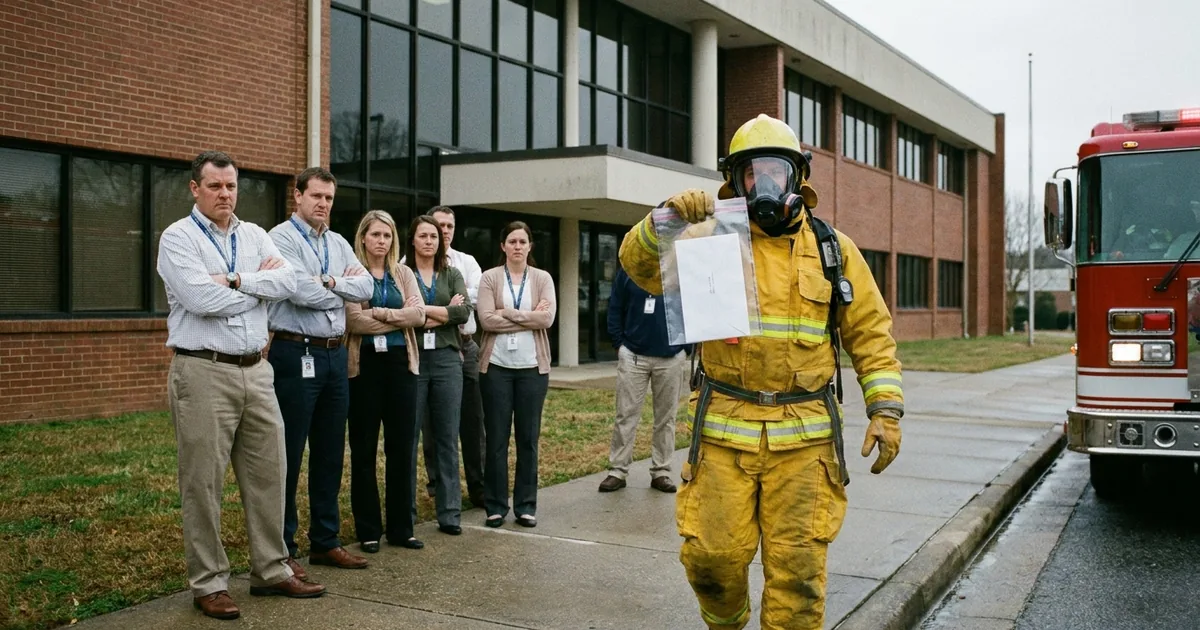
At 12:20 p.m. on Tuesday, a worker in the Louisiana Secretary of State’s Elections Division in Baton Rouge opened a package, found white powder inside, and ended the afternoon in an emergency room as a precaution.
Here is what is established as of Thursday afternoon:
- The FBI says it is investigating “a series of suspicious mailings sent to various addresses nationwide, including Secretary of State offices and their related election offices,” and that some contained “an unknown substance.”
- Election offices in Louisiana and Oklahoma were evacuated on Tuesday.
- Postal inspectors intercepted letters bound for election offices in Ohio, Maryland, Mississippi and South Dakota, with more stopped before reaching officials in Connecticut and New Hampshire.
- Senate offices were warned that “it is possible that some letters may reach their destinations,” and Sen. Chris Murphy’s office confirmed it received one.
- Nobody has been reported hurt, and no one has been arrested.
Most coverage is treating this as a fresh scare with a line of history at the bottom. It is the third nationwide powder-letter campaign against election workers in three election cycles. We searched for an announced arrest in either of the first two and found none, and this one lands after the federal government stripped out much of the help election offices used to get.
Three Elections, Three Waves of Letters
We put the three campaigns side by side, using the contemporaneous reporting on each.
| When | Who was targeted | What was inside | Arrest announced |
|---|---|---|---|
| November 2023 | County election offices in Washington during ballot counting, plus offices in Georgia, California, Nevada and Oregon | Powders, some field-testing positive for fentanyl | None found |
| September 2024 | Secretaries of state and election offices in more than 15 states, signed “U.S. Traitor Elimination Army” | White powder, early tests suggested harmless | None found |
| October 2026 | Election offices in at least eight states, Senate offices, a pollster | “Unknown substance,” per the FBI | Under investigation |
The 2023 letters arrived while Washington’s county workers were processing ballots, and some tested positive for fentanyl.
Some offices afterward started keeping naloxone on hand. That is a sentence about election administration in America now.
The 2024 envelopes reached officials in more than 15 states. Minnesota’s came from a return address the sender called the “U.S. Traitor Elimination Army.”
This week’s count may be the largest yet. Votebeat reported more than 100 letters sent nationwide, a figure the FBI has not itself confirmed.
The Person Who Opens the Mail
Think about that Baton Rouge worker for a second, because the whole design of this tactic runs through them.
In October, an election office’s job is opening mail. Absentee ballot applications, returned ballots, voter registration forms, provisional paperwork. Every envelope has to be handled by somebody.
A powder letter does not need to contain anything dangerous to work. It only needs to make the next envelope frightening.
Louisiana’s response shows the cost. Secretary of State Nancy Landry said her office evacuated the Elections section and turned off the building’s air conditioning “out of an abundance of caution.” Workers spent an extended stretch outside. The employee went to the ER.
In Oklahoma, State Election Board Secretary Paul Ziriax said no one was hurt after his office cleared out Tuesday morning.
Multiply that afternoon by every office on the list, three weeks before Election Day, and you get the point of the exercise. Lost hours, frightened staff, and a reason for an experienced clerk to quit before November.
Ohio Secretary of State Frank LaRose, a Republican, put it plainly: election officials “should never have to fear for their personal safety while performing their duties.” The national associations of secretaries of state and state election directors said the same in a joint statement.
They are right. The question is who is supposed to make that true.
Washington Walked Away From the Clerks
Election offices did not face the 2024 letters alone. They had the federal Cybersecurity and Infrastructure Security Agency, which states had long relied on to help secure their electronic and physical infrastructure. They had the EI-ISAC, the threat-sharing center created in 2018, during Trump’s own first term.
In early 2025 the Trump administration ended the EI-ISAC’s federal funding, and DHS fired more than 130 CISA staff that February. In July, the White House fired the remaining Election Assistance Commissioners, four months out from the midterms.
Meanwhile, the FBI found the capacity to order field offices to surge 260 analysts into a probe of Fulton County’s 2020 election.
We think that set of priorities is indefensible. A government that can redeploy 260 analysts to relitigate an election Trump lost can find the people to solve three waves of letters aimed at the workers running this one.
Nobody knows yet who sent this week’s envelopes, and we are not going to guess. Responsibility for the response is already clear, though. The postal inspectors and FBI agents chasing this deserve credit. The administration that dismantled the support system around them does not.
What Readers Are Asking
Was anyone hurt by the letters?
No injuries have been reported. A Louisiana employee who opened a package went to an emergency room as a precaution, and Oklahoma’s election board said no one was hurt.
Does this affect my ballot or my vote?
No state has reported any disruption to ballots or voting. Oklahoma’s election board said its operations were unaffected. The risk is to the people processing the mail, and to the hours they lose.
Who is investigating?
The FBI, the U.S. Postal Inspection Service and the U.S. Capitol Police. The Postal Inspection Service’s Brendan Donahue said they are working to identify “the individual or individuals responsible for the letters.”
Ballots are already moving through the mail in states across the country, and they will keep coming through November 3. The people opening those envelopes will open every one of them anyway. They should not have to wonder whether anyone in Washington is still behind them.