
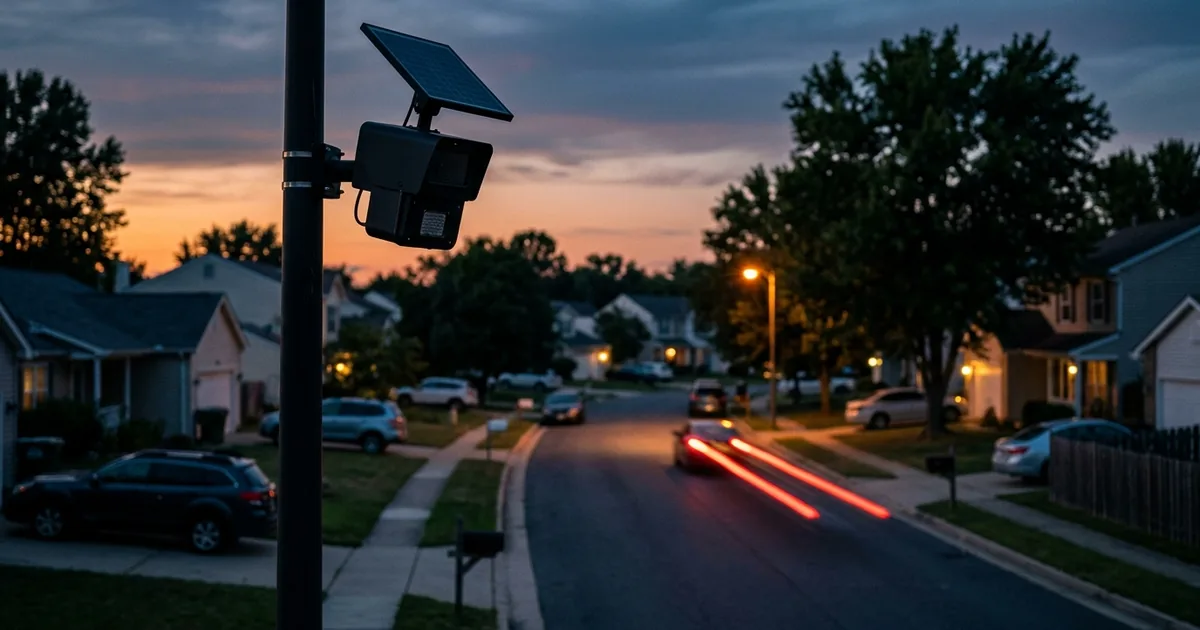
Over the past week, “flock camera map” became one of the most-searched phrases in the United States, which means a large number of Americans spent their evening typing their own address into a website to find out how many cameras are logging their car.
The answer, for most of them, was: more than they thought.
Roughly 119,000 automated license plate readers have now been mapped across the country by crowd-sourced projects like DeFlock, and Flock Safety accounts for about 83 percent of that mapped total. The Atlanta company itself says it has close to 100,000 cameras live across more than 6,000 communities in 49 states. That is not a pilot program. That is national infrastructure, and it was assembled almost entirely without a single national decision.
Nobody Ever Voted on a National Vehicle Database
This is the part that gets lost when the story is covered city by city, which is how it is almost always covered.
No legislature ever debated whether the United States should have a searchable, continuously updating record of where private vehicles go. What happened instead was that several thousand city councils and county boards each approved a small, sensible-sounding purchase: a handful of cameras at the entrances to a subdivision, funded out of a public-safety line item, pitched as a tool for recovering stolen cars and catching hit-and-run drivers. Each of those decisions was defensible in isolation. Most passed with little opposition, because on its own terms the pitch is reasonable.
The cameras do not just read plates. Flock’s system builds what the company calls a vehicle fingerprint, which extends to make, model, color, and distinguishing features down to roof racks and bumper stickers, and the resulting records sit in a searchable database for 30 days or more. Then the default sharing settings knit those thousands of local installations into something none of them individually bought: a network where an officer in one state can query cameras in another, or nationwide.
That is the structural why behind the entire backlash. The consent was collected at the municipal level. The capability was assembled at the national level. The two were never the same thing, and the gap between them is where every scandal of the past year has lived.
The Side Door
The thing that turned a slow privacy argument into a cancellation wave was reporting by 404 Media, which found that state and local police had been running immigration lookups through Flock on behalf of ICE, an agency with no Flock contract of its own. More than 4,000 such searches, performed either at federal request or as an informal favor.
The detail that makes this story is how it was caught. Flock requires a user to type a reason for each search. The immigration lookups were discovered because officers had typed the reason honestly: “ICE,” “illegal immigration.” The audit trail worked exactly as designed, and what it revealed was that the audit trail was the only thing standing between a local camera network and a federal agency that had never been granted access to it.
Then the same pattern turned up in formal audits. In June, San Francisco’s police chief disclosed at a police commission meeting that a compliance review had found the Northern California Regional Intelligence Center had queried the city’s Flock network on behalf of federal and out-of-state agencies: 299 improper inquiries over roughly a year, in a jurisdiction with some of the strictest surveillance-oversight rules in the country. San Francisco wrote the rules, ran the audit, and still found hundreds of searches it had not authorized.
If the city with the strongest oversight regime in America discovers this only through a routine audit a year later, the reasonable inference about the several thousand cities with no audit regime at all is not comforting.
Cities Are Leaving, and the Company Has a Credibility Problem
The cancellations have piled up fast. Somewhere between 30 and 80 municipalities have dropped or deactivated Flock contracts depending on which tracker you trust, with 53 attributed specifically to unauthorized federal data access. The Los Angeles Police Department let its three-year operating agreement lapse on July 11 rather than renew it, with data ownership, privacy and security all unresolved. Last week Binghamton’s city council passed a resolution urging its mayor to terminate the city’s Flock contracts, which is roughly the shape of a dozen other local fights right now.
Underneath the cancellations is a trust problem the company has not solved. The ACLU has documented what it describes as a pattern of Flock misrepresenting its product to city councils and police departments across the country, and has separately tracked how far the company’s ambitions extend beyond license plates, into drones, gunshot detection and broader video.
A surveillance vendor’s most valuable asset is not its cameras. It is the assumption, held by a few thousand city councils simultaneously, that the settings are what the sales deck said they were.
That assumption is what is actually being withdrawn right now, one council vote at a time.
The Fight Is About Defaults, Not Cameras
It would be easy to read the cancellation wave as a referendum on license plate readers as such. It is not, and pretending otherwise concedes an argument nobody needs to concede.
Plate readers solve real cases. Police departments can produce specific stolen vehicles and specific arrests, and residents in neighborhoods with a car-theft problem are frequently the ones asking for them. The people showing up to council meetings to keep the cameras are not wrong about the thing they care about.
What the last year established is that the cameras were never the interesting part. The interesting part is the sharing defaults, the retention window, the query-reason field nobody reads, the regional intelligence center with standing access, and the question of who audits any of it. Those are configuration choices made by a private vendor and inherited wholesale by every customer, and they are the reason a purchase approved in one town for stolen cars became a lookup tool for a federal agency in another.
This is the same structural problem Congress ran into with the fight over Section 702 surveillance authority: a capability built for one purpose, quietly available for others, with the oversight arriving years after the infrastructure. The difference is that Section 702 at least required a congressional vote. Flock’s network required roughly six thousand of them, none of which were about the network.
The trackers being handed around this week, DeFlock and its counterparts, which the coverage keeps directing readers toward, are a fairly blunt instrument. They are also the only mechanism by which most Americans have ever been told what is on their street. That a volunteer mapping project is doing the disclosure work here, rather than the vendor or the cities that bought from it, is the whole indictment in one sentence.
Type in your address. Whatever the number is, nobody asked you first.