
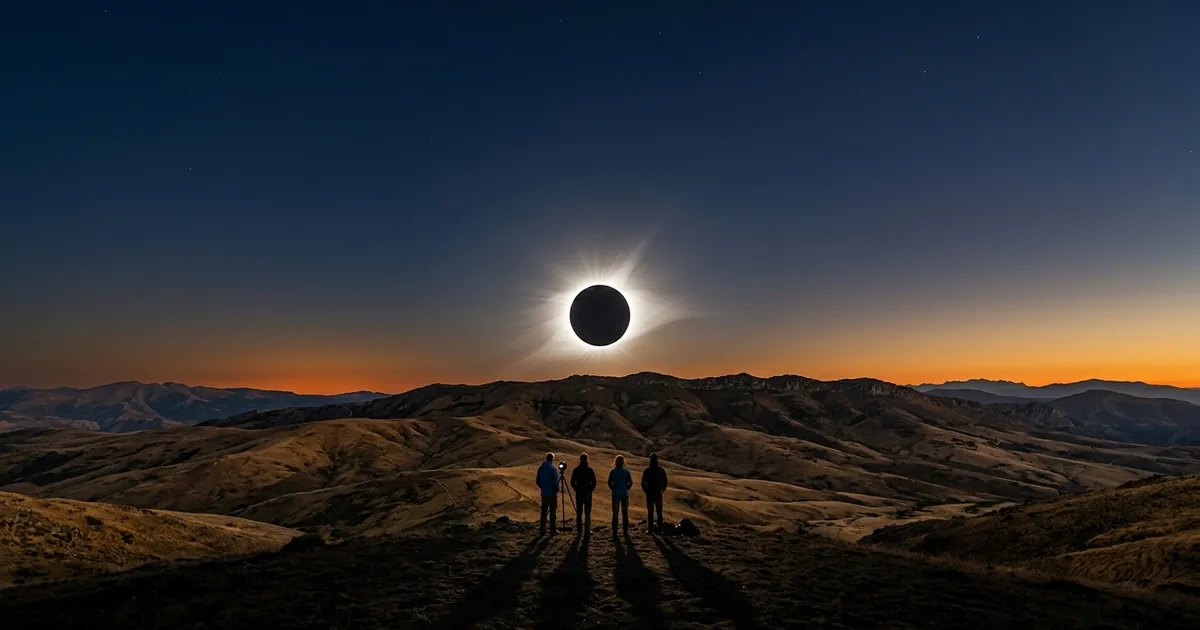
For about two minutes this evening, the moon’s shadow will race across eastern Greenland, western Iceland and the northern half of Spain, and mainland Europe will go dark for the first time in 27 years.
Americans get to watch it on a livestream, which is the closest thing to a front-row seat we will have for the next 18 years.
That is the part worth sitting with. The United States has spent the better part of a decade treating total eclipses as a national event, with the 2017 and 2024 crossings drawing enormous travel booms and a genuine burst of public science enthusiasm. Today’s is not ours. The path of totality, as NASA lays out in its official briefing, clips a remote stretch of Siberian Russia, then Greenland, then Iceland, then Spain and the northeastern corner of Portugal. Maximum totality runs 2 minutes and 18 seconds. Nowhere in North America sees it.
The Weirdest Eclipse Most People Will Ever Watch
Here is what makes this one genuinely strange rather than just geographically inconvenient: in Spain, the sun will be almost down when it goes out.
Totality arrives in the late evening, shortly before sunset, with the sun sitting between roughly 2 and 12 degrees above the horizon depending on where you stand. On Spain’s north coast it will be around 10 degrees up. By the time the shadow reaches the Balearic Sea it drops to about 4. For scale, hold your fist at arm’s length: that is roughly 10 degrees. The entire event happens inside one fist-width of the skyline.
Which means the usual eclipse advice is useless. You do not need a clear sky so much as a clear horizon. A hill, a stand of trees, a mid-rise apartment block, a parked truck: any one of them can eat the whole thing. Spain’s national geographic institute has been publishing detailed altitude and timing guidance precisely because a lot of people are going to travel a long way and then discover a ridgeline in the way.
The upside is that a low-sun totality is spectacular in a way a high-sun one is not. The corona sits right on the landscape. Shadows stretch to absurd lengths. The color of everything goes wrong at once. Eclipse chasers have wanted this specific geometry for years.
Spain Just Became the Center of the Eclipse World
The other thing most coverage is burying: today is not a one-off for Spain. It is the opening night of a run.
- August 12, 2026 (today): total eclipse across northern Spain, Portugal’s northeast corner, Iceland and Greenland. Spain’s first total solar eclipse in over a century.
- August 2, 2027: another total eclipse, this time across the southern tip of the peninsula, with parts of Andalusia getting more than four minutes of darkness. That is nearly double today’s maximum.
- January 26, 2028: an annular eclipse, the “ring of fire” variety, crossing Portugal and Spain.
Three central eclipses in under 18 months, a sequence BBC Sky at Night Magazine and others have taken to calling the Iberian trio. Spain has spent two years building tourism infrastructure around it, and the country is about to find out what happens when several hundred thousand people with tripods converge on the same set of hilltops three summers running.
Compare that to the American calendar. The next total solar eclipse touching the continental United States is August 23, 2044, and it only clips Montana and the Dakotas. The next genuinely national one, coast to coast from California to Florida, is August 12, 2045. Nineteen years out, to the day, from today.
Watch It Anyway
The European Space Agency is running the most serious broadcast, from the Javalambre Observatory in Aragón, combining telescope feeds with drone footage and commentary. It starts at 1:30 p.m. Eastern, and ESA has published a full guide to watching from home. NASA’s own stream begins slightly earlier, at 1:15 p.m. Eastern. Totality at Javalambre lands at 20:31 local time and lasts 1 minute 21 seconds.
If you are in Spain or Iceland and planning to look at any of this directly, the eye-safety rule has not changed and does not bend for a low sun: certified solar filters until the moment of totality, and back on the instant the first sliver of photosphere returns. A sun four degrees above the horizon is dimmed by atmosphere, which makes it feel safe. It is not.
The Nonsense Cycle, Right on Schedule
Every eclipse now arrives with a small parade of viral claims attached, and this one drew a good one: that the alignment could trigger earthquakes. It got enough traction that Forbes ran a straightforward debunk of the eclipse-earthquake claim a couple of days ago.
The tidal forces involved during an eclipse are not meaningfully different from those during any new moon, which happens monthly without anyone noticing. The reason the claim spreads is not that it is plausible. It is that eclipses generate enormous search volume for a few days, and search volume is a business. The same dynamic produced the “the sun will disappear for six days” hoax that recirculates every couple of years.
That is a small thing, but it is the recurring cost of a genuinely great public-science moment: the attention it creates gets farmed. Al Jazeera’s practical rundown of where and when to watch is the kind of coverage that actually helps, and it competes for the same clicks as the earthquake thing.
Two Minutes and Eighteen Seconds
Total eclipses are, objectively, a coincidence. The moon is roughly 400 times smaller than the sun and currently sits roughly 400 times closer, which is why the disks match. That ratio is not permanent. The moon drifts away from Earth by about an inch and a half a year, and in a few hundred million years the geometry stops working and total eclipses simply end.
Today’s is one of a finite and slowly shrinking number. Spain gets the next two. The rest of us can open a browser tab at 1:30 and watch somebody else’s sky go out.