
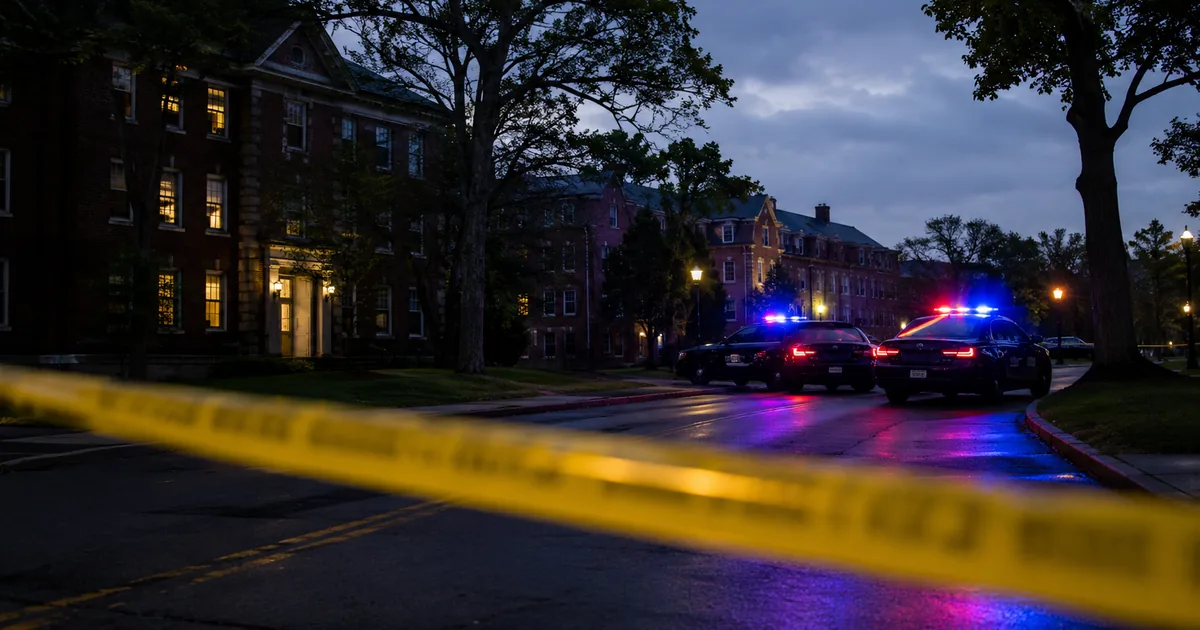
Five people were shot outside a Virginia State University residence hall at about 1:28 on Saturday morning, and one of them is in critical condition.
Police say only one of the five was enrolled at the school, and that single fact should change how this story gets read.
Chesterfield County officers responded to the Quad Annexes, near where Boisseau Street meets Third Avenue in Ettrick, and found five people with gunshot wounds. All five were taken to area hospitals. Four had injuries police described as non-life-threatening. The fifth, initially listed as life-threatening, was later described as critical. VSU Police Chief David Bragg lifted a campus-wide lockdown at roughly 8:20 a.m., telling the university community to remain mindful of the ongoing law enforcement activity while investigators worked the scene.
No one has been arrested. The university said the shooting involved multiple suspects, and Lt. James R. Lamb of the Chesterfield County Police Department’s Major Crimes Unit told CBS News that this was not a drive-by. Investigators believe they are looking for more than one shooter, and they have released no descriptions.
The Detail That Changes the Story
The phrase “campus shooting” does specific work in an American news cycle. It summons Virginia Tech and Parkland, it activates a national argument about student safety and active-shooter drills, and it points every institutional response toward the same set of tools: lockdown protocols, alert systems, door hardware.
Lamb’s account points somewhere else entirely. He said only one of the five people shot was a VSU student, and that investigators believe the others may be from surrounding communities. That is not a story about a threat inside a university. It is a story about gun violence in Ettrick arriving at the point where an unfenced campus meets a public street at one in the morning.
Those are different problems. They have different causes, and almost nothing that solves one touches the other. A text-message alert system is meaningless to a person shot on a public road at 1:28 a.m. who has no affiliation with the school sending the alert.
Almost Exactly Two Years Earlier, on the Same Street
This is where the story stops looking like an isolated event.
On August 14, 2024, at roughly 12:30 a.m., four people were shot on Boisseau Street near Daniel Gymnasium, on the same street as Saturday’s scene. Two men and two women were hit. All were expected to survive. Chesterfield police arrested two 21-year-olds, Xavier J. Gordon and Clyde D. White Jr., on gun charges within a short time of the shooting. Classes were set to begin that Monday.
The university’s own statement afterward contained the line that matters most:
None of the injured victims or suspects are enrolled at VSU for the Fall 2024 semester.
VSU published that sentence two years ago. Saturday, police delivered a nearly identical finding about a nearly identical incident on the same street, in the same week of the academic calendar, at nearly the same hour of the night. The institution had already diagnosed the pattern. What it has not done, publicly at least, is change the geography.
And Again in October
The clustering is tighter than two data points.
On the night of October 4, 2025, a 20-year-old named Omarion Bryant was shot and killed on the 20900 block of Third Avenue, near the VSU Multipurpose Center. Bryant was not a registered student. Police obtained a second-degree murder warrant for a 19-year-old from Dinwiddie County, and neither man was affiliated with the university. The campus went into lockdown that night too.
Boisseau Street in 2024. Third Avenue in 2025. The corner where the two meet on Saturday. Three shootings in two years, all within a few blocks, all overwhelmingly involving people who do not attend Virginia State University. The campus keeps absorbing the lockdowns, the alerts, and the national headlines for violence that its own police force and the county’s have repeatedly said originates outside the student body.
The Window Between Move-In and Monday
Timing is the other variable nobody is naming.
Both August shootings landed in the same narrow slot: after residence halls open, before classes start. VSU welcomed close to 1,500 new students on Friday at a pinning ceremony where the former NFL MVP Cam Newton spoke. Fall classes begin Monday. Saturday’s shooting happened in the roughly 60-hour gap between those two events.
That window is a genuine institutional blind spot. The campus is full. Thousands of teenagers and their families have arrived, the social life of the place is running at full volume, and almost none of the structures that normally govern a university are switched on yet. No class schedule imposes a rhythm. Faculty are not around. The academic-year staffing that campus police plan against has not started. It is the most populated and least organized moment of the year, and at VSU it has now produced two mass shootings in three Augusts.
Public universities do not control the streets at their edges, and it would be unfair to suggest VSU can simply police its way out of violence that Chesterfield County has not solved either. VSU is a 236-acre public land-grant HBCU on a bluff above the Appomattox River, with public roads running through and alongside it, which is true of most American public campuses. The point is narrower: when the same intersection produces the same kind of shooting in the same week of the calendar for a third time, treating each one as an unforeseeable shock is a choice.
What Is Actually Unresolved
Five people are in hospitals and multiple shooters are unaccounted for. The Chesterfield County Police Department is leading the investigation with the Bureau of Alcohol, Tobacco, Firearms and Explosives, the Hanover County Sheriff’s Office, and VSU police, and it is asking anyone with information to call 804-748-1251 or Crime Solvers at 804-748-0660.
The immediate questions are the obvious ones: who fired, whether the people shot were targeted or incidental, and whether the critically wounded victim survives. The longer question is the one VSU has now had two years to answer in public and has not. If the university already knows that the people being shot at its edges are mostly not its students, and the county already knows which few blocks keep producing these calls, then Monday morning is not the end of this story. It is the deadline the last two years already set.