
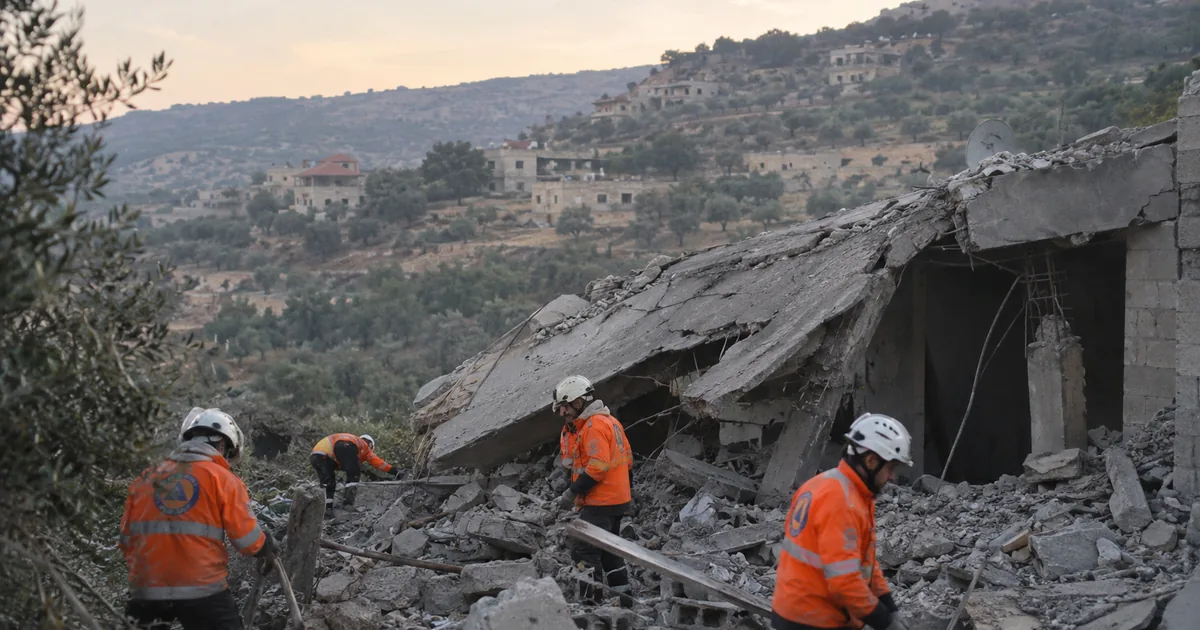
Israeli airstrikes killed eleven people in southern Lebanon early Saturday, seven of them inside a single house on the edge of Ansar, and three of the dead were children.
It was the deadliest day in Lebanon since the June framework agreement that was supposed to stop precisely this, and the design of that agreement is a large part of why it keeps not stopping.
Lebanon’s health ministry settled on eleven by Saturday evening, a number that climbed through the day as crews worked the rubble. Lebanese state media had first reported seven. Wounded totals still differ between outlets, and that gap is worth stating plainly rather than smoothing into false precision, because the casualty count is the single most contested fact in every one of these incidents.
What the Strikes Hit
Lebanon’s National News Agency reported, in an account carried by Al Jazeera, that the first strike destroyed a house on the outskirts of Ansar, in the Nabatieh district. Seven people died there, three of them children. A second strike on nearby Deir al-Zahrani killed four more. The Times of Israel reported that three children and two women were among the eleven.
The Israeli military’s account is unusually specific, which matters when you are assessing a claim. It said an explosive drone hit troops at the Ali Taher Ridge at roughly 2:30 a.m., seriously wounding three soldiers, and that the airstrikes answered that attack. It said it struck Hezbollah infrastructure in the Nabatieh and Ansar areas. It named a man it said it killed, Ali Samir Al-Haj Hassan, calling him a battalion commander in Hezbollah’s Radwan Force. And it said Hezbollah had deliberately placed civilians inside a military compound, which is the standard preemptive answer to the standard question about a destroyed house.
Beirut rejected the framing without hedging. Prime Minister Nawaf Salam said the seven killed at Ansar “are not military infrastructure.” President Joseph Aoun went further and read the strikes as aimed at the negotiating table rather than at Hezbollah.
“A clear message to the negotiation track and to the American efforts.”
That is a head of state saying the ceasefire’s guarantor is being told something by the party that signed it. Aoun is not a Hezbollah partisan. He is the president who agreed to a process premised on American good faith, describing the strikes as a signal to that process.
A Truce That Asks Beirut to Deliver What It Does Not Control
Here is the structural problem, and it is not a matter of who broke the ceasefire on any given night.
The framework announced on June 26 and presented by Secretary of State Marco Rubio as a first step toward peace is a sequenced deal, and the sequence is the whole thing. The Lebanese Armed Forces take security control of pilot zones. Non-state armed groups in those zones are cleared and disarmed. Third-party verification confirms it. Only then do Israeli forces pull back from that ground, including territory taken when the army pushed north to seize Beaufort Castle in June. The Long War Journal’s analysis of the agreement describes Israel’s side as a phased, conditions-based reduction synchronized with the Lebanese army’s verified performance.
Read the order of operations again. Beirut’s civilian government has to disarm Hezbollah first and receives the withdrawal second, and that withdrawal is the only thing it can show its own public as a gain. Hezbollah did not sign this and does not intend to comply. It rejected the deal outright, promised continued resistance, and warned that enforcing it could push Lebanon toward civil war. The Lebanese army is therefore being asked to move against a militia that has already announced the attempt means internal conflict, in return for a withdrawal that arrives only if it succeeds.
That produces a trap with no exit inside the agreement’s own logic. Every Hezbollah operation becomes a justification for Israeli strikes, and Israel has the stronger claim each time it can name a drone and three wounded soldiers. Every Israeli strike becomes Hezbollah’s argument that disarmament buys nothing, since the occupation continues either way and the state that promised otherwise cannot deliver. Salam and Aoun are left issuing statements about a situation neither of them commands. The Lebanese state is the guarantor of an obligation it lacks the power to perform, which is not a peace process so much as a mechanism for assigning blame after the fact.
This Pattern Predates Saturday
The strikes did not begin this weekend. Al Jazeera was reporting Israeli air raids around Nabatieh in early July, a week after the framework was announced, under the same ceasefire and with the same reciprocal justifications attached.
What changed on Saturday is scale. Earlier in August, two Israeli soldiers were killed in an explosion, the first Israeli deaths since the truce took hold. The Associated Press count since the conflict resumed on March 2 stands at more than 4,000 killed in Lebanon against roughly 40 Israeli soldiers and three Israeli civilians. A hundred-to-one ratio is not a detail inside a story about proportionality. It is the story, and it is the number that will define how this framework is remembered regardless of which side is judged to have broken it first.
What a Ceasefire Is Actually For
A ceasefire that reduces violence without ending it can still be worth defending. Hostilities did drop after June, which is why Saturday registered as the deadliest day since. The honest question is not whether the framework has failed but whether it was ever built to succeed on its stated terms, or whether it was built to freeze a favorable military position while assigning the impossible half of the bargain to the weaker party.
Washington has an answer available to it, and it is not another envoy statement urging restraint. The framework’s sequencing was an American design choice. If verified disarmament by a government that does not control the militia is the precondition for withdrawal, then the United States has written a condition that can be failed indefinitely, and it now owns what happens in the villages while everyone waits for it to be met.
Three children died in a house in Ansar on Saturday. Whether that house also held what Israel says it held will be argued for weeks, in the same terms, with the same two accounts, and by the time it is settled the argument will have moved to the next village.