
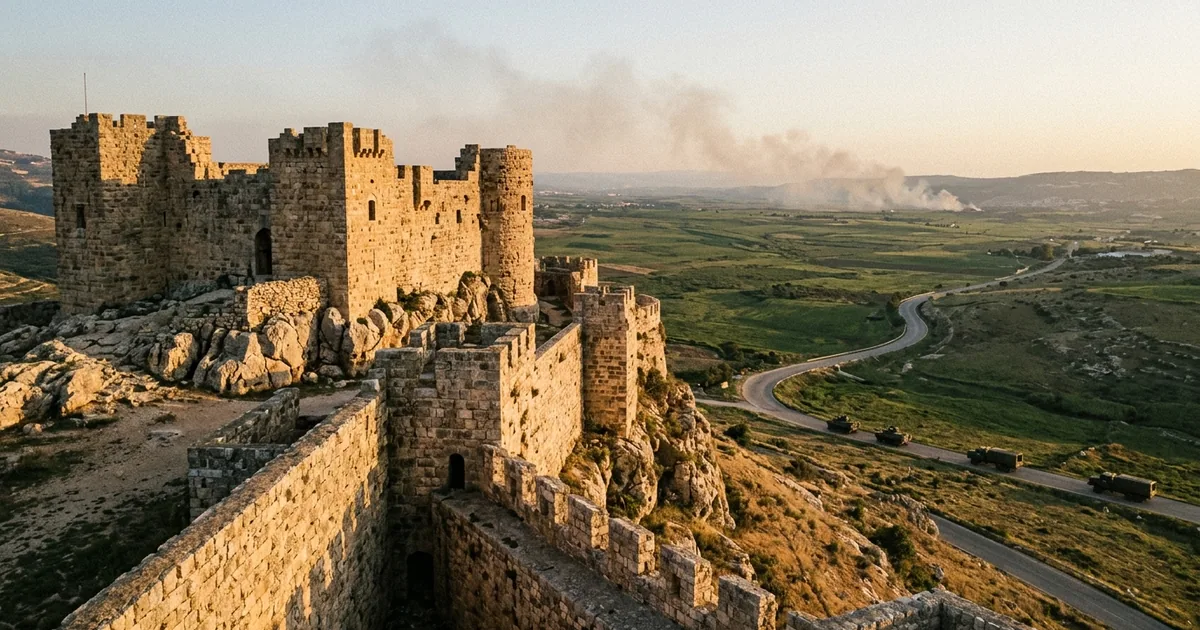
Israel’s military has captured the 12th-century Beaufort Castle in southern Lebanon, marking the deepest Israeli ground incursion into Lebanese territory in more than two decades and signaling that Prime Minister Benjamin Netanyahu intends a long-term military footprint well beyond the boundaries of April’s ceasefire.
A Castle With a Long Military Memory
The hilltop fortress, built during the Crusades and designated by UNESCO as one of the best-preserved medieval castles in the Near East, isn’t just a relic. It commands sweeping sightlines across southern Lebanon and into northern Israel, and it has changed hands between Israeli and Hezbollah forces repeatedly since the 1982 invasion. Israel’s last withdrawal from Beaufort came in 2000. Now the IDF is back, and Defense Minister Israel Katz made the ambition explicit: “Our brave soldiers have captured the Beaufort once again, and they will remain there as part of the security zone in Lebanon.”
That framing matters. A “security zone” is permanent infrastructure language, not the vocabulary of a limited operation. It echoes Israel’s 1985-2000 occupation of a self-declared buffer strip in southern Lebanon, an 18-year commitment that bled resources, generated persistent guerrilla resistance, and ultimately ended in a unilateral withdrawal that Hezbollah claimed as a defining victory.
The Ceasefire That Wasn’t
The castle seizure follows weeks of escalating operations that have functionally shredded the April ceasefire agreement. NPR reported Saturday that Netanyahu ordered troops to push beyond the Litani River, the geographic marker that was supposed to be the outer boundary of any Israeli security presence under the deal’s terms. Lebanese Prime Minister Nawaf Salam has accused Israel of pursuing a “scorched-earth policy,” and the numbers back that characterization.
Entire villages in southern Lebanon have been leveled. The Lebanese ministry of public health reports more than 3,300 people killed since the ground campaign began, roughly 20 percent of them women, children, and first responders. New evacuation orders issued alongside the Beaufort operation push the displacement zone further north than at any point since the 2006 war.
France, a former colonial power with deep institutional ties to Lebanon, issued its sharpest condemnation yet. Paris called the castle seizure a violation of Lebanese sovereignty and demanded immediate withdrawal, language that Euronews noted went further than any previous French statement on the current campaign. The condemnation reflects a broader European frustration: the ceasefire was supposed to be the exit ramp, and Netanyahu just drove past it.
What This Means for the Wider Conflict
The Lebanon escalation doesn’t exist in a vacuum. It unfolds against the backdrop of the broader U.S. military strikes on southern Iran and the stalled Doha ceasefire talks that have defined the region’s trajectory for months. Netanyahu’s decision to deepen the Lebanon front while those diplomatic tracks remain frozen suggests a calculated bet: that Washington, consumed by its own Iran engagement, won’t expend political capital to restrain Israeli operations on a secondary front.
That bet has historical precedent. During the 2006 Lebanon war, the Bush administration gave Israel weeks of operational space before pushing for a ceasefire resolution at the UN. The current dynamic is even more permissive: with U.S. forces actively engaged against Iran, the bandwidth for Lebanon diplomacy is essentially zero.
The displacement toll alone should force the question. More than 1.2 million Lebanese civilians have been uprooted, according to UN estimates. Humanitarian corridors have collapsed. Aid organizations report that southern Lebanon is increasingly inaccessible, with roads destroyed and checkpoints blocking civilian movement. The humanitarian crisis is no longer a side effect of the military operation; it is becoming its defining feature.
The Strategic Gamble
History suggests that seizing territory in southern Lebanon is the easy part. Holding it without generating the exact conditions that feed the next generation of armed resistance is where every previous Israeli campaign has failed. The 18-year occupation created Hezbollah’s recruitment pipeline. The 2006 war, intended to destroy Hezbollah’s military capacity, instead cemented its political legitimacy in Lebanon and across the broader Arab world.
Beaufort Castle is a powerful symbol, but symbols don’t secure borders. The question Netanyahu has never convincingly answered is what the endgame looks like when the cameras move on and the garrison stays. If the pattern holds, the castle will eventually change hands again. The only variable is how many people are displaced, maimed, or killed before it does.