
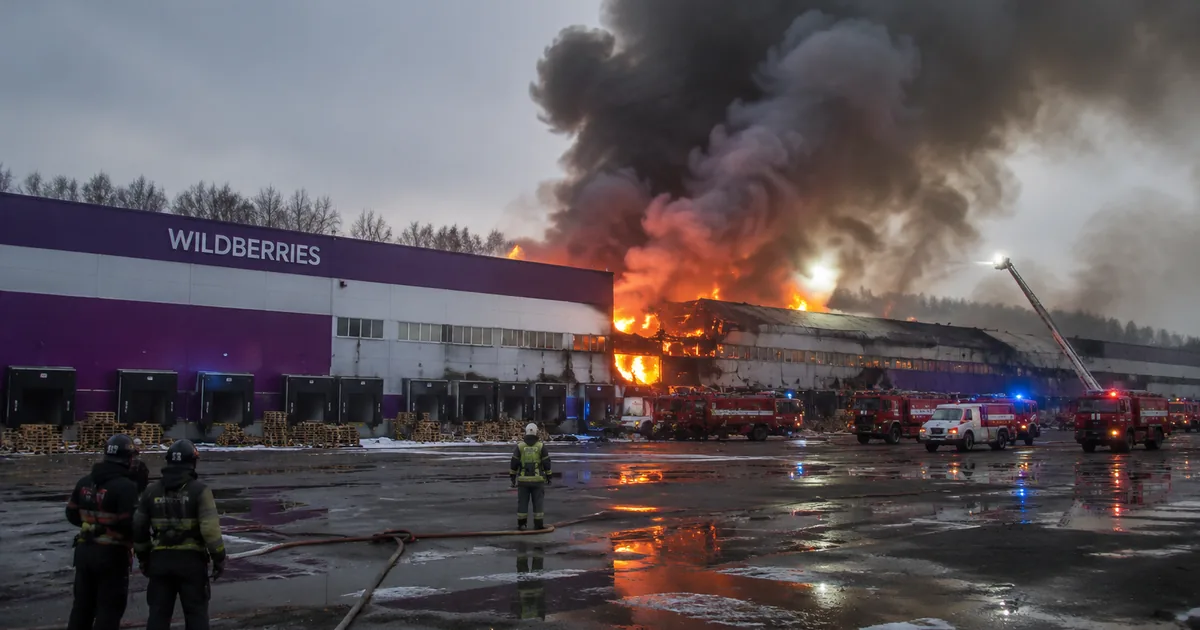
Russia’s Defense Ministry said it shot down 822 Ukrainian drones overnight, the heaviest single night of the year, and the wreckage that mattered most fell on a shopping warehouse outside Moscow.
Ukraine’s Defense Ministry says the strike leaves seven of the ten largest logistics centers run by Wildberries, Russia’s answer to Amazon, out of operation.
That second number is the one to watch. Drone counts are a scoreboard both governments have reason to inflate, and neither side’s tally can be checked from outside. A target list is harder to spin. For four weeks Ukraine has been methodically taking apart the warehouse network of a retail company, and the pattern is now clear enough that it explains more about where this war is going than any interception figure does.
What Actually Burned
Moscow region governor Andrei Vorobyov said air defense and electronic warfare systems downed or suppressed 187 drones across ten towns: Domodedovo, Podolsk, Stupino, Odintsovo, Naro-Fominsk, Ramenskoye, Chekhov, Kolomna, Kashira and Yegoryevsk. Roughly 600 aircraft flew toward the region between Saturday evening and 6:30 Sunday morning, a concentration Russian officials have not reported against the capital region at any point this year.
The fires that followed tell you what got through:
- The Wildberries facility at Koledino, in the Podolsk district, 250,000 square meters and the company’s single largest warehouse.
- The Severnoye Domodedovo production and logistics complex, close to one of Moscow’s main airports.
- Kombinat Kamensky in the Rostov region, a state-owned plant that produces solid rocket fuel.
Ukraine’s General Staff was direct about the last one, saying the plant’s products “are directly used to supply the needs of the Russian Armed Forces.” That is the uncontroversial half of the night. A rocket fuel plant is a military-industrial target by any reading of the laws of armed conflict, and nobody in Kyiv is being coy about it.
The warehouses are the argument.
The Case Kyiv Is Making
Wildberries is not a defense contractor. Founded in 2004, it is Russia’s largest online retailer, ahead of its nearest rival Ozon, and it mostly sells clothes and phone cases. Burning its distribution network degrades civilian consumption in a way ordinary Russian households feel within days.
Kyiv’s position is that the network is also the pipe through which drone components and other sanctioned parts reach the Russian military, riding inside the same commercial logistics that deliver everything else. Ukraine’s Defense Ministry put the campaign’s result plainly:
Ukraine has taken out of operation seven out of the 10 largest Wildberries logistics centers.
The Kyiv Independent, which reported the ministry’s claim, noted it could not independently verify it. That caveat belongs on every number in this piece, including Russia’s.
What is verifiable is the tempo. Ukrainian drones destroyed eight Wildberries warehouses in July alone, covering about 860,000 square meters, which Euromaidan Press calculated at roughly 15 percent of the retailer’s storage capacity. Sunday’s strike was not an escalation so much as the continuation of a program, and it followed the same logic as the Moscow-region oil depot hit at Noginsk in July: find the thing that moves, and stop it moving.
This is where the sanctioned-components claim does real work, and where it deserves more scrutiny than it is getting. If Kyiv is right, these are dual-use military logistics and the strikes are lawful. If the claim is thin, Ukraine has spent a month systematically destroying civilian retail infrastructure, and the difference between those two readings is not rhetorical. It is the difference between a legitimate interdiction campaign and a pressure campaign aimed at Russian consumers. Ukraine has offered the assertion. It has not, so far, offered the evidence, and its Western backers have not publicly pressed for it.
Six People the Target Logic Does Not Cover
Whatever the warehouses were carrying, the people killed were not.
An 83-year-old man died when a drone struck a private home in the Moscow region, Vorobyov said, with three others wounded. Five more were killed in the Rostov region, where more than 150 drones damaged houses, hit a railway station and started a forest fire. That is at least six dead, all of them civilians, none of them in a logistics center.
The uncomfortable symmetry is that Russia spent the same night doing the same thing in the other direction. Ballistic missiles hit Kyiv, setting fires in the Obolonskyi and Holosiivskyi districts and wounding at least one person, as Al Jazeera reported. In Kryvyi Rih, missiles and drones killed one person and wounded six. Russia has been running this pattern at far greater scale and for far longer, including the ballistic attack on Kyiv on August 5 that killed 17 people, and Ukraine did not start a war of long-range strikes on cities.
But the trajectory is worth naming honestly, because Ukraine’s deep-strike campaign has begun producing exactly the kind of casualty lists it once existed to avoid. The refinery strike at Nizhnekamsk on August 10 killed 13 people. Precision at this volume is a statistical claim, not a physical one. Launch 600 airframes at a metropolitan region of some 20 million people and a share of them will come down on houses. That is not an accusation of intent. It is arithmetic, and it is the predictable cost of a strategy built on mass rather than accuracy.
The Drone Nobody Aimed at Romania
At 5:01 a.m., a Spanish F-18 flying a NATO air policing mission shot down a drone inside Romanian airspace. Romanian radar tracked it crossing in from Moldova about 24 kilometers north of Galati, and the fragments came down in an uninhabited stretch between two villages. It was the fourth drone Romania has brought down this year, on a border it shares with Ukraine for 614 kilometers. The defense ministry stopped short of naming the country that launched it, though NATO’s assessment was that it appeared to be Russian.
Nobody targeted Romania. That is precisely the problem, and it is the same problem the missile crater in Poland that triggered Article 4 consultations in July exposed. Both sides are now flying cheap, marginally guided aircraft in volumes that make spillover a matter of frequency rather than decision. A NATO member scrambling fighters four times in eight months to shoot down other people’s drones is not an alliance responding to provocation. It is an alliance absorbing overflow from a war whose weapons have gotten too numerous for anyone to keep inside the borders they were launched at.
The 822 figure will be forgotten by Tuesday. The question that outlasts it is whether a warehouse company can be bombed into a military target by assertion, and whether anyone with leverage over Kyiv intends to ask for the evidence.