
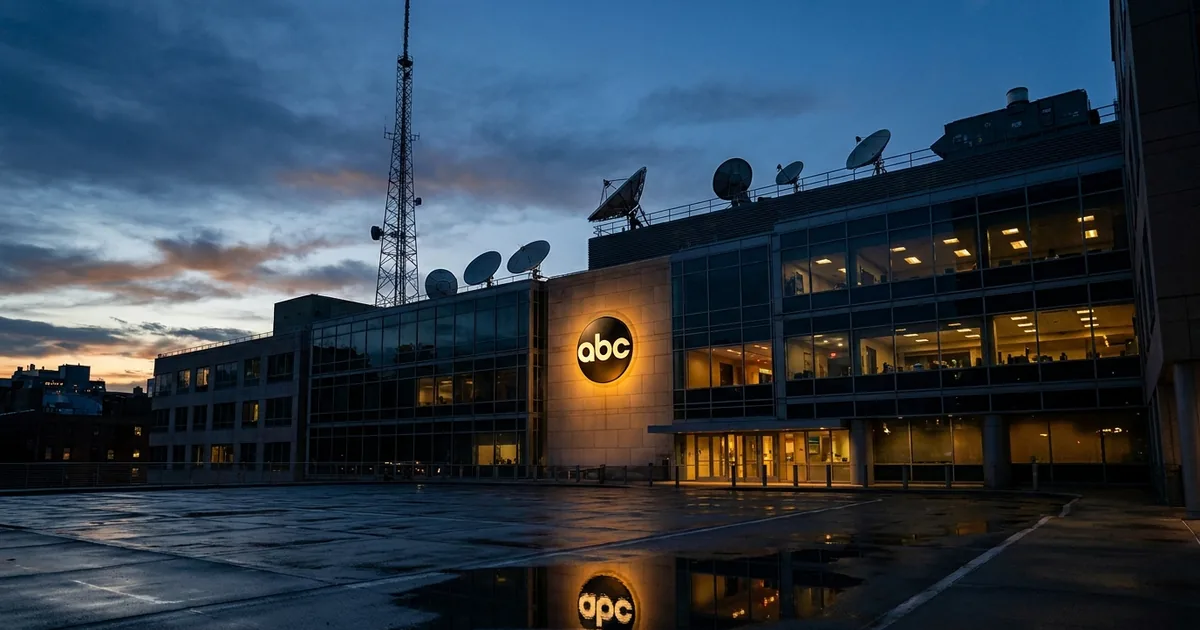
Disney and ABC went to federal court in Washington on Tuesday to stop the Federal Communications Commission from putting eight television station licenses through a renewal review that was not supposed to happen for another two to five years.
The company that paid Donald Trump $15 million in December 2024 to make a defamation suit go away has finally worked out that there is no check large enough to buy off a regulator holding your licenses.
The complaint, filed on behalf of ABC’s owned-and-operated stations, asks the court to block the FCC from taking or even threatening action while the accelerated renewal proceeding runs. Disney is seeking a temporary restraining order and a preliminary injunction. It names the commission, Chairman Brendan Carr, and commissioners Olivia Trusty and Anna Gomez as defendants, and it says in plain language that the agency has been punishing the network for “content and viewpoints the Administration dislikes.”
What the FCC Actually Did in April
The mechanism here is duller than the headline and far more dangerous, which is exactly why it took a lawsuit to surface it.
Broadcast licenses run on eight-year cycles. ABC’s eight stations were not due for renewal until sometime between 2028 and 2031. In late April, Carr’s FCC told Disney to call those licenses in early and gave the company thirty days to file. The stations affected:
- WABC, New York
- KABC, Los Angeles
- WLS, Chicago
- WPVI, Philadelphia
- KTRK, Houston
- KGO, San Francisco
- KFSN, Fresno
- WTVD, Raleigh-Durham
That is a large share of the country by population, moved from a routine paperwork exercise years away into an open-ended proceeding running right now, under a chairman who has spent a year and a half talking about what broadcasters owe the public interest. The FCC’s stated justification is a long-running investigation into Disney’s diversity, equity and inclusion practices, opened by a Carr letter in March 2025. Carr said at the time that the early renewal was not a First Amendment matter.
Disney’s filing does not accept that framing. It points at the president’s own posts about late-night hosts being “almost 100% Negative” to him and his musing about whether licenses should be terminated, and it argues the DEI file is the paperwork wrapped around a speech reprisal. The complaint’s phrase for what the stations face is “existential threat,” which for a broadcaster is not rhetoric. A station without a license is not a station.
The Part Where Paying Made It Worse
Here is the why, and it is the part most of today’s coverage skipped.
ABC settled with Trump in December 2024, handing $15 million to his presidential library plus a million in legal fees over a George Stephanopoulos misstatement. Paramount followed in 2025 with $16 million to end the “60 Minutes” editing suit, and the FCC cleared its Skydance merger shortly after. Both companies treated the payment as a closing cost. Both taught the same lesson in reverse: a settlement is a receipt for the proposition that pressure works.
A defamation suit ends when the check clears. A license proceeding never ends, because the license always comes up again.
That asymmetry is the whole game. Litigation is a one-time expense a media conglomerate can absorb and book. Licensing is a recurring permission slip, and once a regulator establishes that the renewal calendar is his to move, every editorial call at eight stations gets made in the shadow of the next filing window. Our earlier reporting on the April order covered the trigger. What the lawsuit adds is Disney conceding, on the record, that the trigger was never really about hiring data.
The escalation ran through Jimmy Kimmel. ABC pulled him off the air in September 2025 after Carr publicly pressured affiliates over his remarks on the killing of Charlie Kirk, then put him back on within days when the blowback landed on Disney rather than the White House. Seven months later the licenses were called in early. Corporate compliance did not lower the temperature. It set the price.
The View, and a Rule Nobody Has Enforced in Decades
Running alongside the license review is an FCC case examining whether “The View” still counts as a bona fide news program, the designation that exempts a show from the equal-time rule requiring comparable airtime for political candidates. The commission granted ABC that exemption more than twenty years ago. Reopening it now, for one daytime panel show with a well-known point of view, is selective enforcement in a suit and tie.
Equal time is not a censorship rule on its face. It is a scheduling obligation. But an agency that decides which shows are journalism and which are political speech has claimed the power to sort programming by content, and it is holding a license file on the same desk. ABC has argued since July that the proceeding is untimely and unwarranted, and it told the commission that public comments in the docket ran overwhelmingly in its favor. The ACLU went further and filed FOIA demands for the internal records behind the early-renewal decision. None of it moved the agency, which is presumably why Disney stopped asking.
Anna Gomez, the sole Democrat on the commission and a named defendant in a suit she supports, said the FCC has waged a campaign of censorship and control against the ABC stations, using the threat of revocation to punish speech the administration dislikes. An FCC spokesperson said the agency will follow the facts and the law wherever they lead. Carr’s framing in July was that broadcasters “struck a deal with the American people” and have to operate in the public interest, which is true, and which has never historically meant that the chairman gets to decide what “The View” is.
What a Judge Can and Cannot Fix
The narrow question in front of the district court is whether a regulator may accelerate a licensing process in response to protected speech. Disney has a real First Amendment argument and a real Communications Act argument, and it has something better than both: a public record of presidential posts demanding license revocations, which is unusually clean evidence of retaliatory motive. The FCC’s defense will be that renewal review is routine and that no license has been revoked, which is the standard answer to process-as-punishment claims and has the disadvantage of being beside the point.
What no injunction fixes is the chilling that already happened. Kimmel came off the air without any FCC order at all. Two networks wrote checks nobody made them write. The threat to pull licenses over war coverage never had to become a proceeding to change what got aired. The damage in this system is done in the anticipation, and courts are structurally bad at remedying a story an executive quietly decided not to run.
Still, somebody finally made the agency argue its theory in front of a judge instead of on a podcast. That took a year and a half, two settlements, one suspended comedian and eight licenses on the table. The interesting question is which broadcaster goes second.