
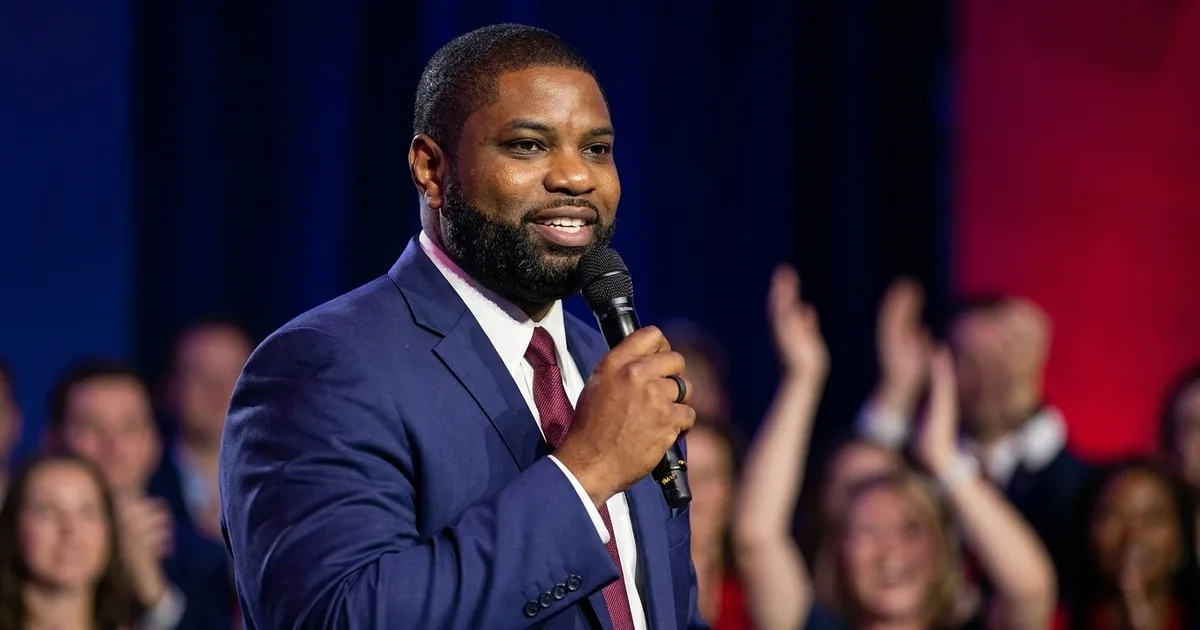
Ron DeSantis spent six years turning the Florida governorship into a national platform, and on Tuesday night Republican voters chose his successor without hearing a word from him. Byron Donalds, the Naples congressman Donald Trump endorsed long before anyone cast a ballot, beat DeSantis’s own appointed lieutenant governor by roughly two to one, and the governor who put that lieutenant governor in office stayed silent for the entire primary.
Donalds will face David Jolly, a former Republican congressman who quit the party over Trump, on November 3. That matchup is the one pollsters had been forecasting for months, so the headline result is not the surprise. The surprise is underneath it: a term-limited governor with a national brand either could not spend that brand inside his own state, or decided it was not worth spending.
The Race DeSantis Declined to Enter
Jay Collins was not a stranger to the man he was trying to succeed. DeSantis appointed him lieutenant governor. That is about as close to an heir designation as Florida’s system allows, and it still bought Collins nothing when the alternative carried Trump’s name. With 93 percent of the vote counted, Fox News reported Donalds at roughly 48 percent to Collins’s 25, with the online provocateur James Fishback trailing at about 10.
DeSantis never endorsed. The reason is not mysterious, and it is the structural fact this whole primary turns on. Endorsing Collins would have meant running at Trump directly in a state Trump now owns outright, four years after DeSantis tried exactly that nationally and lost. Endorsing Donalds would have meant publicly abandoning the man he had elevated. So he did neither, and the non-choice was itself the answer: the Florida Republican Party is Trump’s, and the governor who spent two terms arguing it was becoming something else has stopped making the argument.
That matters beyond one primary night. DeSantis governed as though Florida were a laboratory whose results would export, and a fair amount of it did export. What did not transfer was the authority. CBS News noted that Donalds arrives with a very different resume, a Freedom Caucus member first elected in 2020 who challenged Kevin McCarthy for speaker and forced 15 rounds of voting. He is a national-media Republican, not a Tallahassee operator, and he won a state primary on that basis. If he takes the general, he would be Florida’s first Black governor.
The Democrats Nominated a Republican
The other half of Tuesday is stranger and gets less coverage. David Jolly represented Florida’s 13th district as a Republican from 2014 to 2017, left the party over Trump, spent years as a cable-news never-Trumper, and then registered as a Democrat to run for governor. He won the nomination with about 61 percent of the vote, according to Yahoo News’s account of the Democratic primary. He is the second Republican-turned-Democrat to seek the office in two cycles.
There are two ways to read that, and both are true at once. The generous reading is the one Jolly gave himself on Tuesday night, telling supporters that “there is a new coalition emerging in American politics tonight, and it’s starting right here in the state of Florida,” as WLRN reported from his victory speech. The unkind reading is that a state party with no bench nominated the most credible person willing to take the job, and that person spent most of his career in the other party.
The numbers behind that unkind reading are brutal. WLRN put the Republican registration advantage in Florida at roughly 1.5 million voters. No Democrat has won the governorship since Lawton Chiles in 1994. No Democrat has won any statewide race in Florida since 2018. The Cook Political Report already rates November as Solid R. A party in that position does not get to be picky about where its nominee came from, and pretending otherwise would be its own kind of denial.
Twenty-Four Percent Is the Number Nobody Will Quote
Statewide turnout was running near 24 percent as of 6 p.m. Tuesday. Both nominees were effectively chosen by about a quarter of registered voters in the country’s third-largest state, in a race to run a government of 23 million people. That is normal for an August primary, which is precisely the problem: the timing is a choice, and August primaries reliably produce electorates that are older, whiter, more partisan and more easily moved by a single endorsement than the November electorate they are selecting for.
It is also the mechanism by which a Trump endorsement does the work it did here. In a 24 percent electorate, a national brand is not one input among many. It is close to the only input that scales.
Florida Republicans will spend the fall running on the state’s affordability crunch, and the property tax fight is where that will land. DeSantis pushed a property tax elimination plan through a special session earlier this year, and whatever survives of it becomes Donalds’s to defend or disown. Jolly’s opening is narrow but real: insurance costs, housing costs and the parts of state government that keep producing embarrassments, including the Palm Beach County court clerk DeSantis appointed who was arrested and suspended this week.
None of that changes the arithmetic. Donalds is the favorite, and he should be. What Tuesday actually tested was whether a governor can build a national identity out of a state and still hold the state itself. Florida answered that on the first ballot, and the answer was no.