
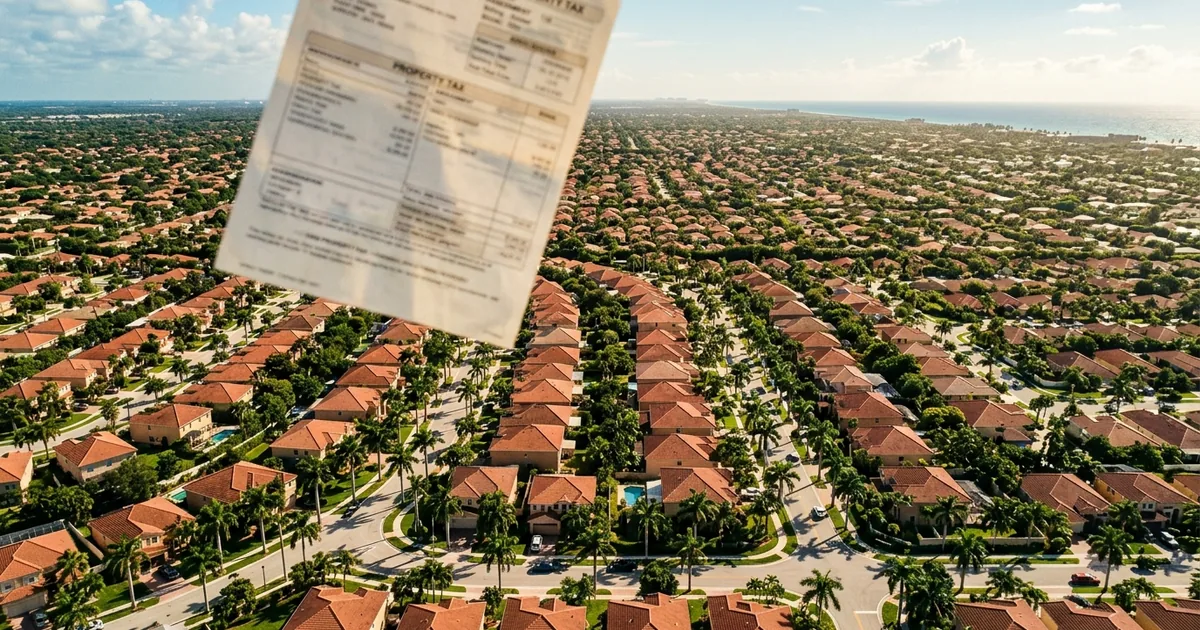
Governor Ron DeSantis has called the Florida Legislature into special session this week to consider what he is branding the “Save Our Homes” plan, a constitutional amendment that would phase out homestead property taxes for most Florida homeowners by 2028. The proposal has obvious political appeal: who does not want to stop paying property taxes? The problem is that the economics of eliminating property taxes in the third most populous state in the country are significantly more complicated than the press release suggests.
What the Plan Actually Proposes
The “Save Our Homes” framework, unveiled by DeSantis on May 27, would create a new homestead exemption of $150,000 starting in 2027, rising to $250,000 in 2028 and adjusted annually for inflation. At the $250,000 level, the governor’s office estimates that 60 percent of Florida homeowners would pay zero property taxes. Raising the ceiling to $500,000 in future years would cover 92 percent of homesteaded residences.
The plan also includes a provision requiring local governments to spend remaining property tax revenue exclusively on “core public needs,” defined as public safety, education, infrastructure, and natural resources. Businesses would get separate protections in the form of limits on future property tax assessments.
There is a significant residency gate, though, that has received less attention. Anyone who establishes Florida residency after January 1, 2027 would need to maintain that residency for up to five years before qualifying for the increased exemption. That is an unusual provision that appears designed to prevent a rush of new residents from immediately claiming the benefit, but it also creates a two-tier system where longtime Floridians receive a tax advantage that newcomers cannot access for half a decade.
The Funding Gap Nobody Wants to Talk About
Here is the part of the conversation that gets uncomfortable. Property taxes in Florida fund schools, fire departments, law enforcement, road maintenance, water systems, and dozens of other services that residents depend on daily. The total property tax revenue collected by Florida’s local governments exceeds $40 billion annually. Eliminating a significant portion of that revenue base requires either replacing it with another source or cutting the services it funds.
DeSantis has not clearly articulated where the replacement revenue comes from. The “core services” restriction on remaining tax dollars sounds responsible, but it functions as a mandate on local governments to maintain services with dramatically less money. Florida already has no state income tax, which limits the available levers for generating replacement revenue without fundamentally changing the state’s tax structure.
Local government advocates have warned that the proposal would make Florida “more unaffordable” by forcing cuts to services that residents rely on, particularly in areas like fire rescue, emergency medical services, and infrastructure maintenance. The irony is thick: a proposal marketed as making homeownership more affordable could degrade the public services that make communities livable.
The Political Math Is as Important as the Fiscal Math
The constitutional amendment pathway requires 60 percent support in both legislative chambers and 60 percent voter approval in a November referendum. That is a high bar, but property tax elimination polls extremely well with Florida voters regardless of party affiliation. Homeowners like paying less in taxes. That is not a partisan insight.
What makes this politically interesting is the timing. DeSantis is positioning himself for life after the governor’s mansion, and a signature achievement of “eliminated property taxes for most Floridians” is the kind of legacy item that plays well on a national stage. Whether the policy actually works as advertised is a separate question from whether it advances his political trajectory, and the special session format, with its compressed timeline and reduced opportunity for detailed fiscal analysis, is designed to move fast.
The Florida Realtors association has already begun tracking the legislation, recognizing that the proposal could dramatically reshape the state’s real estate market. Eliminating property taxes would make Florida even more attractive to retirees and remote workers, potentially driving home prices higher through increased demand, which would partially offset the savings for buyers who end up paying more for the house itself.
What to Watch This Week
The special session is expected to move quickly, and the political dynamics favor passage at the legislative level. The more consequential fight will be the November ballot measure, where opponents will have months to make the case that gutting local government revenue creates risks that voters should weigh against the appeal of a smaller tax bill.
The fundamental question is whether Florida’s government can maintain the public services that make the state functional while eliminating one of its primary revenue streams. DeSantis says yes. Local government leaders, fiscal analysts, and the people who run fire departments and school districts are considerably less certain. And the residents who will vote on this in November deserve a clearer answer than either side has provided so far.