
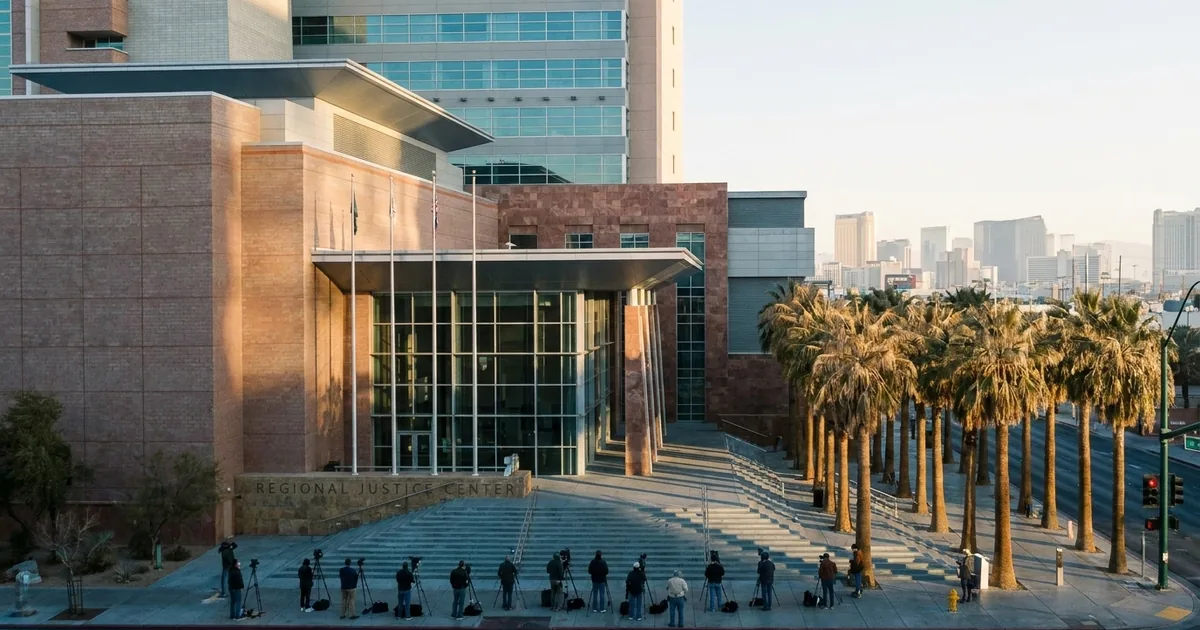
For twenty-seven years the killing of Tupac Shakur sat unsolved in Las Vegas, and the reason was never that nobody knew what happened.
It was that the man prosecutors say organized it kept telling the story in public, on television and in a book with his name on the cover, and for most of those years nobody in Nevada treated a confession sold as entertainment as evidence.
They are treating it that way now. Duane “Keffe D” Davis, 63, went on trial in Clark County District Court this month on a single count of murder with a deadly weapon, with a gang enhancement attached. Prosecutors are not claiming he pulled the trigger. They are claiming he organized the drive-by, and their strongest witness against him is the version he published himself.
What the State Is Actually Alleging
The charge is narrower than the headline suggests, and the distinction matters to a jury. As NBC News laid out when the trial opened, the state’s theory is that Davis obtained a gun and directed the shooting from a white Cadillac in retaliation for a beating his nephew, Orlando Anderson, had taken in the MGM Grand lobby earlier that night, minutes after Mike Tyson knocked out Bruce Seldon. Shakur was hit four times at Flamingo Road and Koval Lane and died six days later, on September 13, 1996.
Twelve jurors and four alternates were seated on August 13 after a selection process CNN described as the hardest part of assembling this trial, in a city where nearly everyone has an opinion about the case. Davis has been jailed since late 2023 and has pleaded not guilty. Proceedings are expected to run about a month.
The structural reason this took three decades is not forensic. It is that the case was always going to depend on Davis’s own words, and those words came wrapped in a commercial motive his lawyers can now use. Davis appeared in the BET docuseries “Death Row Chronicles” in 2018 and published a memoir, “Compton Street Legend,” in February 2019, opening with a play-by-play of that night. CNN put the problem precisely: he is both the defendant and the state’s key witness. District Judge Carli Kierny ruled in June that the memoir comes in as evidence. The defense answer has been consistent since 2023, and it is not subtle: he made it up to sell books.
Day One Was a Bike Cop and a Missing License Plate
The state did not open with the confession. It opened with the mundane, which is usually a sign the prosecution intends to build the night minute by minute before it gets anywhere near a motive.
Garry Dale told jurors he had spent 25 years at the Las Vegas Metropolitan Police Department starting in 1983 and was working the bike team on September 7, 1996. He testified that he pulled over a black BMW that evening because it had no visible license plate, and that the men inside identified themselves as Tupac Shakur and Suge Knight. That is a traffic stop nobody wrote up as significant at the time, and it is now sworn testimony placing both men in a specific car on a specific street hours before the shooting.
Jurors also heard from a woman who was in the vehicle directly ahead of Knight and Shakur when the shots were fired, and from James McDonald, who ran security at Club 662, the venue Shakur never reached. CNN’s live coverage of the first day of testimony captured the shape of it: geography, sequence, who was where.
Day Two Was a Body Bag
The second day went where these trials always go, and the Shakur family had to decide in real time whether to watch. PBS NewsHour reported that Dr. Lisa Gavin, a Clark County forensic pathologist, walked jurors through the wounds while photographs went up on the courtroom screens, beginning with a green body bag. Some family members left the room. Others stayed.
There is something worth sitting with in that image. Shakur has been an industry for three decades, a posthumous catalog and a documentary subject and a hologram and a merchandising line, and everyone in that room on Tuesday was looking at a coroner’s photograph of a 25-year-old who bled out from four gunshot wounds. The mythology and the autopsy are the same person, and courtrooms are one of the few places that collapse the distance.
What a Verdict Would and Would Not Settle
The trial will probably not answer the question people actually want answered. The Las Vegas Review-Journal has been clear that prosecutors are not attempting to identify the shooter, only to prove that Davis directed it. A conviction establishes orchestration and gang purpose. It does not put a name on the trigger, and the man most often named, Orlando Anderson, was himself shot dead in 1998.
That is a strange kind of resolution, and it is worth being honest that hip-hop’s oldest open case is arriving in court at a moment when the genre’s relationship to the legal system has been rewritten from a different direction entirely, through federal prosecutions of living executives rather than cold cases from the Death Row era, as the Sean Combs verdict last summer made plain.
A jury will decide whether a man’s own published account of a murder can convict him of it. Whatever it decides, the answer will be about what Davis said, not about what anyone finally proved from the physical evidence. That is not how most murder cases are supposed to work, and after thirty years, it may be the only way this one ever could.