
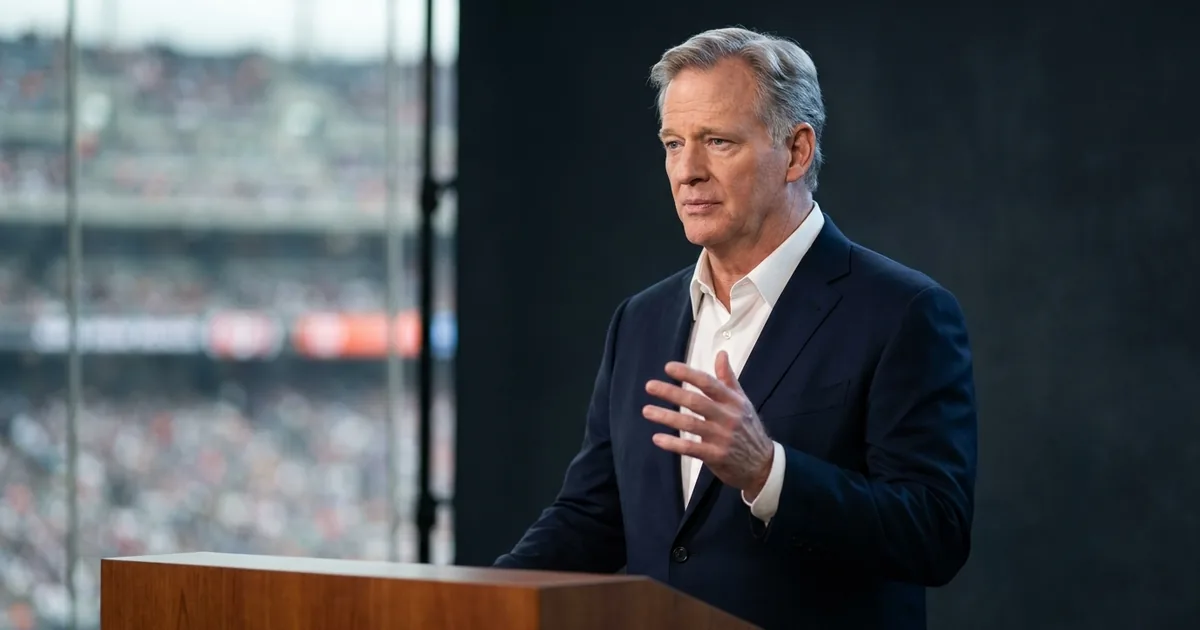
Roger Goodell told a German broadcaster this week that he has no doubt the NFL will one day have franchises based outside the United States, and the quote traveled fast because it is the kind of thing commissioners usually hedge. What almost nobody picked up is the word he used. He said teams, plural, and he did not say expansion.
Those are two very different futures, and the difference decides whether a city in Ohio or Louisiana wakes up in ten years without a football team.
What He Actually Said
The remarks came in an interview with RTL and ntv alongside former NFL defensive lineman Markus Kuhn, and the league published them on its own site. “At some point, there will be NFL teams outside the USA,” Goodell said, per the NFL’s own account of the interview. “I have no doubt that this will happen one day.”
He added a sequencing detail that got less attention and matters more. Asked about staging a Super Bowl abroad, ESPN reported he said the league would want a permanently based international team in that city first. So the order of operations is a franchise, then the championship. Not a showcase game that grows into something. A team that lives there.
The groundwork is already visible on the schedule:
- Nine regular-season games are being played outside the United States this season.
- Week 1 opens in Melbourne, with the Rams and 49ers playing the league’s first game in Australia.
- Host cities this year include Melbourne, Paris and Mexico City, alongside the established European stops.
- Owners voted this year to allow as many as 10 international games per season starting in 2027, up from eight.
That is not a marketing experiment anymore. That is roughly one out of every thirty regular-season games leaving the country, with the ceiling rising.
Expansion Costs Owners Money. Relocation Does Not.
Here is the part the commissioner left for everyone else to work out, and it is straightforward once you look at how the league’s money is divided.
The NFL’s national media contracts are split evenly among its 32 clubs. Add a 33rd and a 34th, and every existing owner’s slice gets smaller in perpetuity, unless the expansion fees and the new market’s incremental revenue more than cover the dilution forever. That is a genuinely hard case to make, and it is a large part of why the league has not added a franchise since the Houston Texans began play in 2002. Twenty-four years of “eventually” and no new teams.
Move an existing franchise to London or Frankfurt or Mexico City, though, and the arithmetic inverts. The number of shares stays at 32. The pie gets bigger, because you have swapped a mid-size domestic market for a country. Nobody’s slice shrinks. That is our read rather than league policy, and Goodell said nothing to confirm it, but he also did not say the word expansion when he had an obvious opening to, and commissioners choose those words on purpose.
UPI framed the comments as the league putting a foreign-based team ahead of a foreign Super Bowl, which is right as far as it goes. Newsweek went further and read the plural as a signal that more than one franchise is in play. Neither addressed the obvious follow-up, which is the only question that matters to any fan reading this in a smaller American market: if these are not new teams, they are somebody’s current team.
The Part Fans Should Actually Be Asking About
The NFL has spent fifteen years teaching Americans to treat this as a growth story, and for the league it is one. Football is nowhere near saturated in Europe, Latin America or the Pacific, and the media rights attached to a genuinely global sport are worth more than the rights to a domestic one. None of that is cynical. It is just true.
But relocation in this league has never been a negotiation with a city. It has been an announcement delivered to one. Ask St. Louis, Oakland or San Diego how much warning arrived before the moving trucks, and how much of the public money that built those stadiums came back. Stretch that same playbook across an ocean and the leverage gets worse, not better: a franchise that can credibly threaten to move to a market of 60 million people has an argument no city council can answer.
Goodell was asked about growth and gave an answer about growth. The honest version of his answer has a second half, and it goes to a city that does not know yet that it is the one being talked about.