
Croatian police detained a Ukrainian man in the Adriatic port of Pula on Wednesday on a German warrant accusing him of helping plant the explosives that tore open the Nord Stream pipelines in 2022.
He is the same man a Polish court examined ten months ago, concluded had committed no crime worth extraditing him for, and released.
That second fact is the actual story here, and almost every wire report is burying it under the arrest. Two European Union member states have now looked at one man and one act and reached opposite conclusions about whether a crime happened at all. Croatia has been handed the tiebreaker.
The Man Poland Decided Not to Hand Over
German federal prosecutors identify him only as Vladimir Z., following the country’s convention of withholding a suspect’s full name. Polish authorities were less restrained when they had him: they named him as Volodymyr Zhuravlov, and Meduza reports he worked as a diving instructor. Prosecutors in Karlsruhe describe him as a trained diver who, in their phrasing, participated in the necessary dives, one member of a team that fixed explosive charges to the Nord Stream 1 and Nord Stream 2 lines on the Baltic seabed.
Poland picked him up near Warsaw on September 30, 2025, on that same European warrant. Seventeen days later the Warsaw District Court refused to send him to Germany and ordered him released on the spot, as PBS NewsHour reported. Judge Dariusz Lubowski did not hedge. He held that the pipeline attack was military action in a just war, which meant no criminal responsibility attached to it, and he questioned whether Germany had jurisdiction at all given that the explosions happened in international waters rather than on German territory.
Prime Minister Donald Tusk welcomed the ruling and declared the case closed. He had already framed the argument in terms that left no room for German sensitivities.
The problem of Europe, the problem of Ukraine, the problem of Lithuania and Poland is not that Nord Stream 2 was blown up, but that it was built.
Zhuravlov walked out of Polish custody a free man. He has denied involvement throughout, saying he was in Ukraine when the pipelines blew.
Two Courts, One Seabed, Opposite Answers
The European Arrest Warrant is built on mutual recognition. One member state issues a warrant, another executes it, and the executing country is not supposed to relitigate whether the underlying conduct was really criminal. The whole mechanism runs on an assumption that the twenty-seven broadly agree on what counts as a crime.
Nord Stream is where that assumption came apart. Germany treats the explosions as an attack on its own critical energy infrastructure, prosecutable because the pipelines make landfall on German territory. Poland treats the same explosions as a legitimate blow against the revenue engine of a state currently shelling its neighbor. Both positions are internally coherent. That is precisely the problem, and it is why the case has become something larger than one diver’s legal exposure.
Poland’s reading is not eccentric within its own security context, either. This is a country that spent July dealing with a Russian missile crater on its own soil and reaching for NATO’s Article 4. A judiciary operating in that atmosphere was never going to view a pipeline full of Russian gas as neutral civilian property.
Croatia now has to pick a lane, and whichever way Zagreb goes, one of two EU legal systems gets overruled in practice.
What Actually Happened Under the Baltic
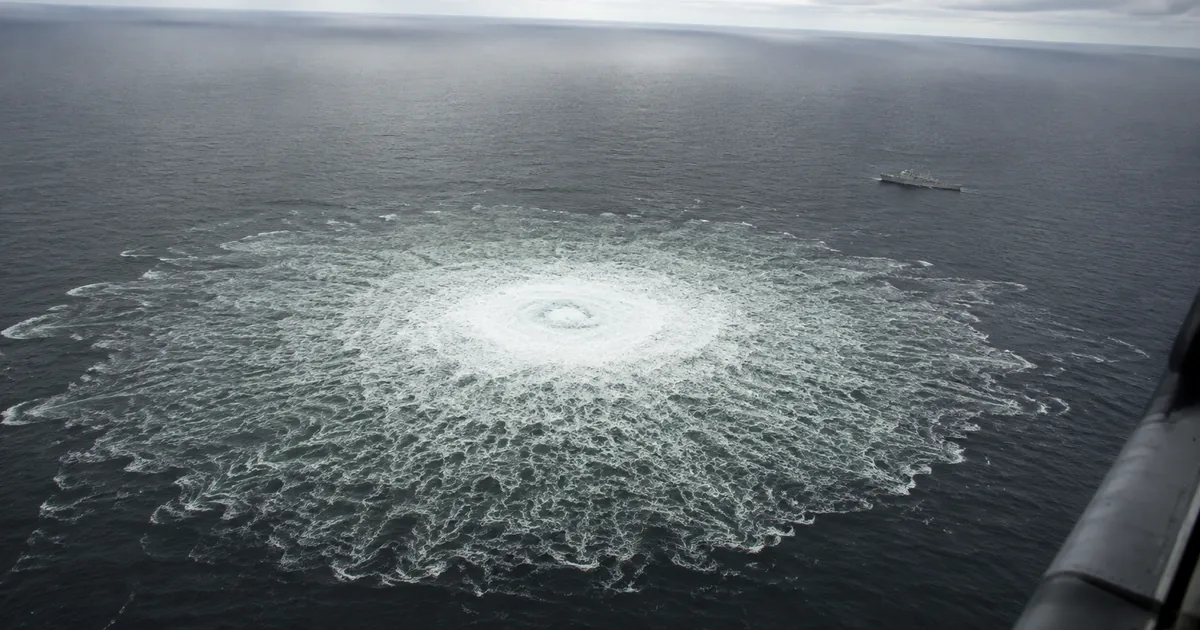
The blasts hit on September 26, 2022, in the Baltic Sea near the Danish island of Bornholm, and they left three of the four pipeline strings permanently inoperable. Danish and Swedish authorities recorded the ruptures as deliberate explosions within days. The sea above the largest breach churned in a circle more than a kilometer across as methane boiled to the surface, an image captured by a Danish F-16 that became the defining photograph of the incident.
Worth remembering what the pipelines were actually doing at that point: nothing. Russia had already throttled Nord Stream 1 to zero, and Nord Stream 2 had never entered commercial service after Berlin froze its certification following the invasion. The sabotage destroyed an asset that had stopped delivering gas, which is part of why the German case leans on constitutional and infrastructure-protection statutes rather than on economic damage to consumers.
The Trial Already Waiting in Hamburg
Wednesday’s arrest is not happening in isolation. It lands seven weeks after German Prosecutor General Jens Rommel filed the first charges anyone has brought over Nord Stream, against another Ukrainian, Serhii Kuznietsov, as Al Jazeera reported at the start of July. Kuznietsov, a former Ukrainian army officer, is accused of leading the operation and commanding the yacht Andromeda that carried the dive team. He was arrested in Italy in the summer of 2025, and Italian courts cleared his extradition that November. He sits in custody in Hamburg awaiting trial, denying he was anywhere near the Baltic.
His defense is the argument that matters for everyone else charged in this case. Kuznietsov says he was a serving member of Ukraine’s armed forces, which would give him functional immunity for acts carried out as a soldier. German judges have rejected it, holding that the pipelines were not legitimate military targets and that combatant immunity does not extend to covert operations conducted by personnel indistinguishable from civilians. Prosecutors go further and allege he acted on behalf of Ukrainian authorities, a claim Kyiv has not accepted. Ukraine’s Prosecutor General’s Office has not established any state involvement, and President Volodymyr Zelensky said in July that it was too early to respond to charges whose details he had not seen. Our coverage of Germany’s decision to charge a Ukrainian over the pipeline attack laid out how novel that prosecution was when it landed.
Zhuravlov faces a narrower but still serious set of counts if Croatia sends him north. The Kyiv Independent lists them as jointly causing an explosion, anti-constitutional sabotage, and destruction of buildings. After extradition he would be brought before an investigating judge at Germany’s Federal Court of Justice.
Kuznietsov’s lawyer has said the case will keep affecting Ukraine’s relations with European countries for a long time, which is the most accurate assessment anyone directly involved has offered.
Berlin Is Paying a Political Price to Run This Case
Here is what makes the German position genuinely difficult rather than simply legalistic. Germany is among Ukraine’s largest financial and military backers. It is also now the country putting Ukrainian veterans on trial for an operation that damaged Russian export infrastructure, and it is doing so in an environment where the far-right Alternative für Deutschland is hunting for exactly this kind of material. Thomas Laffitte of the Brussels Institute for Geopolitics expects the AfD to work the case hard against the government, though he notes German public support for Ukraine has held up well enough to limit the damage.
The reparations chatter is the piece to watch. Some German politicians have already floated the idea that Ukraine should pay for the pipelines, and Ukrainian officials worry that a conviction becomes a legal hook for claims against the frozen Russian assets Europe has been slowly maneuvering toward using for Ukraine’s benefit. A criminal verdict in Hamburg could end up doing real work in a completely different fight over money.
None of that is a reason to abandon a prosecution. A state that lets its own critical infrastructure be blown up without investigating has a rule-of-law problem, and German prosecutors are entitled to follow the evidence where it goes. But it is worth being honest that the institutional machinery here was designed for a Europe where member states agreed on who the criminals were, and it is now being asked to process a case where they emphatically do not.
Croatia’s courts will decide in the coming weeks whether Zhuravlov boards a plane to Karlsruhe or walks out of a courtroom in Pula the way he walked out of one in Poland. Either outcome tells you something uncomfortable about how much the European legal order actually agrees on. The question nobody in Brussels seems eager to answer out loud is what the arrest warrant system is for, if the same warrant produces a prison cell in one capital and a shrug in another.