
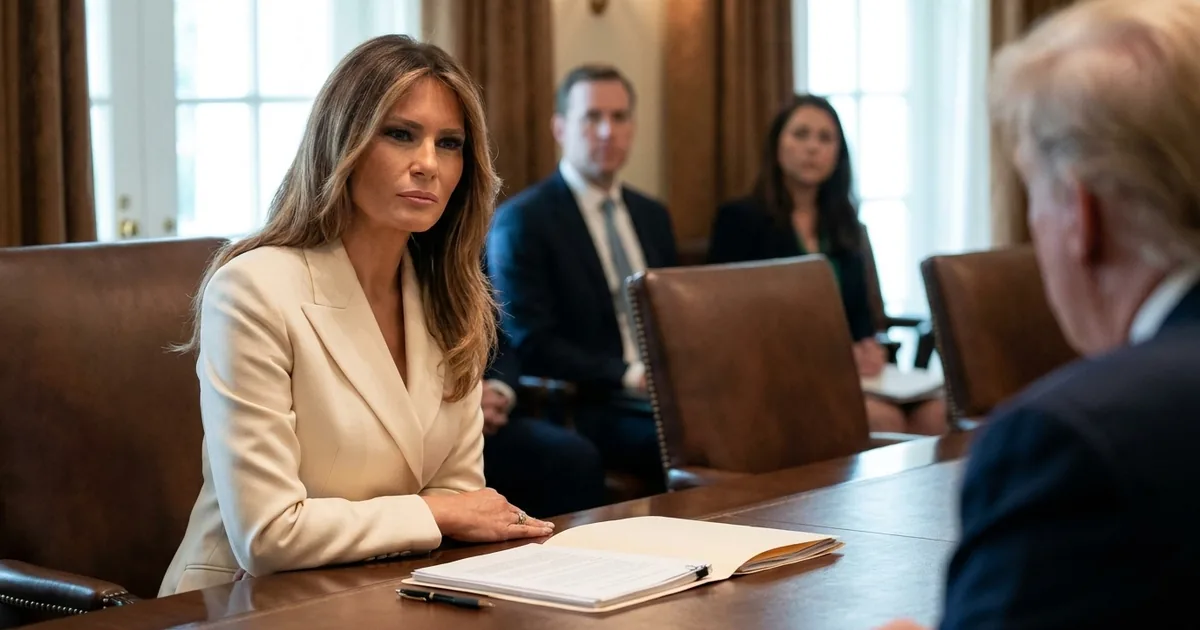
Melania Trump has appeared in public on 38 days so far in 2026, roughly once every six days, and has not been seen at all since the World Cup final on July 19.
That is the least visible any modern first lady has been, and it turns out to be a deliberate trade rather than an absence.
The easy story here is the one that writes itself every few weeks: where is she. Tabloids have run the counter on her disappearances, Newsweek marked a 25-day stretch earlier this year, and the ribbon-cuttings and hospital visits that fill a normal first lady’s calendar are largely missing from hers. NBC News reported that she has done about half as many public events as she had by this point in her husband’s first term.
The harder and more interesting story, which CNN reported on Thursday, is what she has been doing with the time she is not spending on camera. It is substantially more than Be Best ever amounted to, and it is worth taking seriously even if you find the rest of this administration indefensible.
The Part of the Job She Kept
Every first lady inherits two jobs bolted together. One is ceremonial: the state dinners, the school visits, the standing-behind-the-podium. The other is soft-power advocacy, where a spouse with no electoral mandate and no confirmation hearing can nonetheless move an agency, a budget line, or a bill. Most first ladies do the first job fully and the second job partially. Melania Trump has inverted it.
The output, as her office and the Administration for Children and Families have documented it, is not nothing:
- A Fostering the Future executive order, signed last November, that pushed state child-welfare agencies toward standardized data tracking on outcomes for foster youth.
- Fostering the Future Accounts, IRA-style savings and investment vehicles for children in foster care, launched in June alongside Treasury Secretary Scott Bessent.
- A $25 million line in the fiscal 2026 budget for housing and support aimed at young people aging out of the system.
- A push at the state level against what the administration calls the orphan tax, the stack of benefit and asset rules that can penalize foster youth for saving money or inheriting anything.
- Direct lobbying on Capitol Hill, where her team has worked with members on housing, education, and job-training programs for youth who have aged out.
Foster care is also about the only domain in American politics right now where a Trump initiative draws something other than reflexive opposition. Roughly 350,000 children are in the system nationally, the outcomes for those who age out without a permanent placement are genuinely dire, and the constituency has no lobby. Child-welfare advocates who would not be caught endorsing this White House on anything else have engaged with the data-tracking piece, because standardized outcome data is the precondition for knowing whether any of this works.
Where the Skepticism Belongs
None of that means the ledger balances. A few things deserve to be said out loud.
The savings-account program is the piece most likely to be oversold. IRA-style accounts are a real benefit for a young person who ages out with a job and a stable address, and close to meaningless for one who ages out into a shelter. Asset-building instruments help people who have assets to build. The $25 million for transitional housing is the line item that addresses the more urgent problem, and $25 million spread across a national population is a pilot, not a solution.
There is also the structural question that applies to every first lady and gets asked seriously about almost none of them. An unelected spouse directing federal agency priorities and lobbying Congress is a real exercise of power that sits outside every accountability mechanism the system has. That was true of Eleanor Roosevelt’s work and Hillary Clinton’s health-care task force, and the objection was more often raised in bad faith than in good. It is still a legitimate structural concern, and the fact that this particular agenda is comparatively benign does not resolve it.
And the invisibility itself is not free. A first lady who does not appear in public also does not answer questions in public. The 38-day count is usually reported as a gossip item, but it is also a description of a person who has largely opted out of scrutiny while accumulating influence. We covered her rare appearance before the UN Security Council in March, and the ratio of policy output to public accountability has only widened since.
The Comparison Nobody Is Making
Be Best, the first-term anti-cyberbullying initiative, was widely treated as a punchline, and it mostly earned that. It had no legislative vehicle, no budget line, and no measurable output. The gap between that and a signed executive order with an agency implementation timeline is the actual story of her second term, and it is being buried under headlines counting the days since anyone photographed her.
That undercovering is partly her own doing. She has built a model where the work happens and the person does not surface to defend it, which means the work gets attributed to the White House generally rather than to her, and the coverage defaults to the absence. When the press did try to make the free-speech fight over a late-night joke at her expense into a story about her, the substance was somewhere else entirely.
Whether the foster-care agenda survives contact with the next budget is the open question. Executive orders are reversible, pilot appropriations expire, and the data-tracking requirement only matters if someone reads the data. But the reflex to treat this first lady as a purely decorative figure who has stopped showing up for work is a bad read of what has actually happened, and the people it most misserves are the ones aging out of the system in a few months.