
Canada is done with the idiocy of the Trump regime and their use of tariffs as a weapon of economic warfare.
It suspended the negotiations Saturday morning, recalled its officials to Ottawa, and let a 50% tariff wall come down at midnight rather than sign terms Washington had rewritten hours before the deadline.
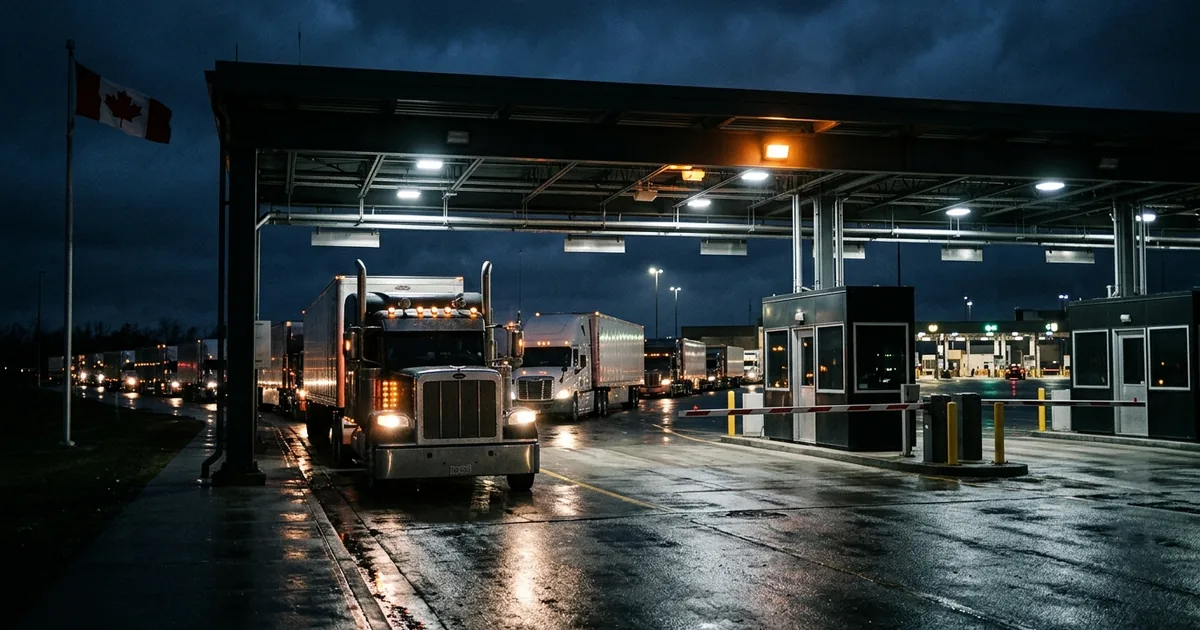
The distinction matters more than the headlines suggest. Goods are still crossing the border this morning. Trucks are still queued at Windsor. What stopped is the process by which the two governments were supposed to end the tariffs, and Prime Minister Mark Carney’s own explanation for stopping it is the most consequential sentence any G7 leader has said about the United States this year.
Last-minute changes in the American terms, he said in a statement issued minutes before the deadline, “were unfair, uneconomic, and called into question the reliability of any deal.”
Not the fairness of this deal. The reliability of any deal.
What Actually Took Effect at Midnight
The tariffs that landed are 50% duties on Canadian goods, and the two governments cannot agree on how much trade they cover. Carney’s statement puts the figure near $28 billion. The Office of the United States Trade Representative says roughly $20 billion. Nobody has reconciled the gap, which tells you something about how much shared ground was left by Friday.
The affected list is stranger than a trade war usually produces: hockey sticks, building materials, liquor, certain categories of clothing. NBC News reported that the duties took hold at the stroke of midnight while Carney’s negotiators were already booked home. Canada has said it will match the tariffs dollar for dollar.
Three days earlier, the same tariffs had been paused by Trump, who announced on social media that the two countries had reached a deal, subject to final documentation. The documentation is where it died.
The Law Nobody Had Ever Used
Here is the part almost no coverage of Friday night has mentioned, and it is the part that explains the rest.
These are not the steel and aluminum tariffs. They are not the emergency tariffs the Supreme Court struck down in February, which took the International Emergency Economic Powers Act off the board as a tariff instrument. They rest on Section 338 of the Tariff Act of 1930, a provision that allows the president to impose duties of up to 50% on any country he finds to be discriminating against American commerce, and which had never once been used to impose a tariff in the 96 years it has been on the books.
Trump signed three Section 338 proclamations on July 20, each naming a specific Canadian practice as the discrimination in question:
- Canada’s 25% surtax on American vehicles
- Provincial bans on American alcohol sales
- Dairy tariff-rate quota rules that favor European suppliers over American ones
We covered the proclamations and the product lists when they landed in July. What has become clear since is the choice the statute represents. Section 338 requires no International Trade Commission investigation, no agency finding, no comment period. It requires a presidential determination and a signature. When the Supreme Court closed the emergency-powers door, the administration went looking through the statute books and found a 1930 law that opens with a lock nobody had ever tested.
That is the real content of Friday night. Canada was not asked to negotiate against a tariff. It was asked to negotiate against an instrument that can be re-aimed by proclamation, at any target, on any finding, without a hearing.
Why a Rational Government Walks Away
The standard read on Friday is that Canada overplayed a weak hand. American officials have pushed that version hard. Trade Representative Jamieson Greer said Canada declined to finalize a deal agreed earlier in the week, and that new Canadian demands upended a careful balance. A senior administration official told reporters Canada wanted concessions on steel, aluminum, autos and lumber that Washington would not give.
Take that account at face value and Carney’s decision still makes sense, because of something that happened on July 1 and had nothing to do with hockey sticks.
That day the USMCA Free Trade Commission held the six-year joint review written into Article 34.7 of the agreement, and the United States declined to confirm that it would extend the pact for the further 16 years the text contemplates. The agreement did not die. Something subtler happened to it. Instead of a horizon running to 2042, North American trade now runs on an annual review that has to be won again every year until the parties agree to extend or the whole thing expires in 2036. CSIS has been tracking what that conversion does to the continent’s commercial planning.
Stack the two facts. The legal instrument can be swapped for another statute whenever a court closes one off. The treaty framework now expires annually unless renewed. Under those conditions, what exactly does a signature buy? A country that signs a deal in August under a law that has never been litigated, inside a treaty that has to be re-won next July, has purchased roughly eleven months of quiet at the cost of conceding the point permanently.
Carney’s sentence about reliability was not a rhetorical flourish. It was a valuation.
The Sentence Carney Went Back To
On Saturday he stopped being careful. Speaking to reporters after the talks collapsed, Carney reached past the language of trade policy and picked up a line he had used repeatedly during last year’s federal election campaign, the one that helped win it.
“Last spring, I warned that America is trying to break us so that they can own us.”
Prime Minister Mark Carney, August 22, 2026
Read that at face value, because he meant it at face value. A sitting G7 head of government said in public that the objective of American trade policy toward his country is not a better dairy quota. It is acquisition. He called the new tariffs “designed to hurt and divide us” and, in the same breath, “a miscalculation,” which is the more interesting word of the two. A miscalculation implies someone expected Canada to fold and was wrong about it.
He also put numbers behind the retaliation. As CBC reported from the Saturday remarks, the matching duties are dollar for dollar and reach dairy, steel, appliances, pulp and paper, and electronics. CNN’s account of the same day has Carney describing an American side that asked too much and offered too little, which is the polite translation of the quote above.
This is where the annexation talk of the past two years stops being a rhetorical sideshow and starts doing work in the file. If you believe the goal is a trade concession, you hold out for a better price. If you believe the goal is ownership, the price is not the variable, and every month you spend at the table is a month spent conceding that the other party is negotiating in good faith. Carney has now said in public which of those two things he thinks is happening.
The Diversification Is Not a Bluff Anymore
Canadian governments have promised to reduce dependence on the American market after every trade shock since the softwood lumber disputes of the 1980s, and they have never done it, because the geography always won.
This time there is a ledger. Carney’s statement points to nearly $25 billion in support already extended to affected workers and businesses, more coming, and a target of doubling Canada’s market access to 1.5 billion consumers by the end of the year. The trade agreement Ottawa struck with Beijing in January was the first serious move in that direction, and it drew far less attention in Washington than it deserved.
Whether Canada follows through is a real question. But American leverage over Canada has always rested on the assumption that there is nowhere else to go, and that assumption is now being tested by a government that has run the numbers on staying.
What Breaks Next
NPR reported that the collapse came minutes before the deadline, and The Hill noted that neither side has set a date to resume. There is no scheduled next round. There is a matching set of tariffs, a suspended process, and a statute heading for the Court of International Trade, where the questions waiting for Section 338 include whether a later trade law superseded it and whether the president can skip the investigation the statute’s own structure implies.
Litigation is the likeliest off-ramp, which is its own indictment. The tariff policy of the world’s largest economy toward its closest neighbor now depends on how a trade court reads a Depression-era provision that sat untouched through the entire postwar trading system.
Somebody in Ottawa did the arithmetic on that and decided the deal on the table was not worth the paper it would have been reopened on.