
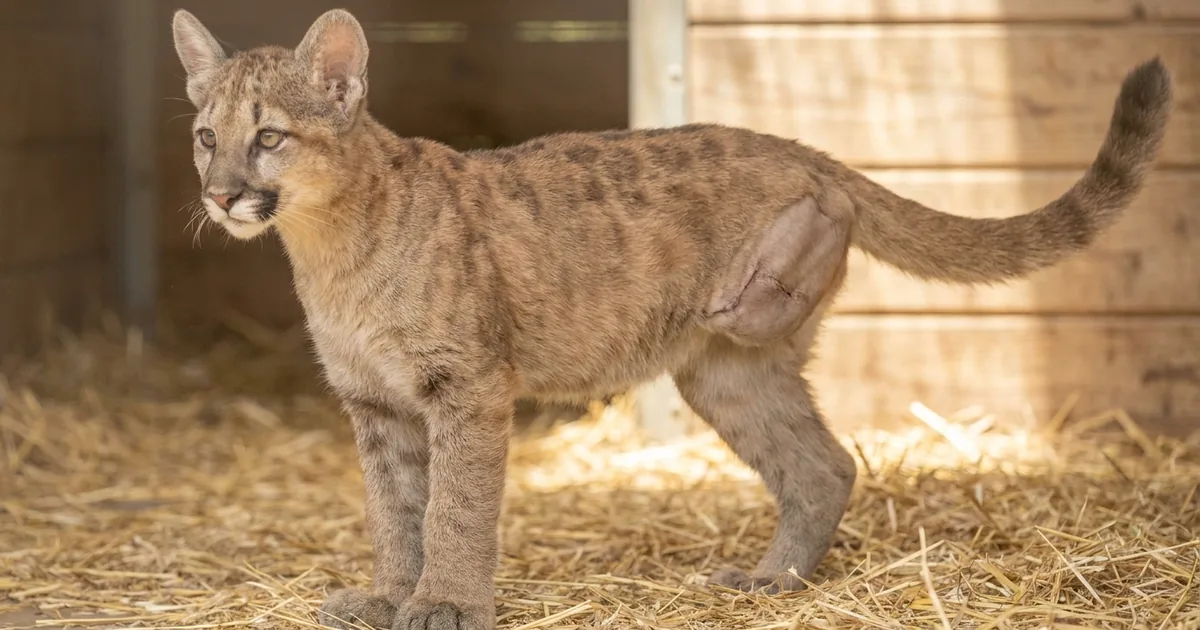
A mountain lion kitten who became an internet fixture this spring for his blue eyes and his three-and-a-half working paws had one of his hind legs amputated this month, and the zoo says he was back to being an obnoxious adolescent cat within days.
The part of the story that gets shared is the recovery. The part worth sitting with is that Oakland Zoo has a number for how many cubs like him it has taken in, and the number is 33.
Three Weeks Old, Missing His Toes
Crimson was pulled from a den in Southern California on March 25, roughly three weeks into his life. The National Park Service and the California Department of Fish and Wildlife brought him to the Los Angeles Zoo first, then a volunteer animal-transport flight moved him north. Oakland Zoo’s account of its 33rd mountain lion rescue records him as being in good health apart from one detail: the toes on one hind foot were gone, an injury that had happened in the wild.
Wildlife officials could not say for certain what caused it. Fish and Wildlife raised umbilical cord strangulation as a possibility. The zoo floated a bleaker explanation, that the abnormal limb itself may have triggered the mother’s instinct to move on without him. Either way he was alone, and at three weeks a mountain lion cub alone is a mountain lion cub who dies.
He did not. He got bottle-fed every three hours by keepers, and then something else happened that nobody plans for: he went viral. CBS San Francisco covered the point at which the cub became a genuine online fixture, and the San Francisco Chronicle wrote up how the zoo’s cubs turned into online stars with millions of views and coverage in papers on both sides of the Atlantic.
The Surgery Nobody Wanted to Do
For months the plan was to keep the leg. Veterinary and animal care staff tried a sequence of bandages and braces, consulted specialists, and monitored how the limb developed as he grew. The problem was growth itself. A three-week-old cub who mostly sleeps is a manageable patient. A five-month-old cougar who climbs, pounces and objects to being handled is not, and the dressings stopped being able to protect an area he was determined to use.
In an update published on August 14, the zoo said the team had concluded that amputating the affected limb offered him the best chance at long-term comfort, mobility and healing. The surgery was performed by Dr. Kim Tong, a board-certified veterinary surgeon. According to the zoo, Crimson was back to curious, energetic cub behavior almost immediately, though he may end up with limits on climbing and top speed.
Cats handle three legs unusually well. What he will not do is go back to the Santa Monica Mountains. A cub orphaned that young and hand-raised by humans is not a release candidate under any circumstances, and an amputee certainly is not. The goal instead is a permanent placement, and eventually a companion: Clover, a female cub found alone on a roadside in El Dorado County, underweight and covered in ticks, who needed round-the-clock care and a blood transfusion from another rescued lion. SFist covered the arrival of the pair the zoo named Crimson and Clover. Popular Science put it more directly, describing two animals rescued from certain death.
Thirty-Three Is the Real Story
Here is the thing the cute-cub coverage tends to skip. Oakland Zoo did not build a mountain lion rescue capability because a cub turned up once. It built one through the Bay Area Cougar Action Team because California keeps producing orphans, from opposite ends of the state and for the same underlying reasons:
- The western Santa Monica Mountains, where Crimson came from, a population effectively marooned by freeways
- El Dorado County in the Sierra, where Clover was found on a roadside
- The Peninsula, where the zoo has taken in siblings orphaned at once
- Any place a female is killed by a vehicle, poisoned by rodenticide moving up the food chain, or forced to den somewhere she would not have chosen
Mountain lions in populated parts of California live on habitat islands separated by traffic. A female raising cubs on an island has fewer safe denning options, a shorter life expectancy and a much higher chance of leaving kittens behind. The rescue program is not a heartwarming eccentricity. It is a downstream service industry for a landscape decision, and the thirty-third case in a program is not a milestone, it is a trend line.
The Cuteness Is the Funding Model
None of this is a criticism of the zoo, which does the work and does it well. It is an observation about what gets paid for.
Conservation money follows attention, and attention follows faces. Crimson generated millions of views because he is a big-eyed kitten with a limp, and those views are worth real money to a rescue program that has to fund thirty-three of these. The same dynamic operates at the top end, where enormous commitments like the $200 million Phoenix Species Project backed by Leonardo DiCaprio and the Bezos Earth Fund are announced around charismatic species and finite pledge windows. It works, up to a point, and the point is that habitat connectivity does not photograph well and a wildlife crossing has no blue eyes.
Crimson will get a good life on three legs somewhere, probably with Clover, and that is a genuinely good outcome that a lot of skilled people worked hard for. The next cub is already coming. Nobody has posted about him yet.