
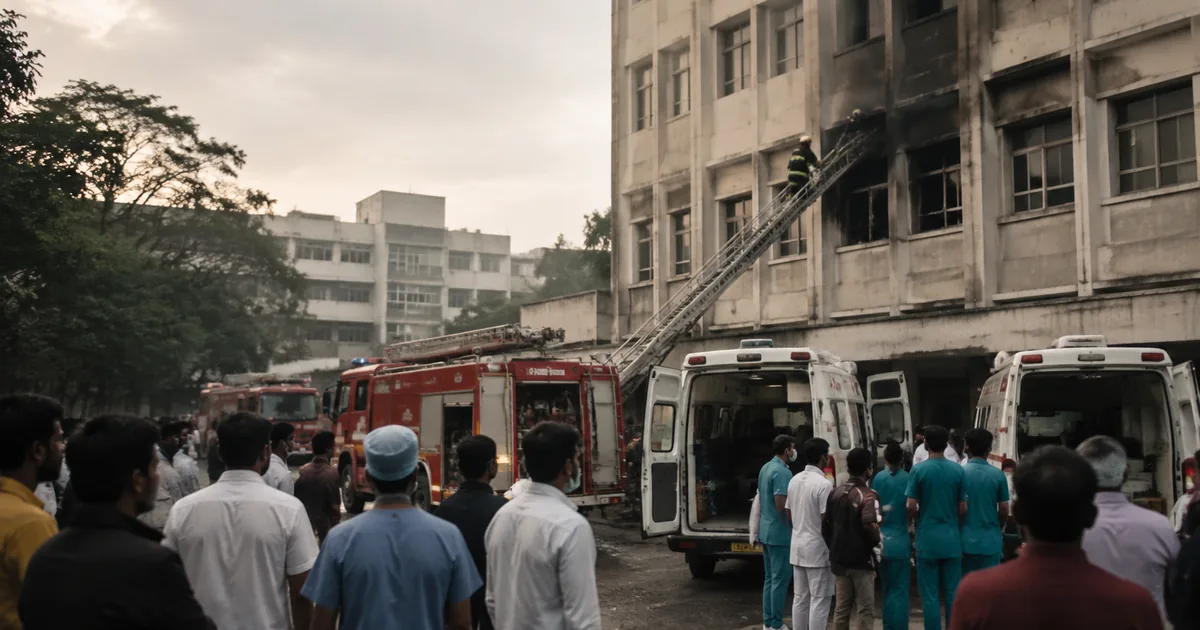
A fire that began in a nursery air conditioner killed 14 newborn babies on the third floor of Pakistan’s largest public hospital in Islamabad early Wednesday.
One infant came out alive, and by nightfall the state had removed its most senior health official and convened two separate inquiries, moving faster on blame than it ever moved on the building.
The blaze broke out around 6:45 a.m. local time inside the nursery of the Mother and Child Centre at the Pakistan Institute of Medical Sciences, the sprawling state-run complex known as PIMS that serves as the capital’s hospital of last resort for families who cannot pay for private care. Al Jazeera reported that the fire was contained to the third floor and extinguished within the morning. The babies inside it were not.
The One Ward You Cannot Evacuate
The detail that tells you the most about what went wrong is not the air conditioner. It is how the rescuers got in. The Associated Press reported that firefighters reached the nursery by putting ladders up the outside of the building and breaking the windows, then pulled a single baby out through the glass. Six fire engines and four ambulances responded, according to Arab News, and the fire never spread past the nursery. No adults were reported hurt.
Read that sequence again. The fire stayed in one room, the response arrived, the rest of the hospital was fine, and almost everyone in that room still died. A neonatal nursery is the single hardest space in any hospital to clear. The patients cannot walk, cannot be woken, cannot be told to crawl below the smoke, and many of them are tethered to incubators and ventilators that do not travel. A nurse can carry two. Smoke fills a closed ward in a couple of minutes. The only thing that saves that room is engineering installed long before anyone smells anything: detection that triggers early, compartmentation that holds the smoke, suppression that runs without a human deciding to start it. When the plan for a third-floor neonatal unit turns out to be a ladder and a broken window, the plan was already gone before the compressor blew.
Even the cause is contested. Rescue officials told local media that an air-conditioner compressor exploded inside the nursery. PIMS Executive Director Imran Sikandar attributed the blaze instead to an electric short circuit. Those are not the same failure, and the difference matters for who is answerable, which is presumably part of why both versions were in circulation within hours.
A Toll Still Being Counted
Federal Health Minister Mustafa Kamal put the number of dead at 14. Geo News reported 15, citing hospital sources, and NBC News carried the higher figure as it moved through Pakistani outlets. Accounts of how many infants were in the nursery when the fire started also differ between 15 and 16. One was rescued, by a doctor, and that is the only number nobody disputes.
By the time Arab News filed, nine bodies had been released to their families. Kamal said the immediate priority was supporting the parents and returning the infants. There is no version of this where the paperwork moves fast enough for the people in the corridor.
What Islamabad Already Knew
Here is the part that turns a tragedy into a policy failure. Months before this fire, Islamabad authorities surveyed roughly 6,500 buildings in the capital, including about 300 government facilities, and found that most of them lacked fire-safety approvals or certificates. Pakistani healthcare facilities are formally required to maintain fire-safety plans covering prevention, detection, suppression and evacuation. The survey establishes that the requirement and the reality had already come apart, in writing, in the same city, on the government’s own paper.
A survey is not a smoke detector. Identifying 300 uncertified public buildings and then funding nothing is a decision, not an oversight.
That is the structural why, and it is worth being precise about its limits: the published accounts of the survey do not single out PIMS, and nobody should claim they do. What they establish is the environment. A capital city took an inventory of its own fire-safety compliance, learned that most of the stock failed, and did not follow the inventory with money. Certification in that system is a document you either have or do not have, decoupled from whether anything in the building would actually contain a fire at 6:45 in the morning.
This is a familiar shape. In January, a fire at a Karachi shopping complex killed at least 65 people, in a country where building codes are widely treated as advisory. It is also the shape of disasters far outside Pakistan. Italy spent seven years getting to a verdict after the Morandi bridge came down, and LNC covered the Genoa collapse sentencing that finally arrived in July, where the core finding was that the risk had been documented by the people responsible for the structure well before it killed anyone. Documentation is not the scarce resource. Acting on documentation is.
It can go the other way. When engineers flagged structural risk at a Manhattan high-rise this summer, the response was evacuating the building rather than filing the finding. The difference is not that one country produces better inspectors. It is that somebody was compelled to act on the inspection.
Blame Moved in a Single Afternoon
Prime Minister Shehbaz Sharif ordered an immediate investigation and said those responsible should be identified and face the strictest possible action. His office called the loss of children irreparable. President Asif Ali Zardari called the deaths heartbreaking. Then the machinery started, quickly: Sharif ordered Health Secretary Aslam Ghauri, the health ministry’s most senior civil servant, removed from his post. A high-level inquiry committee was constituted under former interior secretary Shahid Khan. The Islamabad administration separately appointed a fact-finding committee and gave it 24 hours to report on the cause, the spread and the adequacy of both the fire-safety measures and the rescue.
Twenty-four hours is a realistic deadline for naming a compressor. It is not a deadline on which anyone retrofits a neonatal ward. That mismatch is the point. Sacking a secretary is same-day, costs nothing in the budget, and reads as decisive. Sprinklers, smoke compartmentation, fire doors that actually close, and drilled evacuation procedures across 300 uncertified public buildings are capital expenditure spread over years, with no ribbon to cut and no obvious moment where a politician gets credit. Personnel accountability keeps getting used as a substitute for the expenditure, and it keeps not working, because the next building does not care who was fired.
The families outside PIMS on Wednesday were waiting for bodies, not committees. The committee under the Islamabad administration is due to report by Thursday. The question worth tracking is not what it says about a compressor on the third floor. It is whether anyone asks the same question about the other 299 buildings the city already checked.