
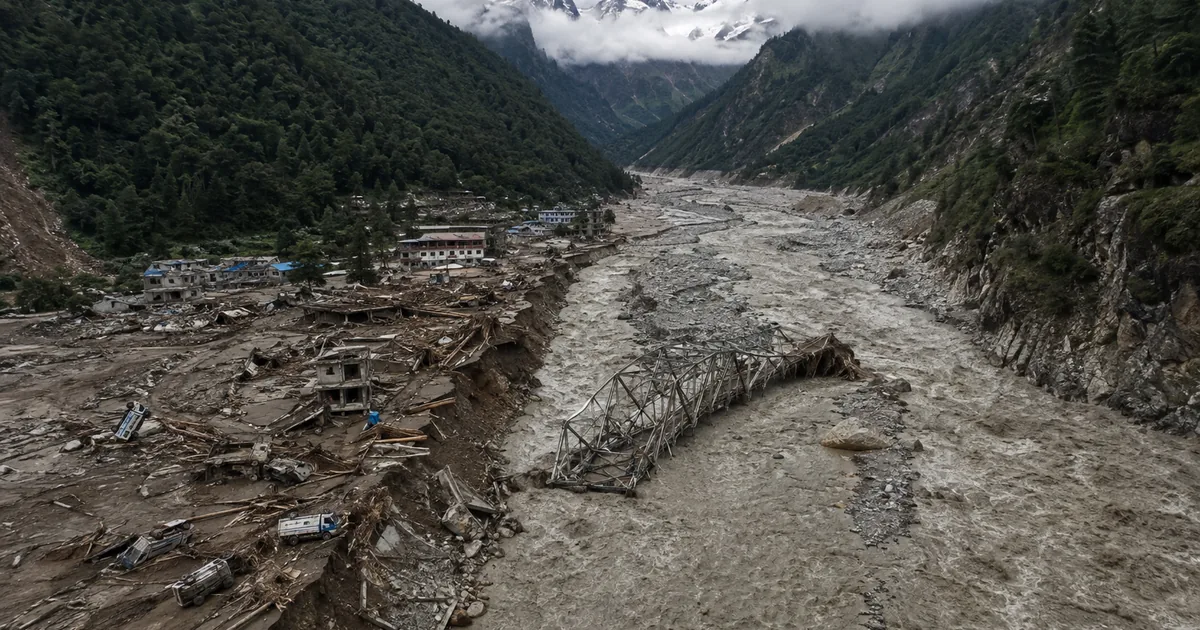
A wall of water came down the Bhote Koshi river in Nepal’s Rasuwa district at around nine in the morning on Wednesday, and by the afternoon police had counted at least 22 dead with 384 people on a missing list.
The last time this valley flooded, the trigger sat 35 kilometers inside Chinese territory, and Nepal built its entire response around watching that direction.
There had been no heavy rain. That detail is the first thing anyone standing in Timure would have noticed, and it is what separates this disaster from the monsoon events Nepal plans for every year. Scientists at the Kathmandu-based International Centre for Integrated Mountain Development traced the surge to an ice and rock avalanche off a glacier that dropped into the Lhende Khola, a small tributary of the Bhote Koshi, and dammed it. The blockage held, then it did not. What arrived downstream was not a river rising. It was a reservoir arriving all at once.
Al Jazeera reported that the water tore through Timure and Syapru Besi, two settlements in a district of roughly 50,000 people, and kept going into Nuwakot and Dhading. Rescue helicopters reached the area and could not put down. The Kathmandu Post found that the flood had destroyed the local helipad, and quoted the pilot Subash Khadka describing what he saw from the air: the entire village of Timure was out of sight.
What Came Down the Lhende Khola
The mechanism here matters more than the meteorology, because it is the part that can be watched.
A glacial outburst is not weather. It is a structure failing. Ice and rock come off a warming slope, land in a narrow channel, and hold back water until the pile gives way. The lag between the collapse and the flood can be minutes or it can be days, and during that window the hazard sits in one identifiable place, generating no signal anyone downstream can see. Research from the mountain development centre has found that ice loss across the Hindu Kush Himalaya has roughly doubled its rate since 2000, which means more of these piles, in more channels, more often.
Saswata Sanyal, a disaster risk reduction specialist at the centre, put the sequence plainly to the Associated Press, and his framing is the whole story compressed into two sentences.
The Lhende Khola has flooded twice in fourteen months, this time triggered by an ice rock avalanche from a glacier on the Nepal side that blocked the river and released a sudden surge downstream. In a warming Himalaya, early warning is the first line of adaptation.
Twice in fourteen months, in the same tributary. That is not a freak recurrence. That is a channel telling you what it is.
The Same River, Fourteen Months Apart
On July 8, 2025, a supraglacial lake burst high in the mountains inside Tibet, about 35 kilometers upstream of the Rasuwagadhi border crossing. The water came down the Bhote Koshi and took the Nepal-China Friendship Bridge with it, killing nine people and wrecking a dry port that was still under construction. Nepal’s most important overland trade link to China went down ahead of the festival season, and the stranded cargo alone ran to billions of rupees in electric vehicles, garments and electronics.
The response was diplomatic, and on its own terms it was sensible. By late August 2025, Nepal and China had agreed to share cross-border information on glacial lake outburst risk across the Tibetan plateau. If the danger originates in China and arrives in Nepal, an information channel across that border is exactly the instrument you want.
It was also an instrument pointed in one direction. The 2025 flood taught Nepal that the threat was upstream and foreign, and the institutional answer encoded that lesson. Fourteen months later the mountain that failed was on the Nepali side of the line, above a tributary inside Nepal’s own territory, and there was nothing between that slope and the villages except distance.
This is the part worth sitting with, because the failure mode shows up well beyond Nepal. An agreement is not a sensor. A memorandum with Beijing does not measure a slope above the Lhende Khola. Cross-border cooperation solved the diplomatic problem the last disaster presented and left the physical one, which was never really about the border at all, sitting unmonitored in a valley that hundreds of people pass through every day.
A Trade Route and a Missing List in the Same Half Mile
The reason a nine a.m. flood produced a 384-name missing list is that Nepal has spent years concentrating everything valuable in that valley into one narrow corridor.
The preliminary list released by the Nepal Tourism Board runs to 384 people, of whom 291 are foreign nationals and 93 are Nepali. CBS News reported that at least three Americans are among the unaccounted for, alongside British, Indian, Malaysian, South Korean, South African, Australian and Dutch nationals, with more than a hundred still unidentified. Most were traveling with tour and travel operators. Rasuwagadhi is the gateway for overland groups heading toward Tibet, so on any given weekday morning the valley floor holds a rotating population of people who do not live there and have no idea what the river has done before.
The corridor holds the country’s power supply too. Sixty workers are missing from the 20 megawatt Langtang Khola hydroelectric project, which was still under construction. The Nepal Electricity Authority put the damage at roughly 430 megawatts of generation capacity across hydropower and solar, more than twelve percent of a national hydro fleet of about 3.2 gigawatts. A single morning took out an eighth of how Nepal makes electricity, because a substantial share of it was built along the same steep, fast, high-gradient rivers that make the country’s geography good for turbines and dangerous for everything else.
Across the border the picture is similar. CNN reported major casualties in Tibet’s Gyirong county after a mudslide struck the land crossing, with Chinese President Xi Jinping calling for an all-out search.
What Early Warning Actually Buys
None of this argues that Nepal should abandon the corridor. A landlocked country with two neighbors does not get to relocate its trade route, and a country with Nepal’s hydrology is not wrong to build hydropower on its rivers.
What it argues is that the corridor’s value is precisely why it needs instrumentation, and that the case is now unusually easy to make. The distance from the Lhende Khola’s headwaters to Timure is short, but a glacial dam failure is not instantaneous. Sanyal’s phrase, first line of adaptation, is doing real work here. Sirens and river gauges do not stop an avalanche. They move people off a valley floor in the interval between the slope failing and the water arriving. That interval is the only defense anyone gets, and it is worth nothing if nobody is measuring the slope.
Nepal has now had two demonstrations in the same channel inside fourteen months. Prime Minister Balen Shah, five months into the job, has a rescue operation to run first, and government spokesman Sasmit Pokharel said Nepal has asked both India and China for help with it. Rasuwa’s chief district officer Narendra Pariyar was blunt about how little anyone yet knows, warning there could be heavy casualties or loss of property while saying he could not say for sure. The toll will move.
The harder question arrives after the search ends, and it is not really about glaciers. When the last flood came from across the border, Nepal built a way to talk to the country it came from. This one came from a mountain nobody had been asked to watch. Whether the rebuilt bridge, the rebuilt road and the rebuilt dry port come back with anything upstream of them that can see what is coming is a decision Kathmandu will make quietly, months from now, long after the helicopters have stopped flying.