
Another wave of corporate reports shows that the boom in artificial intelligence continues to generate returns for investors. At the same time, however, its other side is becoming increasingly apparent.
The main problem for the industry remains not a lack of demand, but the cost of meeting it. Companies are ready to sign multibillion-dollar contracts for computing power, but to fulfill them they have to rapidly ramp up capital expenditures, purchase accelerators, and build new data centers.
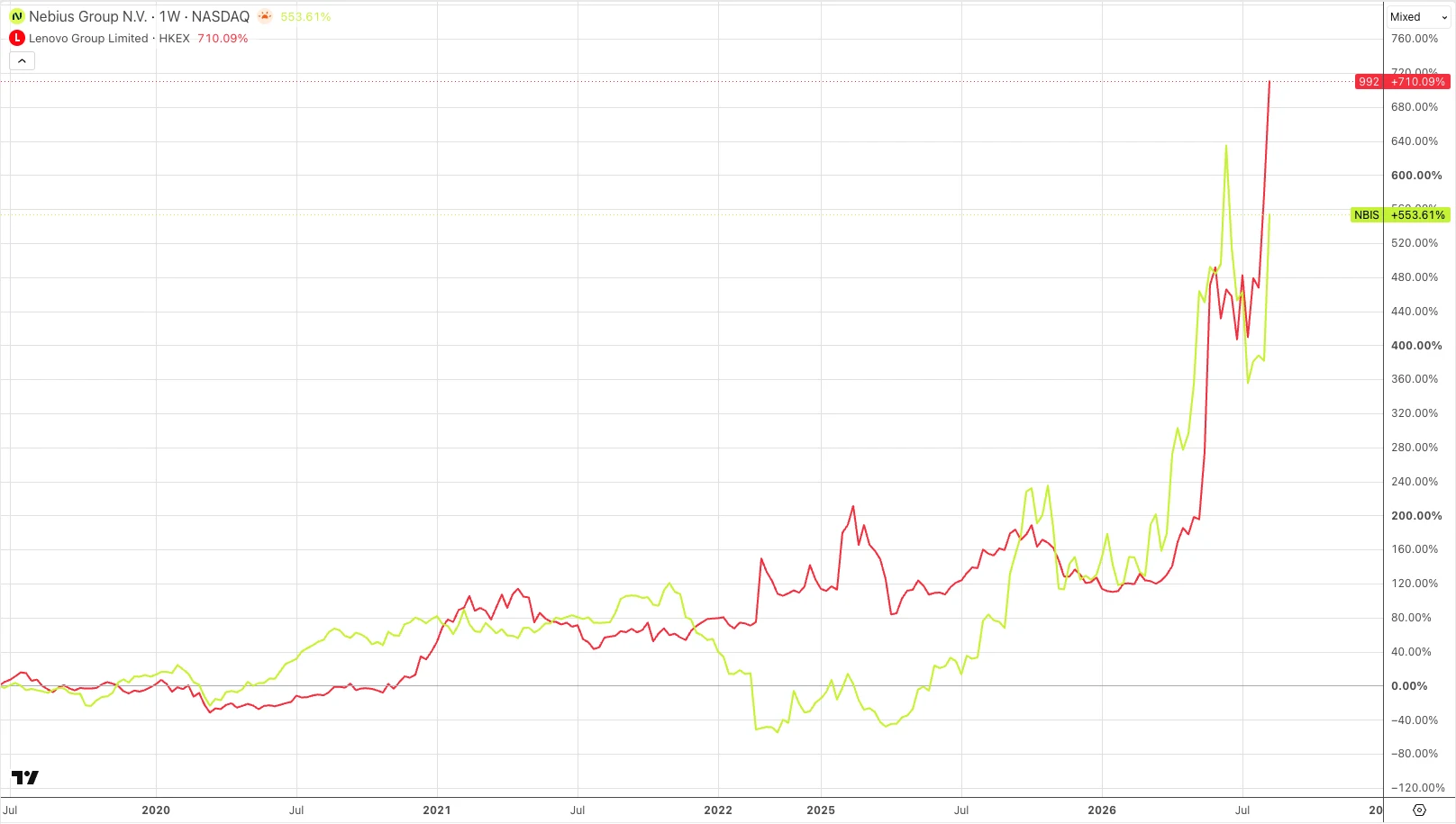
An illustrative example is Nebius. In the second quarter, the company’s revenue reached $582.3 million, exceeding analysts’ expectations, while its core AI cloud business increased sales almost sixfold. Against this backdrop, Nebius emerged as one of the notable premarket movers, with its shares subsequently gaining more than 30%.
The main takeaway from the company’s results, however, is not the quarterly revenue itself, but the scale of its future commitments. In three months, Nebius signed four contracts worth more than $1 billion each. The total value of contracts has increased fourfold, while deals with new clients grew nine times. The company claims that it is already able to sell all the computing capacities planned through 2027 at current commercial terms.
Nebius expects to increase its contracted power to 5 GW by the end of 2026 and add more than 1 GW of new capacity annually starting in 2027. At the same time, capital expenditures have already reached about $5.7 billion, significantly above analysts’ expectations of $4.7 billion.
This creates something of a vicious circle. To win more deals, companies need to build more data centers and purchase more GPUs. Doing so requires huge investments. And the attractiveness of those investments is determined by how long customers remain willing to pay for computing power at current prices.
The company expects to receive more than $9 billion in customer prepayments by the end of the year, while total customer commitments already exceed $40 billion. This significantly reduces the risks of financing infrastructure construction, but at the same time puts more pressure on the company to bring new capacity online on schedule.
Lenovo is showing a similar picture. In the first quarter of fiscal year 2027, its revenue surged by 43% to a record $26.9 billion, while net profit rose by 176%, reaching $1.1 billion. At the same time, AI is no longer a secondary focus for the company. The corresponding revenue increased by 60% to $9.3 billion and now accounts for 35% of Lenovo’s total revenue.
The infrastructure business is growing especially fast. Revenue in this segment rose by 98% to $8.5 billion, and the volume of orders for AI servers grew sequentially by 157%, reaching $54 billion. In international markets, sales of such servers increased at triple-digit rates.
The AI boom is therefore generating revenue far beyond model developers and accelerator manufacturers. A significant portion of the capital is gradually flowing through the entire supply chain, from servers and components to data centers, cloud platforms, and services.
At the same time, Lenovo offers investors a particularly interesting combination of growth and profitability. Despite rising component costs, the company was able to maintain the operating margin of 7.1% in its smart devices segment, while the infrastructure business delivered a margin of 9.1%. In the solutions and services segment, the margin reached 24.2%.
Lenovo shares responded with a gain of more than 20%, and since the beginning of the year, the stock has risen by about 230%. The market is clearly pricing in expectations for further growth in AI, which could provide up to half of the company’s total revenue by the end of the decade.
However, companies are already looking not only for additional computing power, but also for ways to make existing capacities more efficient.
This is what makes Anthropic’s potential $6 billion acquisition of startup Decart AI particularly significant ahead of a potential Anthropic IPO. The company faces constraints on computing resources and even relies on capacity rented from competitors. Acquiring a company specializing in more efficient use of computing infrastructure could help reduce the cost of model training and inference.
What makes the potential deal even more notable is that Decart AI was valued at about $4 billion just a few months ago after raising $300 million, with Nvidia and Adobe Ventures among the investors. Now the potential price of the deal could reach $6 billion.
Not only companies that are able to offer more computing power are starting to gain value, but also those who are able to reduce the amount of compute needed to produce the same results.
That shift may prove critical to how the entire AI sector is valued in the future. Today, investors are ready to finance the construction of new data centers, and companies are signing contracts worth billions of dollars. But if model and software efficiency improves faster than compute demand grows, the current shortage of GPUs and data center capacity could eventually turn into oversupply.
This scenario is still far away. Nebius continues to increase investments, Lenovo is seeing record orders, and Anthropic is reportedly willing to pay billions for computing optimization technologies. Therefore, current statistics confirm the continuation of the AI boom rather than its completion.