
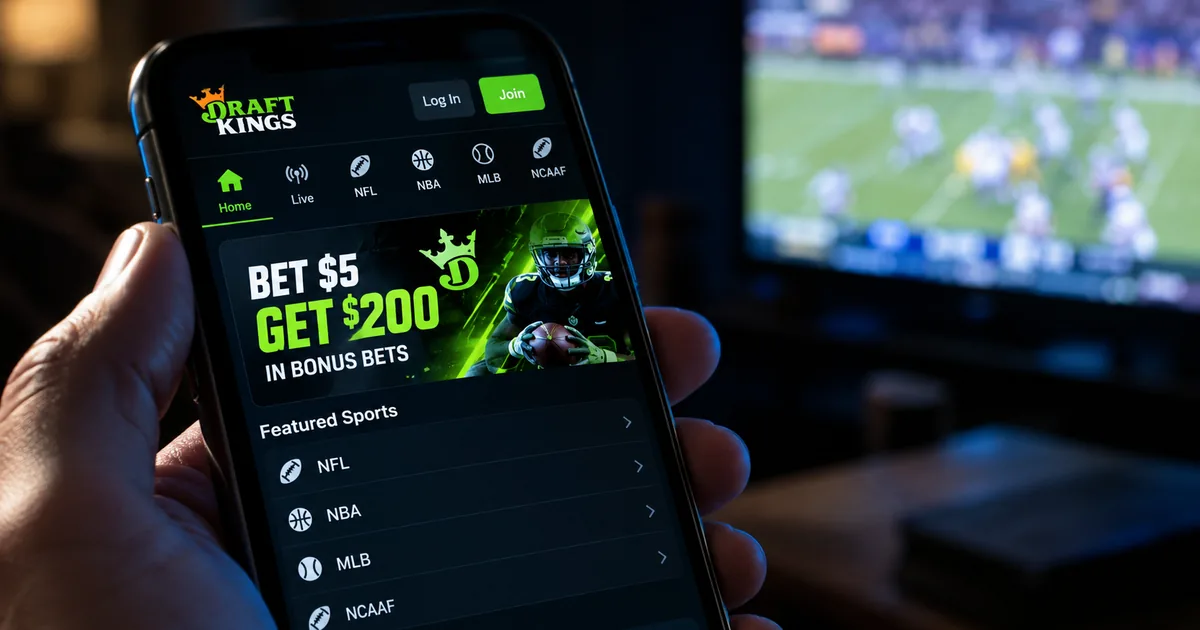
On Monday morning, Google’s trending searches feed for the United States listed ten entries.
Five of them were sportsbook promotions: theScore Bet promo code, DraftKings free bet, DraftKings sportsbook, bet365 free bet, FanDuel promo code. That is the part of this story nobody has put on the page yet. Every outlet has now written up the New York Times investigation into the machine-learning model DraftKings used to decide who gets a bonus. Almost none of them have looked at what the demand side of that machine looked like on the very weekend the investigation landed, which is half of a nation’s trending curiosity pointed directly at the free bets the reporting describes.
The Score, and What It Was Built to Predict
The Times investigation, published Friday and built on internal memos, betting records and interviews with more than forty former employees, describes a model DraftKings built in 2023. It read a customer’s playing frequency, their daily account balance patterns, and the ratio of their losses to their total wagers, and it output a number. Staff called it an elasticity score. The higher the score, the more the company expected to make back on every promotional dollar it spent on that person.
DraftKings directed roughly $400 million in automated promotions at high-scoring accounts in 2025, and its executives have told investors that data science improved sportsbook margins by 13 percent that year. A former analyst put the logic in plainer terms to the Times, saying that what the team was looking for were traits indicating a good investment, and that the best investment would be a problem gambler.
“It is as predatory as it sounds.”
That was a former DraftKings analyst’s summary, reported by Operation Sports. The company disputes the characterization. It says its offers go to customers who show sustained, engaged use of the platform rather than to people singled out for losing, and it told the Times it could not give a definitive response to some of the internal tests described because it had not seen or verified the underlying material.
There is a second model in this story, and Gizmodo’s write-up was one of the few to carry it. Starting in 2024, staff began building the mirror image of the elasticity score, a risk model that would have used much of the same data to flag customers sliding toward gambling harm. Six former employees said the loss-targeting work kept getting refined. Four said the harm-detection work stalled or was shut down. DraftKings’ chief responsible gaming officer has said leadership made a collective decision against predictive risk tools because the approach was not evidence-based.
Hold those two facts next to each other. The same infrastructure, pointed in two directions. One direction got $400 million behind it. The other got a standard of evidence it was never going to clear, applied by the people who did not want it built.
The Part That Happens in Public
Here is what makes the trending data worth measuring rather than shrugging at. The promotional offers at the center of this investigation are not hidden. They are the single most visible product in American sports media, and they are distributed in large part by news organizations.
Look at what those trending searches actually surfaced on Monday morning. The bet365 entry returned a bonus code with a broadcaster’s initials embedded in the code itself. The DraftKings and FanDuel entries returned promo articles pegged to Sunday night football. These are affiliate placements, published by outlets that earn a cut when a reader signs up, and they run alongside the same outlets’ coverage of a report about how those signups get targeted.
That is not a conspiracy. It is a business model, and it is the delivery layer the elasticity score was steering. A model that decides who deserves a $200 bonus is inert without a channel that puts the $200 bonus in front of tens of thousands of people at the moment they are most likely to act on it. American sports media is that channel. The investigation has been covered as a story about DraftKings’ engineering. It is at least as much a story about distribution, and the outlets doing the covering are part of it.
What LiveNewsChat Thinks
The defense DraftKings is offering does not survive contact with its own conduct. The company says it targets sustained engagement, not losses. But a model trained on loss-to-wager ratios and balance patterns is a model that finds heavy losers whether or not anyone writes that word in the specification, and the company knows this, because it started building the tool that would have named those same customers as at-risk and then declined to finish it. You cannot argue that predicting harm is too speculative to act on while running a production system that predicts the profitable half of the same behavior with enough confidence to move $400 million.
The regulatory position is worse. No regulator has accused DraftKings of breaking a law, and that is the actual finding here. In most states, this conduct appears to be legal. Sportsbooks were licensed on the theory that legalization would bring the activity into a supervised market, and supervision turned out to mean tax receipts and age checks rather than any limit on how precisely a company may aim its marketing at the people its own systems identify as likely to lose. We have watched the same gap open in the prediction-markets fight, where the federal agency claiming sole authority over sports betting has exactly one commissioner left to exercise it.
The SAFE Bet Act, reintroduced by Senator Richard Blumenthal and Representative Paul Tonko, would ban exactly this: AI-driven targeting, personalized offers built on behavioral data, bonus bet promotions, and advertising during live games, alongside affordability checks and deposit limits. Sportsbook trade groups call it an overreach that would push bettors to offshore books. That argument was more persuasive before we learned what the licensed, supervised, onshore version does with its data. A bill that bans behavioral targeting in gambling is not a radical intervention. It is the minimum a legislature can do once it has been shown, in the company’s own memos, what the targeting is for.
What to Watch
State gaming regulators are the pressure point, not Congress. Licensing conditions are written state by state, they are renewed on a schedule, and a regulator who wants to require disclosure of promotional targeting models does not need a federal statute to do it. Watch New Jersey, Michigan and Massachusetts, which have the largest regulated markets and the staff to read a model card. Watch also whether DraftKings restarts the harm-detection work it shelved. If the company’s position is that predictive tools are not evidence-based, the fastest way to test that claim is to ask it why one of them is still running.
Meanwhile, the promo codes are still trending. Week 3 starts Thursday.