
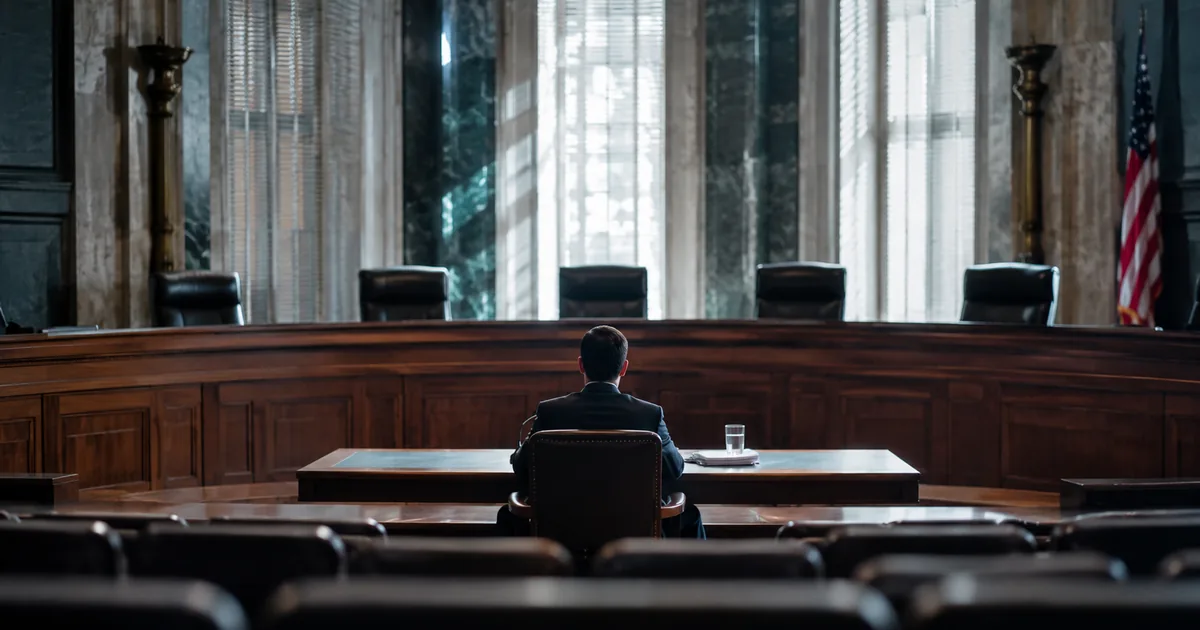
New Jersey asked the Supreme Court this week to settle whether a state can still police sports betting when the wager is booked on a federally regulated exchange instead of at a sportsbook. Every account of that filing frames it as a turf war between the Commodity Futures Trading Commission and the states, and not one of them mentions the fact that makes the federal half of the argument strange: the CFTC that claims exclusive authority over this market currently consists of one person.
That is not a rhetorical flourish. Chairman Michael Selig was sworn in on December 22, 2025, the last sitting commissioner resigned shortly afterward, and the securities bar has spent 2026 writing explainers about what happens when a five-seat commission runs on a single vote. The trade publication TheCorporateCounsel.net called it a one man band. Unlike the Securities and Exchange Commission or the Federal Trade Commission, both of which have written quorum rules, the Commodity Exchange Act sets no minimum. One commissioner exercises the full authority of the commission. There is nobody to dissent, nobody to slow a rulemaking down, and nobody to lose a vote to.
So when the question in front of the Supreme Court is framed as “should this be regulated federally or by the states,” the honest version of that question is narrower and much harder to answer with a shrug.
What the Third and Ninth Circuits Actually Disagree About
The petition exists because two federal appeals courts read the same statute and reached opposite conclusions inside five months.
In April, the Third Circuit affirmed a preliminary injunction that stopped New Jersey from enforcing its gambling laws against Kalshi, holding that the company’s sports event contracts qualify as “swaps” under the Commodity Exchange Act and that federal law therefore preempts the state. It was a 2-1 decision, with Judge Jane Roth dissenting on the ground that gambling is exactly the sort of thing states have always regulated, so the presumption against preemption should apply. Paul Weiss walked through the reasoning in a Columbia Law School analysis.
Late last month the Ninth Circuit went the other way in KalshiEX, LLC v. Assad, finding that Kalshi had not shown the federal statute likely preempts Nevada’s gaming laws. The split turns on a distinction that sounds like philosophy and functions like a billion-dollar line item. As the National Law Review summarized it, the Ninth Circuit reasoned that whether the Super Bowl happens is the occurrence of an event, while whether a particular team wins it is the outcome of one. A swap hedges against occurrences. Betting on outcomes is something else.
Both rulings came out of preliminary injunction proceedings rather than final judgments, which gives the Supreme Court an easy reason to wait for a cleaner case. It should not take that exit.
Six States Sued by One Appointee
The reason to resolve this now is not that the doctrine is interesting. It is that the doctrine is being enforced, aggressively, by an agency with no internal check on it.
Since February, the CFTC has gone to court against a growing list of states that tried to apply their own gambling law to prediction markets:
- Arizona, Connecticut and Illinois, sued after their gaming regulators issued cease and desist orders, per the commission’s own announcement
- Wisconsin and New York, added over the spring
- Minnesota, after Governor Tim Walz signed the country’s first outright state ban on prediction markets
CNBC has been tracking the map as it grows. The commission has already won a preliminary injunction against Arizona.
“What we’re seeing is an attempt by the state gaming commissions to effectively nullify federal law.”
That is Selig on CNBC’s Squawk Box in April, defending the suits. It is a coherent legal position. It is also a position that one Senate-confirmed official is currently asserting against at least six state legislatures and gaming commissions, with no colleagues who could have voted the other way.
The Part Nobody Wants to Say Out Loud
Here is where LiveNewsChat comes down on it. The exclusive-jurisdiction theory is not wrong on its face. Federal preemption of state law is ordinary, and a national exchange genuinely cannot function under fifty conflicting rulebooks. But preemption arguments carry an implicit promise, which is that the federal regulator taking the field will actually regulate. A commission that cannot seat a quorum because there is no quorum requirement to fail is not a substitute for state oversight. It is the absence of oversight with a federal letterhead on it.
New Jersey is not a sympathetic plaintiff here and it is worth saying so plainly. This is the state that spent six years and a Supreme Court case dismantling the federal ban on sports betting so it could tax the proceeds, and it is now in court arguing that a competitor booking the same bets should be shut down. The financial interest is obvious. It is also beside the point. A state’s motive for defending its police power does not tell you whether it has one.
What should happen is not complicated, and it is not really the Court’s job. The White House should nominate commissioners and the Senate should confirm them, because a market where sports contracts routinely make up 80 percent or more of weekly volume, as CNBC reported in its account of the petition, is not a niche derivatives product that a caretaker can mind. Failing that, Congress should write the rule itself instead of leaving a definitional fight over the word “swap” to decide whether every state gambling statute in the country still applies. Neither of those things is going to happen before the NFL season ends. So the Court should take the case.
The Cost of Waiting
Prediction markets have already stopped being a curiosity. We covered the teleprompter operator who made six figures betting on the words he was about to load into the machine, and Meta launched its own prediction app in June. Every month the Court waits, more money moves into a market whose legal status depends on which circuit the trader happens to be sitting in.
NPR noted in its report on the petition that the question is simply who regulates. That framing is too generous. The question is whether anyone does.