
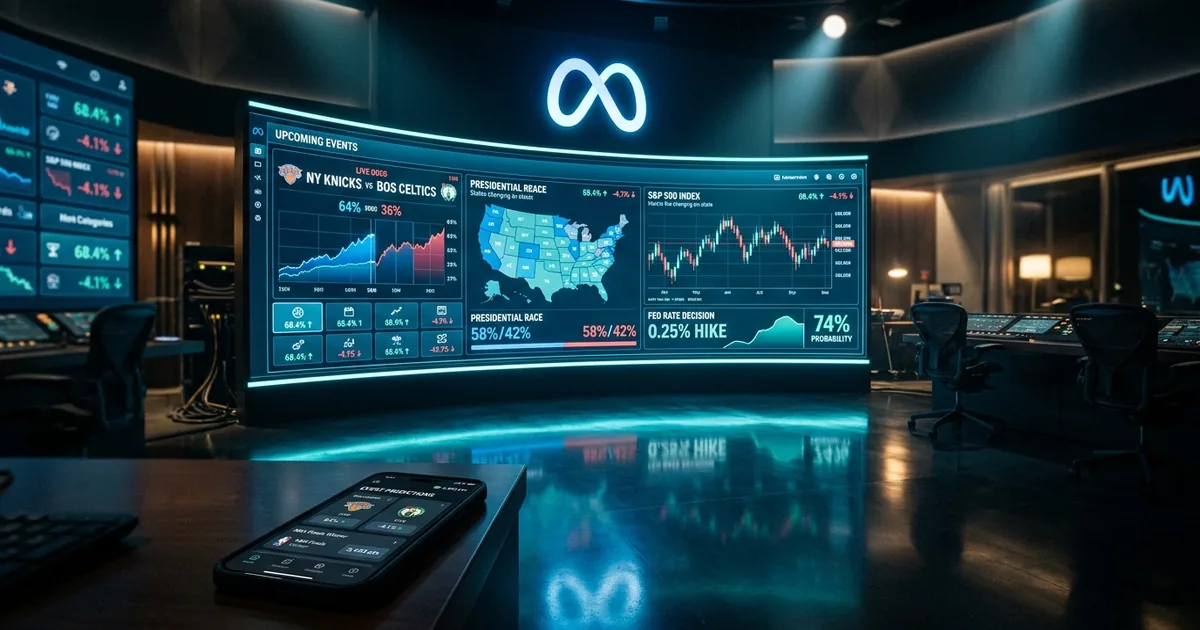
Mark Zuckerberg has ordered a Meta team to build a standalone app where users stake play-money points on the outcome of real-world events, the clearest sign yet that Silicon Valley now treats betting on the future as the next attention business.
The project, first reported by The New York Times and codenamed Arena, would drop the world’s largest social-media company into a fast-growing, lightly policed corner of the internet that has already produced multibillion-dollar valuations.
What Arena Actually Is
Arena, which staff have also referred to internally as Antwerp and FBForecast, would hand every user a daily allotment of virtual currency to spend predicting how events break: a playoff game, an election, a Federal Reserve decision, a closing stock price. No real money changes hands at launch. Meta has not ruled out a real-money version later, which is the part worth watching.
The engine underneath is the tell. According to documents reviewed by NPR, Arena would lean on Llama, Meta’s large language model, to spin up prediction questions automatically from whatever is trending that hour. That turns the news cycle itself into an endless feed of things to wager on, generated faster than any human editor could write them. It is the prediction-market equivalent of an algorithmic timeline: not a marketplace people seek out, but a stream engineered to keep them tapping.
Why Zuckerberg Wants In
The pull is obvious once you look at the numbers. Kalshi and Polymarket, the two startups that defined the category, drew a combined $50 billion in trades in 2025. In 2026 the total has already pushed past $130 billion, and some analysts float a $1 trillion industry within a few years. Kalshi is reportedly raising a round that would value it at $40 billion. For a company whose advertising machine is mature and whose metaverse bet still has not paid for itself, a high-engagement, high-margin format aimed at exactly the speculation reflex that powers meme stocks and crypto is hard to resist.
Wall Street read the threat instantly. When the plan surfaced, shares of betting-exposed companies including DraftKings and FanDuel parent Flutter slid, as CNBC reported, on the prospect of Meta pointing its roughly three billion users at a product that overlaps with sportsbooks. Distribution is the moat Meta brings that no incumbent can match. Kalshi has to acquire each user one at a time. Zuckerberg can put Arena one tap away inside apps people already open dozens of times a day.
The ‘Play Money’ Tell
The play-money framing is doing a lot of work, and it deserves skepticism. Free-to-play points are how a regulated activity gets a soft launch: no wagering statute is triggered, no gambling license is required, and the company gets to train both its users and its algorithms before anyone has to answer the hard legal questions. We have watched this pattern before. Social casinos, loot boxes, and “no purchase necessary” sweepstakes all live in the gap between a game and a bet, and they monetize the same dopamine loop whether or not cash is formally on the table.
Layer that onto Meta’s specific record and the concern sharpens. This is a company that spent the spring in court over claims its products harm children, a fight that produced a landmark trial over harm to minors and renewed scrutiny of how its engagement systems treat vulnerable users. Handing that same engagement apparatus a betting mechanic, even a points-based one, invites the obvious question of who ends up most exposed when the real-money version arrives.
The Regulators Are Already Circling
Prediction markets occupy contested legal ground, and the rules are being written in real time. The Commodity Futures Trading Commission has jurisdiction over event contracts, but the boundary between a financial hedge and a sports bet is exactly what is in dispute. Kalshi is now suing the state of Illinois over a new law imposing the country’s first tax on sports-event contracts, a 15% levy on gross receipts, a sign that states intend to treat these platforms like sportsbooks no matter how the companies label themselves.
Meta walking in changes the politics of that fight. A startup pushing the legal envelope is one thing. A trillion-dollar platform with a long history of antitrust and privacy battles doing the same is another, and it will draw regulators and state attorneys general who already keep a file open on the company. The likeliest near-term outcome is that Arena ships as a points-only product precisely because the real-money path runs straight through a thicket of state gambling law, CFTC oversight, and a Congress that has already shown interest in how these platforms handled events like the Polymarket bets on the Iran ceasefire that triggered an insider-trading probe.
What to Watch Next
The question is not whether Meta can build a prediction app. It can, and Llama makes the content side nearly free. The question is what it does to a news environment already strained by engagement-maximizing design. When the same feed that shows you a war, an election, or a market crash also invites you to bet a stack of points on the outcome, the line between being informed and being played gets thin. Arena is still a prototype. The decision that matters is the one Meta has not announced yet: whether the points ever turn into dollars.