
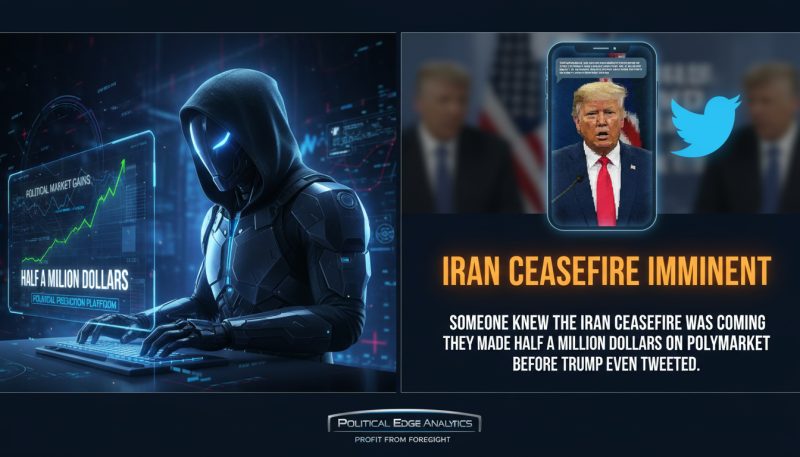
Minutes before President Donald Trump announced a 14-day ceasefire with Iran on his social media platform, at least 50 brand-new accounts on the prediction market site Polymarket placed substantial bets that a ceasefire was imminent. These weren’t casual wagers from regular users testing a hunch. These were accounts that had never placed a single bet before, created hours earlier, loaded with funds, and laser-targeted at one outcome. The collective profit: approximately $550,000.
If this were the stock market, there would be a name for it. There would be handcuffs.
But this is Polymarket, and the rules, or the lack of them, are exactly the problem.
A Pattern That Keeps Repeating
The Iran ceasefire bets are not an isolated incident. They are the latest in a series of suspiciously well-timed trades that have turned Polymarket from a quirky crypto experiment into what critics are calling the most consequential unregulated financial platform in America.
In January, an anonymous user made $400,000 by betting that Venezuelan leader Nicolas Maduro would be removed from office, placing the wager hours before Maduro was captured. In March, an account trading under the username “Magamyman” collected more than $553,000 by betting against Iranian Supreme Leader Ayatollah Ali Khamenei’s survival, just before a joint U.S.-Israeli strike killed him. On Polymarket alone, half a billion dollars was traded on the timing of when U.S. forces would strike Iran.
These are not abstract financial transactions. These are bets on human life and geopolitical violence, placed with what increasingly appears to be advance knowledge of classified military operations.
Harvard Found $143 Million In Suspected Insider Profits
Researchers at Harvard University released a paper last month that put a number on the problem. Using public blockchain data, the team estimated that $143 million in profits have been made on Polymarket by individuals who potentially had insider information about events. The range of events is staggering: from Taylor Swift’s engagement to the awarding of the Nobel Peace Prize to the outcome of military strikes.
The study does not use the phrase “insider trading” in the legal sense. What it documents are statistical anomalies so pronounced that the researchers concluded the trading patterns are inconsistent with public information alone. Accounts that had no prior activity would appear, place large directional bets on a specific geopolitical outcome, collect profits, and go dormant. The pattern repeated across dozens of major world events.
Congress Is Finally Paying Attention
The political response has been bipartisan, and it’s accelerating.
Rep. Ritchie Torres (D-NY), who sits on the House Financial Services Committee and its subcommittee on digital assets, sent a letter to the Commodity Futures Trading Commission demanding the regulator review and investigate the well-timed Iran trades. Senator Richard Blumenthal went further, calling Polymarket “an illicit market to sell and exploit national security secrets unlike any in history.” Rep. Blake Moore (R-UT) added a national security framing: “We don’t want to imagine a world where America’s adversaries use prediction markets to anticipate our next move.”
There are now at least two bills pending in Congress, one in each chamber, co-signed by members of both parties. The legislation would bring prediction markets under tighter regulatory oversight and address what current commodity trading law already technically prohibits: making trades based on death and war. Under existing U.S. law, such bets are illegal because they create a financial reward for violence, human suffering, and geopolitical instability.
The problem is enforcement. Polymarket operates as an overseas exchange, meaning it sits outside the jurisdictional reach of Washington’s regulators. The CFTC, which oversees derivatives markets including prediction markets, has the authority to investigate but has not announced a formal probe.
The Trump Administration’s Conflict Of Interest
Here is where the story gets uncomfortable. Donald Trump Jr., the president’s son, serves as an adviser to Polymarket. His venture capital firm, 1789 Capital, has invested millions into the company. And the Trump administration has already dropped two federal investigations into Polymarket that were opened under President Biden.
That combination of facts creates a conflict that is difficult to overstate. The platform where anonymous traders appear to be profiting from advance knowledge of U.S. military operations is financially tied to the president’s family. The regulatory body that should be investigating has been effectively told to stand down. And the legislative efforts to impose oversight are battling against an administration that has made deregulation of crypto and financial technology a policy priority.
The Bigger Question Nobody Wants To Answer
Prediction markets were supposed to be the future of information aggregation, a tool that harnesses collective intelligence to forecast outcomes better than polls, pundits, or models. Polymarket’s defenders argue that the platform provides valuable price signals about real-world events and that regulation would kill innovation.
But what the Iran bets reveal is something different. If the people placing these wagers have access to classified information, then Polymarket isn’t aggregating public knowledge. It’s monetizing state secrets. And if adversaries, whether foreign governments or domestic actors with security clearances, can profit from advance knowledge of military strikes, then the platform isn’t just a market. It’s a security vulnerability.
The question for Congress is not whether prediction markets should exist. It’s whether a platform can be allowed to operate in a regulatory vacuum when the stakes involve war, death, and classified intelligence. The $143 million in suspected insider profits is not a rounding error. It’s a measure of how much damage a system without guardrails can do.
The next suspicious trade is not a question of if. It’s a question of when, and whether anyone with the authority to act will be watching when it happens.