
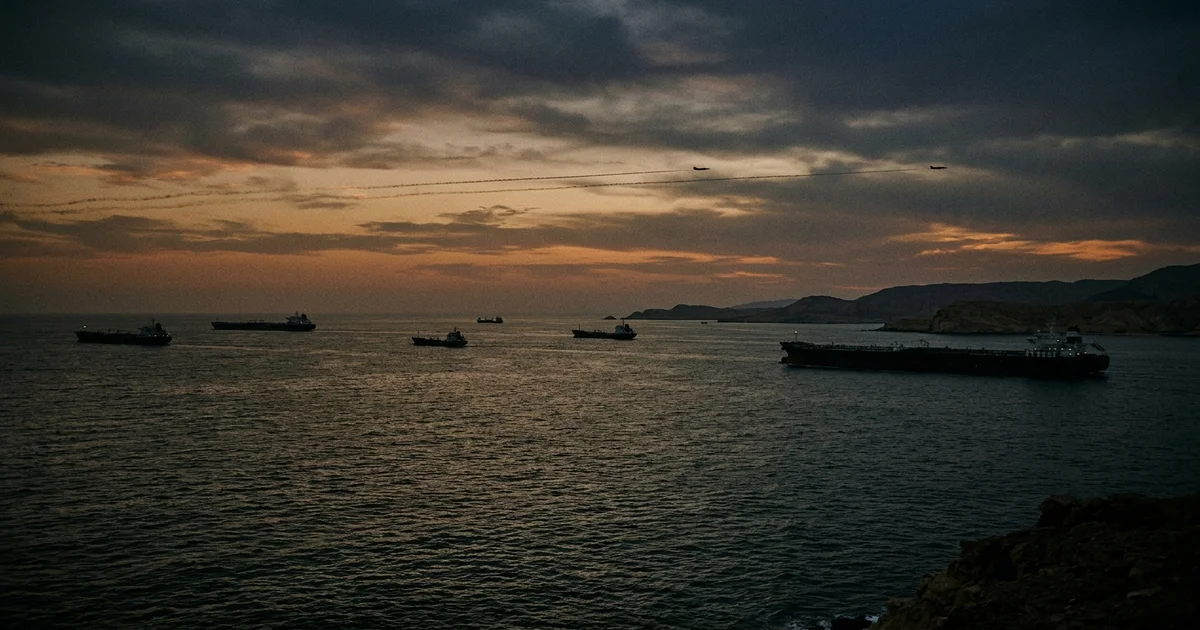
The Pentagon hit Iranian coastal targets on Friday night after Tehran’s Revolutionary Guard fired drones at commercial shipping in the Strait of Hormuz, the first direct military exchange since the two sides signed a ceasefire memorandum just ten days ago.
The strike is the starkest proof yet that the fragile agreement may not survive the fundamental question at its center: who actually controls the world’s most important oil chokepoint.
What Happened in the Strait
Iran launched at least four one-way attack drones at ships transiting the Strait of Hormuz on Thursday, according to US Central Command. One drone struck the upper deck of the M/V Ever Lovely, a Singapore-flagged cargo vessel exiting the waterway along the Omani coast. American forces intercepted the other three. The ship sustained damage but was able to continue its voyage.
President Trump called the assault a “foolish violation” of the memorandum of understanding both countries signed on June 17, which laid out 60 days of open passage through the Strait while negotiators hammer out longer-term terms on Iran’s nuclear program and sanctions relief. Within hours, six US aircraft struck four Iranian sites near the port of Sirik, hitting missile and drone storage facilities and coastal radar installations.
A Ceasefire Built on Quicksand
The problem is structural, not incidental. Article 5 of the memorandum states that Iran and Oman will discuss the “future administration” of the Strait, a phrase so deliberately vague it practically invites the kind of confrontation that played out this week. Washington reads the clause as reaffirming freedom of navigation. Tehran reads it as international recognition that the Strait runs through its sovereign waters and that vessels must seek Iranian permission to transit.
Ebrahim Azizi, who heads the Iranian parliament’s national security commission, made Tehran’s position explicit: “The Strait of Hormuz is governed by Iran, so: respect the rules.” He framed the drone attack not as a ceasefire violation but as “ceasefire management,” a term that should alarm anyone betting on the deal’s survival.
The US has been encouraging ships to use an Omani-side route through the waterway, sidestepping the deeper channel closer to Iran’s coast. Iran’s position is that all vessels must use the Iranian-adjacent passage and request permission, a demand that effectively reinstates the blockade the ceasefire was supposed to end.
Why This Matters Beyond the Middle East
Roughly 20 percent of the world’s oil supply passes through the Strait of Hormuz every day. When Iran blocked commercial traffic earlier this year, gasoline prices in the US surged, and the ripple effects hit everything from shipping rates to grocery bills. The ceasefire was supposed to stabilize that. Ten days in, the underlying dispute over sovereignty and passage rights remains completely unresolved, and both sides have already resorted to force.
This is the pattern with agreements built around ambiguous language and competing interpretations. The memorandum succeeded at the symbolic level. It gave Trump a signing ceremony and gave Iran a framework for sanctions relief talks. But it left the operational reality of who controls the Strait deliberately undefined, and that gap is now filling with drones and airstrikes.
The previous LNC coverage of the ceasefire deal laid out the structural tensions baked into the agreement. Friday’s exchange confirms those tensions were not theoretical.
The Military Calculus
The US response was calibrated to send a message without triggering a broader escalation. Six aircraft hitting four targets near Sirik is a limited operation, focused on degrading Iran’s coastal surveillance and drone launch capabilities in the specific area where Thursday’s attack originated. It is not a campaign-level strike package. Central Command described it as targeting “missile and drone storage locations” and “coastal radar sites,” which suggests the Pentagon wanted to reduce Iran’s ability to repeat the exact same kind of attack without provoking a wider conflict.
But calibration has limits. Iran’s drone and missile infrastructure is distributed across dozens of sites along its coastline, and eliminating a few storage depots near one port does not fundamentally change the military balance in the waterway. What it does is establish a precedent: attack commercial shipping, get hit. That precedent only holds if the US is prepared to enforce it every time, and the operational demands of doing so over a sustained period are significant. The Navy already has carrier strike groups and destroyers positioned in the region, but maintaining that posture indefinitely is expensive and ties down assets that commanders want available elsewhere.
What Comes Next
The 60-day clock is still ticking. Both sides have incentives to de-escalate: Iran needs sanctions relief, and the US wants stable oil markets ahead of a domestic political calendar that does not reward gasoline price spikes. But the Strait sovereignty question is not the kind of problem that resolves itself through patience. Someone has to blink, and neither side has shown any interest in being the one who does.
The next few days will tell us whether this was a one-off provocation and response or the beginning of a cycle that makes the ceasefire irrelevant in practice. If Iran tests passage controls again and the US responds with force again, the memorandum becomes decoration, not policy. And the markets will notice before the diplomats do.