
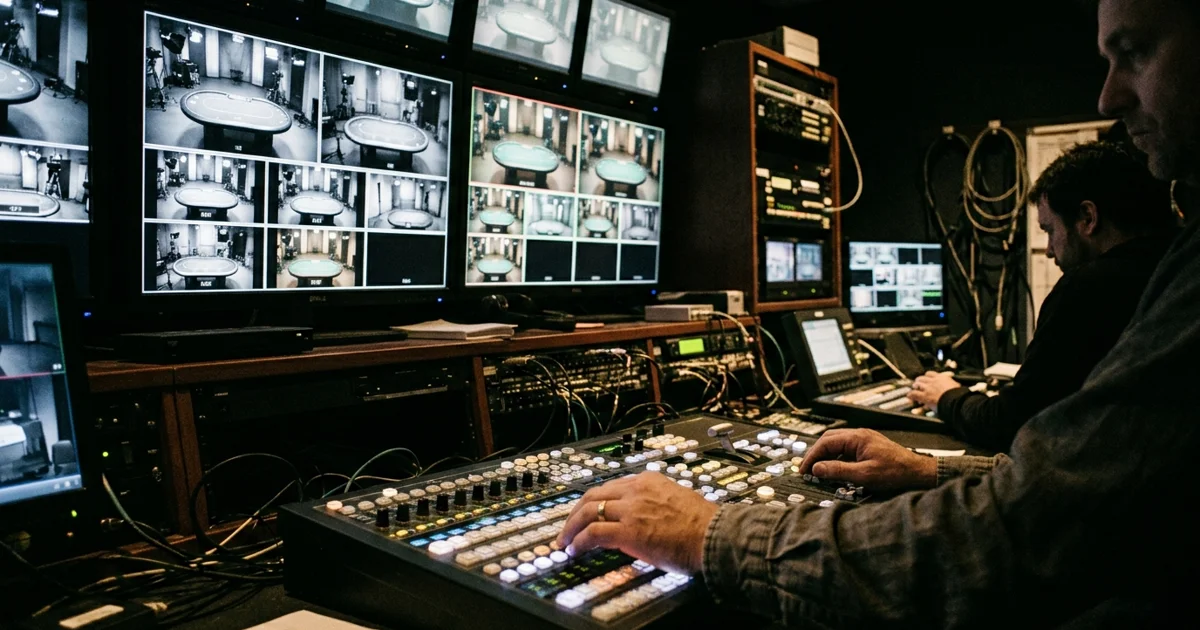
A live table looks like a camera pointed at a dealer. It is closer to a small television studio with a database attached, and the database is the part that decides whether a round stands.
Understanding that production side explains most of what seems odd about live play: the countdown, the frozen betting window, the occasional replayed hand. None of it is arbitrary, and all of it follows from how the broadcast is assembled.
What is actually being broadcast
The video is the visible half. The other half is a stream of data describing every card, pocket and payout in machine-readable form.
Latency is the quiet variable in any live broadcast, and the live section at Pinco casino draws on the same studio feeds that the rest of the market relies on for tables. Those studios run the room, the staff and the equipment, and the operator licenses the result.
Cameras, recognition and the dealer’s routine
Several cameras cover a table, and optical recognition reads each card as it leaves the shoe. The dealer’s routine is scripted to the second, which is why the pace of a table changes so little between sessions. Recognition errors are handled by a supervisor rather than by the dealer, and the round pauses while that happens.
Latency and the betting window
Betting closes a moment before the visible action, because the stream reaches a screen a second or two after the room. That gap is why the interface counts down rather than waiting for the dealer’s hand. A slower connection widens the gap without changing the result of a round.
The formats behind the category
“Live” covers several different products, and they suit very different attention spans.
| Format | What the stream shows | Pace |
|---|---|---|
| Classic table game | A dealer, a table and a shoe or wheel | Steady, set by the dealer |
| Game-show format | A presenter and a large mechanical wheel | Slow, with long gaps between rounds |
| Automated wheel | A machine spinning without a presenter | Fast, with short betting windows |
| Dual play | A stream taken from a public venue floor | Irregular, tied to the physical room |
The pace column matters more than the theme: a game-show table may run a handful of rounds in the time a classic table completes many more. Pinco casino online labels each table with its format and its limits, so the pace is readable before a room is opened.
What the interface leaves to the viewer
Most live clients expose a small set of controls, and they change the experience more than the choice of table does.
- Video quality, which can be lowered when a connection is unsteady.
- Multi-table view, placing several streams on one screen.
- Dealer chat, which can usually be hidden entirely.
- Statistics panels showing previous results for the table.
- Sound, split between room audio and interface effects.
The statistics panel deserves a note of its own: past results are displayed for interest, and they carry no information about the next round.
Access and the account
Live tables sit behind the same login as the rest of the catalogue, so Pinco casino login covers both halves of the site rather than opening a separate area. Pinco casino online treats the live rooms as part of the same catalogue, reached without a second sign-in.
Older directories spell the brand as Pinko casino, and a Pinko login reaches the same profile, the same table history and the same limits. Session records are held against the account rather than the route used to arrive. Pinco casino applies the same table limits to a profile whichever spelling led to it.
Read as production rather than atmosphere, a live table is a scripted broadcast with a data feed underneath. Pinco casino login opens the same rooms every time, which is rather the point of them.