
Church bells rang across Minneapolis at 8:26 on Thursday morning, one year to the minute after a gunman fired through the stained glass of Annunciation Catholic Church into a school Mass.
The state and the city had declared it Annunciation Remembrance Day, and almost none of the coverage of it mentioned that the bill those families spent the year building died in May without a single vote on the floor of the Minnesota House.
That omission is worth sitting with, because the two things happened in the same building, to the same people, eleven weeks apart. Minnesota’s legislature named a day of remembrance for Fletcher Merkel, who was eight, and Harper Moyski, who was ten. The same legislature declined to hold a recorded vote on the gun package their parents had lobbied for all session. One of those actions cost nobody anything.
What the Anniversary Coverage Covered
The remembrance itself was genuine and locally organized rather than performed for cameras. Minneapolis held a day of service at Pearl Park from one to five, where people planted flowers and trees, assembled care kits for young people and collected school supplies. Representative Ilhan Omar and State Representative Emma Greenman turned up, as MPR News reported from the park. Residents were asked to put two candles in their windows. KSTP spent the day with families honoring Harper and Fletcher, and FOX 9 laid out how the city had structured the day around service rather than speeches.
The other anniversary story was the document release. Days before, the Minneapolis Police Department and the Minnesota Bureau of Criminal Apprehension made public a 2,648 page file of reports, interviews and photographs. MPR’s read of the documents found a fast and competent emergency response and, after a year of investigation, close to nothing on motive. CNN reached the same conclusion from the same file.
Both of those are legitimate stories. Neither is the accountability story, and the accountability story has a paper trail.
The Bill, and the Vote That Never Happened
Here is the sequence, all of it on the record:
- August 27, 2025. Robin Westman, 23, fires dozens of rounds through the church windows during an all school Mass. Fletcher Merkel and Harper Moyski are killed. More than twenty other children and adults are wounded. Westman dies by suicide.
- Fall 2025. Governor Tim Walz publicly pledges a special session on gun violence. Negotiations stall once Republicans attach conditions including private school security funding, changes to the state’s gender-affirming care laws and hospital mental health units. The special session is never called.
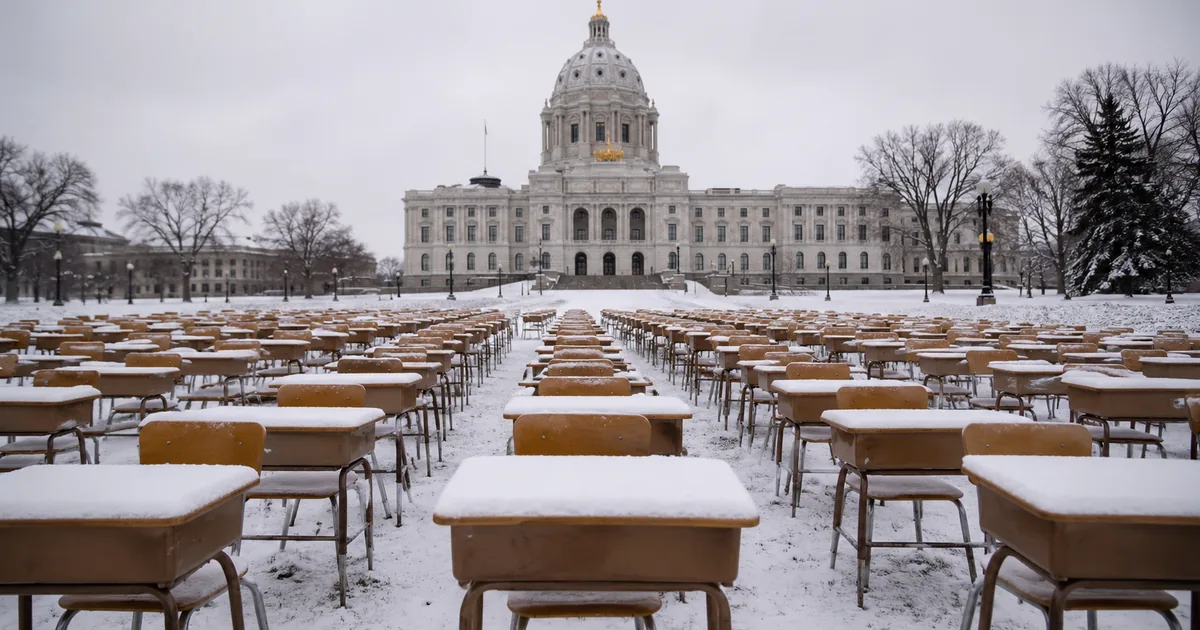
- February 2026. Harper’s parents, Jackie Flavin and Mike Moyski, help build an installation of sixty empty desks outside the Capitol in the snow, with two more placed inside for Harper and Fletcher. The group that grows out of it, the Annunciation Light Alliance, becomes the most visible advocacy presence of the session. FOX 9 followed the survivors who built it.
- May 2026. The DFL controlled Senate passes a 46 page package: bans on semiautomatic rifles and high capacity magazines, plus money for school security and mental health care.
- Three days later. House DFL members hold a press conference accusing Republicans of blocking the bill, posted on the House’s own site. A separate measure that would simply have let cities and counties write their own firearm rules had already failed in committee.
- May 14. Representative Samantha Sencer-Mura tells Speaker Lisa Demuth the caucus will sit in overnight if the bill is not reported by five o’clock. It is not, and they do. The sit-in runs for days inside the House chamber.
- Mid May. The session ends on a Sunday night with no House floor vote on the bill.
Demuth’s stated reason was procedural: the package had not properly cleared the committee process. Annunciation families pressed her directly to bring it up anyway.
Our View: Say Who Made the Choice
We think the procedural defense is not serious, and we think the governor’s failure is the less discussed of the two.
Start with the Speaker. A House speaker controls the flow of business to the floor. That is the job. When Demuth says the bill did not properly clear committee, she is describing a state of affairs she had the authority to change and chose not to. There is a version of this argument that would be honest, and it goes: I oppose banning semiautomatic rifles, my members oppose it, and I am not putting them through a recorded vote on it eleven weeks before an election. That position is defensible on its own terms and voters can judge it. Hiding it behind committee referral is a way of avoiding the judgment, and it worked, because the process story is boring and the remembrance story is not.
Now the governor. Walz stood in front of those families and promised a special session. He did not call one. The reason offered, that Republicans loaded their asks with unrelated demands, is a real description of what happened and a poor excuse for what followed, because calling the session was the mechanism that would have forced those demands into public view. A special session that collapses on camera over gender-affirming care riders is a political event with a cost attached. A special session that never gets called is a story that disappears in a week. He chose the one that cost him nothing, and by the time the regular session arrived the leverage was gone.
We are not arguing that a semiautomatic rifle ban would have passed. In a chamber this closely divided it very likely would not have. We are arguing that the families were owed the vote, that a recorded vote is the minimum a legislature owes people who spent a year in its hallways, and that the difference between losing a vote and never getting one is the difference between a democracy and a customer service line.
The Pattern Is Not Local
None of this is unique to Minnesota, which is precisely the problem. Earlier this month we wrote about Nonthaburi and four years of unfinished gun reform in Thailand, where a shooting produced a national commitment and then a legislative slow walk that outlasted the attention. The American version runs on a shorter cycle and a better vocabulary. We have gotten extremely good at the parts that do not require a vote: the day of remembrance, the empty desks, the bells at the exact minute, the document dump timed to the anniversary. In July a Georgia court sentenced Colin Gray to fifteen years as the first parent convicted of murder over a school shooting, which is real accountability and also, notably, accountability that required no legislator to cast a ballot.
Minnesota’s next governor will be elected in November, and the bill will come back. The families are still organized, still local, and still showing up. What changed this year is that the record now contains a specific name attached to a specific decision not to hold a vote, and that record does not expire when the bells stop.