
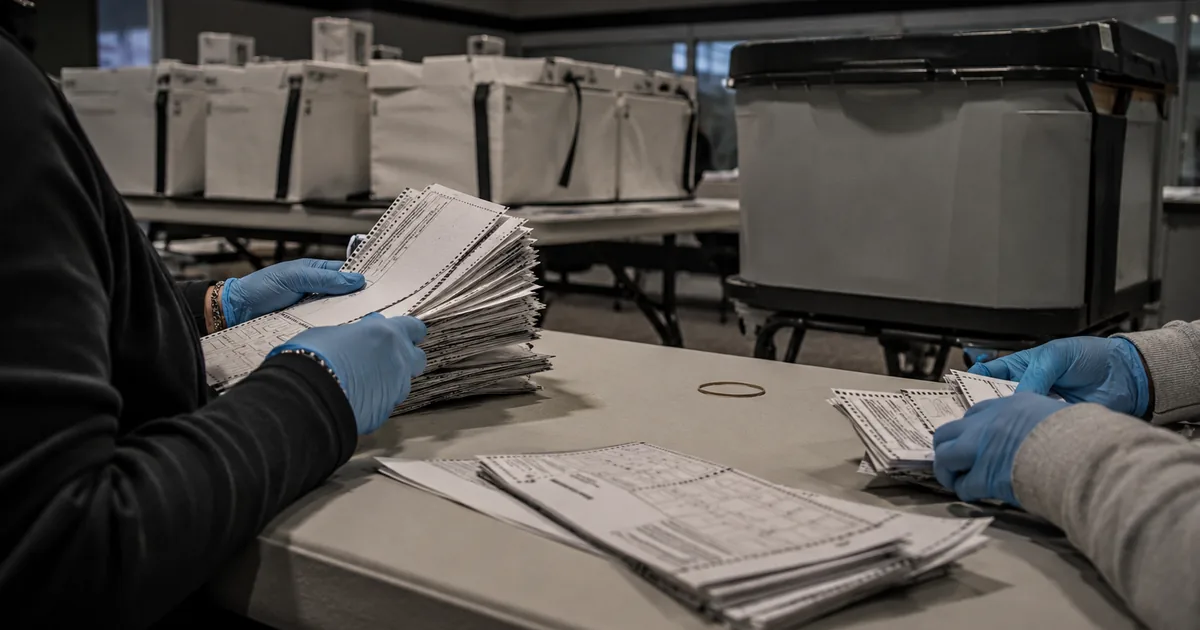
Homeland Security Secretary Markwayne Mullin sent a letter this week warning that the companies supplying more than eighty percent of America’s voting equipment build it with Chinese-made components, and attached a condition to federal election money: states that want their full grant award will have to hand count a random sample of paper ballots after the election.
The coverage split immediately into two piles, one treating the warning as vindication and the other treating it as pretext, and neither pile said the thing that actually matters, which is that the underlying supply chain problem is documented, six years old and was disclosed to Congress under oath.
That is not a defense of what Mullin is doing. It is the reason what he is doing works. A demand you can refuse on the merits is a demand. A demand that happens to be correct is leverage.
The Premise Is Not Invented
Three vendors, Election Systems and Software, Dominion Voting Systems and Hart InterCivic, account for the overwhelming majority of American voting equipment. Executives from all three have acknowledged before the House Administration Committee that their machines contain Chinese-manufactured parts, including chips and touch screens, with one chief executive telling members that for certain components there were simply no alternative suppliers. The supply chain firm Interos examined one widely deployed model and traced roughly a fifth of its hardware to China, and nearly sixty percent to China or Russia combined. Just the News laid out the letter and the market share behind Mullin’s warning this week.
None of that means an American election has been altered. It has not, and nobody has produced evidence that it has. A foreign-manufactured touch screen is a risk surface, not a compromise, and the distinction is the whole ballgame. But a risk surface in critical infrastructure is a real thing to worry about, and the honest position is that this has been a known weakness sitting in plain sight while the political system argued about whether the last election was stolen.
The Remedy Is Not Invented Either
Here is the part that should trouble anyone who cares about elections more than about scoring the news cycle. What DHS is requiring is good practice.
Under the conditions the department published in July, states seeking full Homeland Security Grant Program awards must manually audit at least five percent of ballots cast, reconcile the number of voters who participated against the number of ballots counted, and develop a plan to move away from systems that tabulate votes from barcodes or QR codes rather than from what the voter can read.
Every one of those is something election security researchers have been asking for. The National Academies of Sciences, Engineering and Medicine recommended routine audits of paper ballots and human-readable ballots in its Securing the Vote report in 2018. The barcode objection is older than that and is straightforward: if the machine tabulates a barcode the voter cannot read, the encoded selection can differ from the printed text above it, and no amount of voter verification catches it. Reconciling participants to ballots is basic accounting.
So the department has picked a set of requirements that a serious election administrator would struggle to argue against on substance. That is not a coincidence and it is not generosity.
What the Same Secretary Was Doing Six Weeks Ago
On July 17, Mullin threatened state election officials with criminal prosecution if they refused to feed their voter registration rolls through the federal SAVE database, demanding that secretaries of state confirm within two weeks that they would cooperate. Democracy Docket documented the demand and the threat, including his line that the department would make noncompliant states “a priority to look at who voted in their states.”
The justification was a claim that SAVE had identified more than 250,000 noncitizens registered in California, New Jersey, Nevada and Pennsylvania. No methodology was released. Wendy Weiser of the Brennan Center said the figures were “almost certainly false or wildly overstated.” David Becker of the Center for Election Innovation and Research called the number “irresponsible” given the opacity behind it. A federal judge in Washington had already barred the department from using SAVE to surveil voters and force removals, and courts have repeatedly held that the executive branch has very limited authority to demand access to state rolls at all. The Hill covered the escalation as it happened.
Six weeks later the same official is offering states a package of well-regarded safeguards, conditioned on money, from a department that has been told by a court to stay out of their voter files.
Our View: Take the Audits, Refuse the Arrangement
We think states should conduct these audits and should refuse to conduct them because Washington threatened their grant money.
The reason is not squeamishness about federal involvement. It is that a safeguard adopted under duress belongs to whoever applied the duress. If Ohio hand counts five percent of its ballots because DHS conditioned a grant on it, then the audit is a federal compliance artifact, and its scope, its timing and its interpretation become negotiable by the same secretary who is currently trying to get inside state voter files on a theory a judge already rejected. The audit stops being evidence and becomes a lever. If Ohio hand counts five percent of its ballots because Ohio decided that is how a state proves its results, the audit survives this administration and the next one, and no cabinet secretary gets to decide what it means.
There is also a plainer risk. Election officials who spend the next year fighting DHS over voter rolls will, reasonably, treat everything in the same envelope as hostile, and the barcode transition is exactly the kind of expensive, unglamorous, multi-year reform that dies when it becomes partisan coding. Mullin has managed to put a genuine security improvement on the same side of the ledger as a voter purge apparatus. Some states will now reject the improvement to reject the apparatus, and that outcome is worse than the status quo.
Congress Handed Him This
The uncomfortable conclusion is that this opening exists because nobody closed it. Vendor executives told a congressional committee, under oath, that their equipment depends on components from a country the government formally treats as an adversary. That testimony did not produce a domestic sourcing requirement, a certification standard for supply chain provenance, or a funded federal program to replace barcode tabulation. The National Academies recommendation is eight years old and still not law.
Congress has authority here that DHS does not, and it has spent the intervening years litigating 2020 instead. When a legislature leaves a real problem unaddressed long enough, an executive agency eventually solves it on terms the legislature would never have chosen, and attaches whatever else it wants to the same envelope. That is what happened this week.
We wrote on Monday about the Supreme Court letting Trump’s mail-voting order take effect without ruling on whether it was legal, which is the same shape of problem arriving from a different direction: federal control over state election administration expanding through the path of least resistance. The audits are worth having. The way they are arriving is worth fighting, and states should be clear that they are doing the first thing on their own authority rather than the second thing under a grant condition. The distinction will look academic right up until someone in Washington decides what a five percent sample proves.