
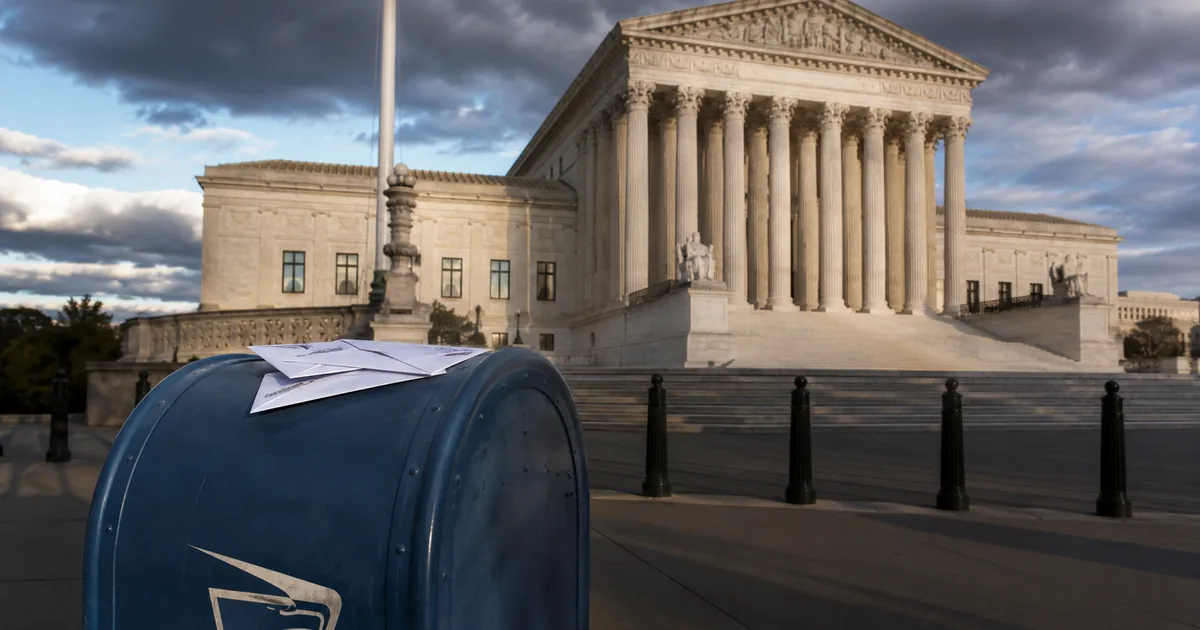
The Supreme Court on Monday let President Trump’s mail-voting executive order move forward in 23 states and Washington, D.C., splitting 6-3 roughly ten weeks before Election Day. The justices went out of their way to say they had decided nothing about whether the order is lawful, and that is exactly what makes the ruling consequential: in election litigation, running out the clock is functionally the same as winning.
What the Court Actually Decided, and What It Pointedly Did Not
The order came down unsigned. As NBC News senior Supreme Court reporter Lawrence Hurley reported, the justices granted an emergency application from the Trump administration and a parallel one filed by Alabama and eleven other Republican-led states, pausing a June 25 injunction from U.S. District Judge Indira Talwani in Boston that had blocked the order’s central provisions in the 23 mostly Democratic-led states that sued.
The reasoning was narrow to the point of being evasive. The majority did not hold that the president may direct how states run their elections. It held that Talwani moved too early, before federal agencies had settled on how they would actually carry the order out. The Court then added a line that reads less like reassurance than like a shrug:
The court’s disposition of this application does not mean that any measure taken by the Government to implement the order will necessarily be lawful. On that score, time will tell.
Time will tell. There are ten weeks until November 3, and absentee voting in some states begins well before that.
The Order Under All This Litigation
Trump signed the executive order in March, and Votebeat’s reporting at the time laid out how far it reached into machinery the White House does not normally touch. It directs:
- The Department of Homeland Security to build state-by-state lists of adult U.S. citizens.
- The Postal Service to obtain, from each state, a list of voters the state intends to send a mail ballot.
- USPS to deliver mail ballots only to people who appear on those lists.
- Election officials to place unique identifiers, such as barcodes, on ballot envelopes.
Talwani’s June ruling concluded that this inverted the constitutional order. The Constitution assigns the power to set the rules of federal elections to state legislatures and to Congress, not to the president, and the Postal Service, which operates independently of any administration, has no statutory authority to decide who gets a ballot. She blocked the key provisions outright.
Trump has justified the order as a defense against voting by noncitizens, a phenomenon researchers have repeatedly found to be vanishingly rare. He also voted by mail in Florida as recently as this year, a detail NPR’s Hansi Lo Wang noted in his account of Monday’s order.
Sotomayor Called the Ruling What It Is
The Court’s three liberals dissented. Justice Sonia Sotomayor wrote for them, and her objection was not that the majority got the merits wrong. It was that the majority declined to reach them at all.
Today’s decision does not address whether the President’s attempts to interfere with states’ administration of the November 2026 elections are lawful. Nor does it suggest that the Executive Branch has any constitutional or statutory authority to implement the President’s directives. Instead, today’s decision merely postpones adjudication of those challenges.
Postponement is the mechanism. A court that defers a constitutional question until an executive action is concrete enough to review will, in an election year, deliver its answer after the ballots have already been counted. The emergency docket, which SCOTUSblog has been tracking closely through this dispute, is built for speed on the question of who gets relief now. It is not built to resolve whether a president may commandeer the Postal Service, and on Monday it did not try.
The Postal Service Is Still the Variable Nobody Controls
Here the picture gets genuinely murky, and any confident account of what changes tomorrow should be treated with suspicion.
A separate case produced a second Talwani ruling on August 11 that blocked the order nationwide, and as of Monday evening that injunction still stands against USPS. Hurley’s read is that Monday’s ruling will likely reach that order too. Wang’s framing is that the Postal Service remains blocked for now. Both can be true a week apart, which tells you how unsettled this is.
Meanwhile the agency has been moving. On August 21, three days before the justices ruled, USPS issued its final regulation implementing pieces of the order. The administration told the Court that the regulation is narrower than the executive order envisioned, and that the Postal Service “will not refuse to transmit ballots” even when a sender is missing from a state list.
That assurance sits awkwardly next to what the Postal Service’s own leadership has said in public.
The gap between a litigating position and sworn testimony is the kind of thing a court resolves at trial. It is not the kind of thing that gets resolved before Halloween.
Ten Weeks Is the Entire Argument
The strongest evidence that timing is the real battleground came from the administration itself. In a July filing, Solicitor General D. John Sauer told the justices that “implementation efforts for any USPS rule or DHS policy will need to begin well before November” to matter for the 2026 election, since mail voting starts weeks ahead of Election Day in some states.
Read that alongside the majority’s ripeness rationale and the shape of the thing becomes clear. The government argued the courts should wait because implementation was not yet defined, while simultaneously telling the same courts that implementation had to start by mid-August or it would be pointless. The Court accepted the first argument without appearing to weigh the second. The practical result is that the executive branch gets to act, and the constitutional question waits its turn.
That is a meaningful shift from where this Court was two months ago, when it upheld state mail-ballot grace periods 5-4 in Watson v. RNC. The difference is not obviously about mail voting. It is about who is asking. A state defending its own election rules got a narrow win in June. A president asking for room to run got a wider one in August, from a Court that had already narrowed the Voting Rights Act 6-3 in its Louisiana ruling this spring.
None of this arrived unannounced. Trump spent the winter telling Republicans he wanted federal control over how Americans vote, and the Brennan Center’s analysis of the executive order laid out months ago why the legal theory behind it was thin. The theory is still thin. It simply has not been tested yet, and the schedule now favors the side that benefits from the delay.
What remains is a race between an underfunded agency trying to stand up a new ballot-screening system in ten weeks and a set of lawsuits that have not slowed down. Voting rights groups are still litigating, the nationwide order has not formally been lifted, and the justices have promised only that time will tell. The question worth watching is not whether the courts eventually rule on the merits. It is whether any ruling arrives while it can still change what happens to a ballot.