
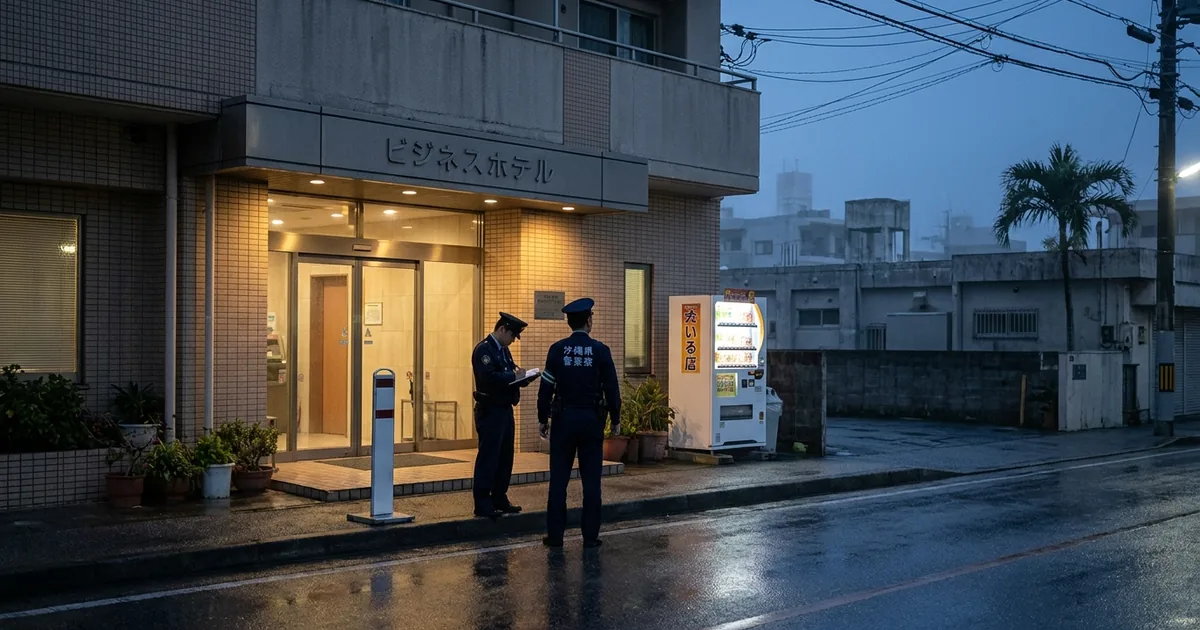
Japanese police arrested a 20-year-old US Marine early Sunday on suspicion of robbing and killing a 39-year-old woman in a Naha hotel, and Prime Minister Sanae Takaichi called the case extremely brutal and vicious before the day was out. Almost every account reaches back to 1995 for context. Almost none mention what changed four days before the killing.
Okinawa swore in a new governor on September 30. Genta Koja, an independent backed by the ruling Liberal Democratic Party, took 59 percent of the vote in September and 423,124 ballots, the largest any Okinawa gubernatorial candidate has won since 1972. He unseated two-term incumbent Denny Tamaki, and he is the first governor in twelve years who wants the Marine air station at Futenma relocated to Henoko rather than cancelled. So the first major criminal case of his tenure has landed on a prefectural government that no longer treats the bases as the enemy.
Lance Cpl. Devin Jacob Ballard, assigned to the III Marine Expeditionary Force at Marine Corps Air Station Futenma, is accused of killing Anna Yagi between 2:10 a.m. and 4:17 a.m. Saturday at a hotel in Naha’s Wakasa district and taking her wallet and a bag. Stars and Stripes reported that security footage showed Yagi entering with Ballard and Ballard leaving alone, and that officers spotted him the following night in an Okinawa City nightlife district, questioned him, then arrested him. He denies the allegations. Foreign Minister Toshimitsu Motegi summoned US Ambassador George Glass to the ministry on Sunday and told him Japan felt strong indignation.
The Two Pressure Points That Closed
Here is the mechanism that decides what happens next. The 1995 rape of a 12-year-old girl by three servicemen became a national rupture for a procedural reason as much as a moral one: under the Status of Forces Agreement, the United States keeps custody of a service member until Japan formally files charges, and Washington’s refusal to hand the three over early is what turned local grief into a mass movement. That fight cannot happen here. Japanese police picked Ballard up off base, so Japan already holds him, and the Marines have confirmed as much. There is nothing for Tokyo to demand on custody.
The second pressure point was the governor’s office. Ota, Onaga and Tamaki each ran Okinawa as a standing objection to the bases, and every case like this one handed them a megaphone. Koja does not have that platform.
Strip both away and you can see what Takaichi’s protest actually is. She asked for cooperation, tighter discipline and measures to prevent recurrence, which is to say a curfew and a review. That is the whole available menu.
Okinawa holds the bulk of the roughly 18,000 Marines based in Japan on a fraction of the country’s land, and the bargain islanders were offered after 1995 was that outrage would eventually shrink that footprint. Washington moves when a host government genuinely pushes, as it did when the last US troops left Iraq under a negotiated timetable, and friction around American basing is not unique to Japan, as the arrests near RAF Fairford showed last month.
But pushing requires someone positioned to push. Anna Yagi’s family will get a prosecution. Okinawa will get a discipline review. Nobody should pretend those are the same thing as leverage.