
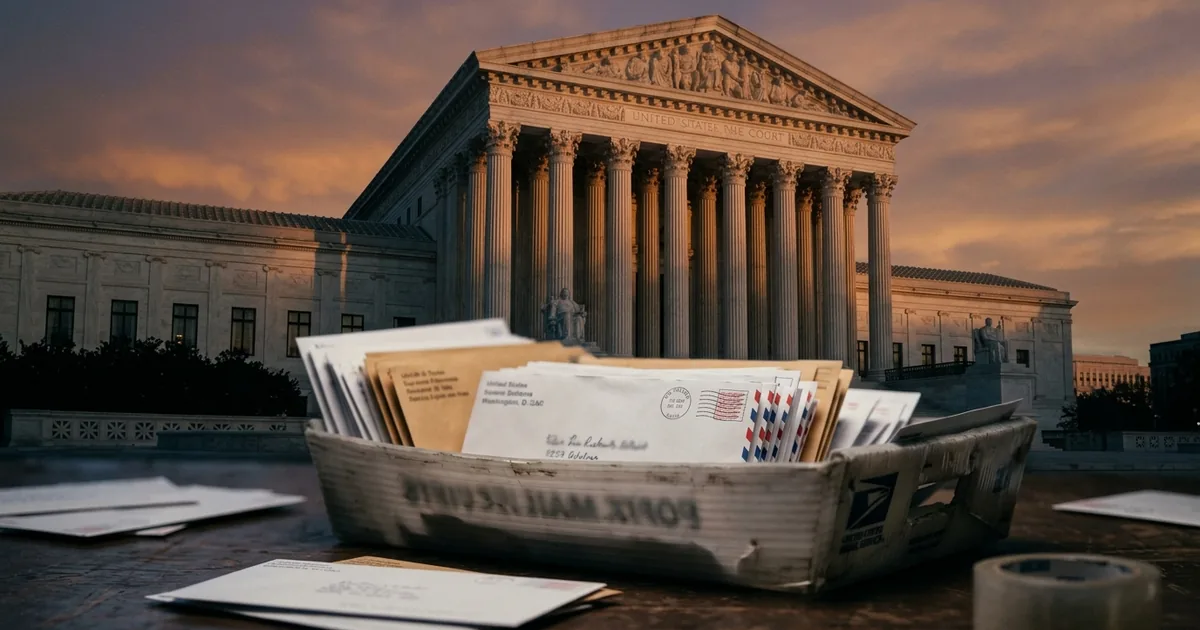
The Supreme Court ruled on Monday that states can keep counting mail ballots that arrive after Election Day, upholding Mississippi’s five-day grace period by a 5 to 4 vote and handing the Republican National Committee a defeat just over four months before the midterms.
The result matters, but the lineup is the real story: Justice Amy Coney Barrett wrote the majority and Chief Justice John Roberts joined her, which means the GOP’s challenge collapsed on the same textualist logic the conservative legal movement spent a generation building.
What the Court Actually Decided
In Watson v. Republican National Committee, the justices held that the federal statutes setting a national Election Day do not bar Mississippi from counting absentee ballots that are postmarked by Election Day and received within five days. Barrett, joined by Roberts and the Court’s three liberals, read the 19th-century laws narrowly. “The election-day statutes say nothing about ballot receipt, and we cannot add to the words Congress chose,” she wrote. The four remaining conservatives dissented.
That one sentence is the whole case. The RNC, backed by the Trump administration, argued that Election Day means every ballot must be in hand when the polls close, and that any state counting later-arriving ballots is defying federal law. Barrett’s answer was that the statutes Congress passed in the 1800s fixed a day for choosing officeholders. They never said a word about when a completed ballot has to land on an election clerk’s desk. As NPR reported on the ruling, the decision keeps grace periods intact in more than a dozen states and the District of Columbia, most of them with rules that look like Mississippi’s.
Why the RNC Lost: Its Own Doctrine Boomeranged
Here is the part worth sitting with. The conservative legal project has spent decades insisting that judges read statutes for what they say, not for what anyone wishes they said. Textualism was the tool used to shrink agency power, narrow civil-rights statutes, and box in the administrative state. In Watson, the RNC asked the Court to do the opposite: to read a ballot-receipt deadline into laws that contain no receipt deadline, because the practical result would shrink mail voting.
Barrett would not do it, and that refusal is the why behind the headline. A justice who built her reputation on textualism could not credibly invent a rule Congress declined to write, then apply it only to a politically convenient set of state laws. Roberts, who guards the Court’s institutional standing more than any other vote on the bench, was not going to put his name on a partisan rewrite of election law five months before voters head to the polls. The GOP did not lose because the Court discovered a sudden enthusiasm for voting rights. It lost because its preferred outcome required the very judicial activism its own movement claims to despise. As CBS News noted in its coverage, the same logic preserves grace periods in Democratic-led states like California, Illinois, and New York, which is precisely why the party wanted them struck down.
The Federalism Trap
There is a second layer, and it cuts in the same direction. The Constitution’s Elections Clause hands states the default power to set the times, places, and manner of federal elections, subject to Congress overriding them. Congress set a day. It did not set a receipt deadline. Under the conservative federalism tradition the Court usually champions, that silence leaves the choice to the states. To rule for the RNC, the majority would have had to read federal preemption into a gap Congress left open, expanding Washington’s control over how states run their own elections. That is a strange posture for a Court that spends most of its term lecturing the federal government about overreach.
So Barrett threaded both needles at once. She honored textualism by refusing to add words, and she honored federalism by leaving the call with the states. The dissenters, who spent oral argument warning that late-arriving ballots could erode public trust, were left arguing policy in a case the majority decided on text.
This Is One Front in a Much Bigger Fight
The ruling does not land in a vacuum. It arrives four days after a federal judge blocked the core of President Trump’s March executive order on elections, which had tried to route mail-ballot oversight through the U.S. Postal Service and build a centralized federal list of eligible citizens. As Votebeat reported, U.S. District Judge Indira Talwani found that neither the president nor the Postal Service has the authority to decide who can vote by mail, because the Constitution leaves voter eligibility to the states.
Read together, the two decisions describe a strategy and its limits. The administration and the party have come after mail voting on every available track: an executive order to choke it administratively, and litigation to choke it judicially. Both tracks hit the same wall. Winning either one demands more federal power over elections than conservative doctrine is willing to grant. The push to narrow mail voting is real, well-funded, and tied directly to the administration’s parallel effort to scrub millions of names from the voter rolls ahead of the midterms. What it lacks is a statute or a constitutional theory that reaches the goal cleanly.
What to Watch Before November
Watson settles the receipt-deadline question for this cycle, which lifts a cloud of uncertainty over how millions of absentee ballots will be counted in the fall. It does not settle the politics. The administration is expected to appeal the executive-order ruling, and the RNC’s wider campaign against mail voting will grind on in lower courts under other theories.
The deeper signal is about this Court. On a question with obvious partisan stakes, two of its conservatives declined to deliver the result their political allies wanted, because the law did not support it. That will not hold on every election case, and nobody should treat one 5 to 4 ruling as a turning point. But it is a useful reminder that a legal doctrine, once built, does not always bend back toward the side that built it. The RNC asked the Supreme Court to bend. The Court handed back the party’s own playbook instead.