
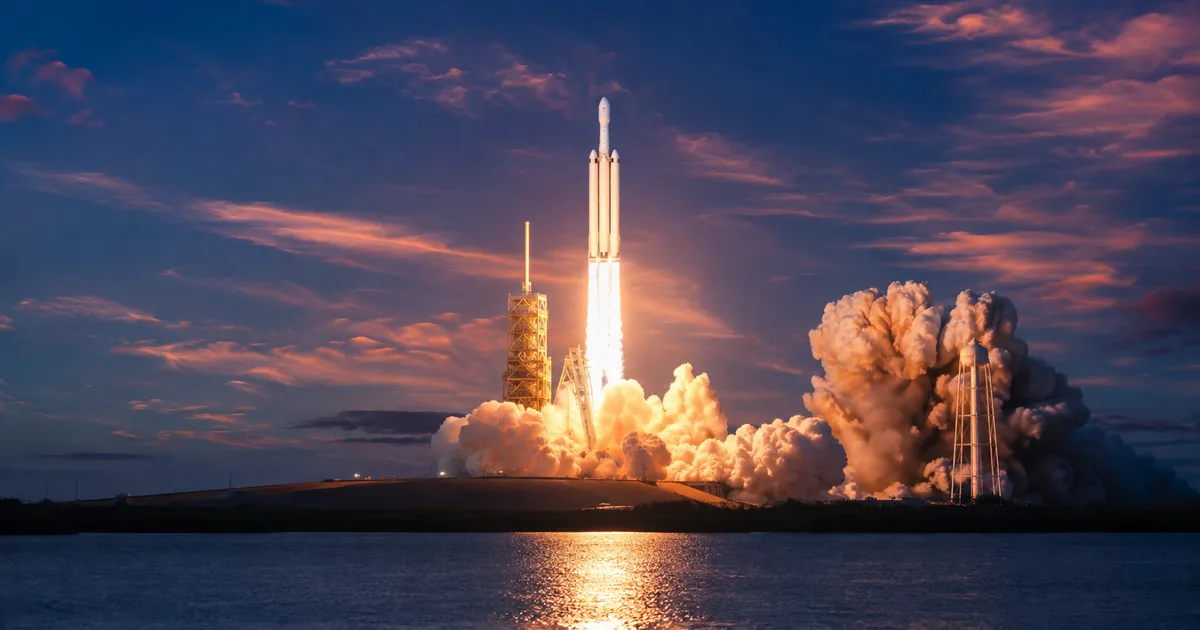
NASA’s Nancy Grace Roman Space Telescope is scheduled to lift off from Kennedy Space Center early on Sunday morning aboard a SpaceX Falcon Heavy, bound for a gravitational parking spot a million miles out.
Liftoff is set for 7:26 a.m. Eastern, and the coverage you will read today is mostly about dark energy, when the more useful fact is buried in a budget document.
Roman was finished early. NASA announced the observatory complete in April, and as SpaceNews reported ahead of the launch, the agency’s astrophysics division described a team that delivered roughly nine months ahead of its formal readiness date while living within its resources. The $4.3 billion program came in ahead of schedule and inside its cost line. That is the part almost nobody is placing next to the other half of the story, which is that this administration spent two consecutive budget cycles trying to kill it. A program cannot be both the poster child for wasteful science spending and the one that finishes early and under budget, and only one of those claims is supported by a delivery date.
The Rationale and the Record Point in Opposite Directions
The cancellation attempts are not a rumor. Scientific American reported on a White House proposal to terminate an observatory that was essentially built and sitting in a clean room. The fiscal 2026 request that carried it sought the largest cut in NASA’s history, with science taking roughly half the damage, and Congress rejected it outright, appropriating $24.4 billion for the agency rather than the figure the White House wanted.
Then it happened again. The fiscal 2027 request repeated the exercise, proposing another roughly 47 percent cut to NASA science, which is why Space.com filed the story under deja vu. The Planetary Society’s read of the FY27 request walks through the same pattern. This is the detail that keeps falling out of today’s launch stories, which tend to use the past tense: the attempt is not historical. It was renewed this spring, and House appropriators had to write a specific floor into the bill, no less than roughly $167 million, to protect the launch date of a telescope that was already finished.
So the sequence runs like this. The administration proposed cancelling a nearly complete observatory. Congress refused and paid for it. The observatory then finished early and under budget. And the administration proposed cancelling the surrounding science program again anyway. If the argument for termination had been about cost discipline, Roman’s own numbers were the rebuttal, delivered on time, in public, by NASA.
What It Is Actually For
Roman carries a 2.4-meter mirror, the same aperture as Hubble, behind a 300-megapixel infrared camera with a field of view something like a hundred times wider than Hubble’s. That combination is the whole point. It is not built to look deeper than the James Webb Space Telescope; it is built to look wider, fast enough to survey large pieces of sky repeatedly and catch what changes.
The targets are dark energy and dark matter, which together account for roughly 95 percent of the universe and remain almost entirely unexplained. Senior project scientist Julie McEnery has said the mission may confirm current hints that the standard model of the universe is wrong, which is an unusually direct thing for a project scientist to say out loud. It also carries a coronagraph as a technology demonstration, an instrument that blocks a star’s light precisely enough to image the planets around it, and it is expected to find thousands of exoplanets along the way.
NASA declared the mission go for launch on Friday, and SpaceX has a backup window on Monday morning if weather or a hold pushes it. Falcon Heavy will send Roman toward the Earth-sun L2 point, about 1.5 million kilometers out, the same neighborhood Webb occupies. First images are months away; the survey science that justifies the telescope is a five-year job.
Congress Was Right and Should Say So Louder
Our position on this is not complicated. Cancelling a finished spacecraft is not a spending cut, it is a write-off, and the officials who proposed it were asking the country to throw away roughly $4 billion of completed work to book a saving on the remaining sliver. Congress was correct to refuse, correct to refuse twice, and correct to write a dollar floor into the appropriation rather than trusting the agency’s leadership to protect a launch date its own budget office had targeted.
What should happen next is that appropriators stop treating this as an annual emergency. Roman survived because a bipartisan group of senators and House appropriators kept manually reversing the same proposal, which is a fragile way to run a national science program. The missions that come after Roman are earlier in development, which means they are cheaper to kill and have no launch date to rally around. Those are the ones to watch, because the pattern here is not really about one telescope.
There is a smaller irony worth noting. This launch will generate a round of official congratulation from an administration that twice asked Congress to prevent it. That is not unusual, and it is not disqualifying. It is just worth remembering in about nine months, when the next budget request lands and the same argument gets made about instruments that do not yet have a rocket underneath them.
We have written before about the gap between a space announcement and what Congress actually authorizes. Roman is the inverse case: the announcement was that it should not exist, and it is on the pad anyway.