
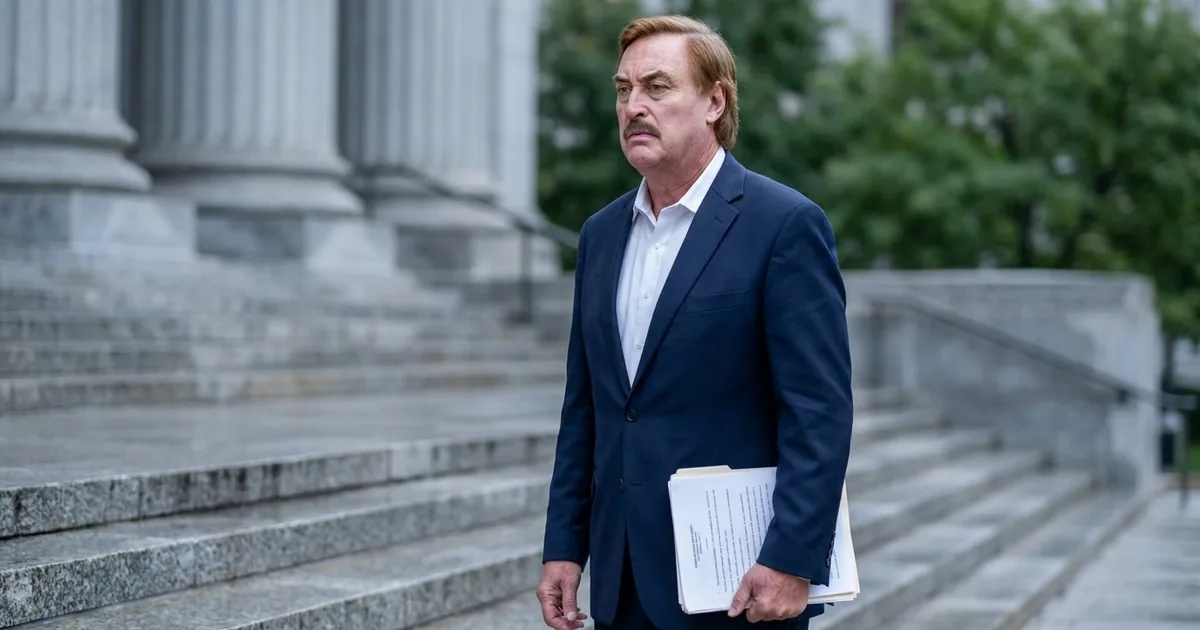
Minnesota’s chief justice signed a six-page order on Saturday denying Mike Lindell the statewide hand recount he had spent three weeks demanding, and nearly every account of it leads with the money he never sent.
That framing is more generous to Lindell than the order is.
The missed payment is real, and it is not what the court decided. Chief Justice Natalie E. Hudson reached the legal argument Lindell used to justify withholding the $825,000, examined what Minnesota’s recount statute actually permits, and found that the Secretary of State’s office and the State Canvassing Board were, in her words, “not committing any wrongful act, omission, or error.” That is a ruling on the merits. It means the recount plan Lindell publicly called unlawful is the plan the law describes, and it means the theory he built his refusal on was wrong before the deadline ever passed. Reported as a missed invoice, this looks like a stumble. Read as written, it is a loss on the substance.
What He Asked For, and What the Statute Allows
Lindell finished about 45,000 votes behind Minnesota House Speaker Lisa Demuth in the August 11 Republican primary for governor, a margin nowhere near the range where state law triggers an automatic recount. That left him one route: a discretionary recount, which a losing candidate may request and must pay for. He announced he would fund it himself, and NBC News reported he put the figure at $825,000, the state’s estimate for hand counting every paper ballot in the race.
Then the scope became the fight. The state proposed recounting the votes cast in the contest being recounted, meaning the ballots for the office of governor in the Republican primary. Lindell wanted considerably more: every one of the seven Republican candidates counted separately, and Democratic primary ballots pulled in alongside them. Fox 9 in Minneapolis reported that he called the state’s terms unlawful and stopped payment on that basis.
His reading rested on statutory language defining a recount as determining the number of votes validly cast for the office to be recounted. He treated “the office” as an opening to reexamine an entire election. Hudson did not agree, and the practical consequence of her order is that a candidate cannot convert a recount he is paying for into a general audit of contests he did not run in.
The Money Was Never the Obstacle
Here is the part the procedural framing buries. Lindell has spent five years insisting that American elections are corrupted by electronic voting machines, and he alleged again this month that his team had found irregularities in Minnesota’s data. A hand recount of paper ballots is the single instrument that tests that claim directly. The ballots existed. The price was named. He had said, on camera, that he would cover it.
By August 24, the deadline to formally request the discretionary recount and submit the payment, he had done neither. CBS Minnesota documented the withheld payment as it happened, and NOTUS reported that the state considered the deadline itself missed, not merely the money.
After losing, he told NBC News he would go to the U.S. Supreme Court, and added a line worth sitting with:
I’m willing to pay even more money. I don’t care what it costs.
He said that about a recount he had already declined to buy at a price he had already agreed to. Our read is that the scope dispute was doing different work than it appeared to. A recount confined to the governor’s race would have produced a number, and a number ends an argument. Widening the request to a scale the statute does not authorize kept the claim alive without ever subjecting it to paper. Lindell did not lose the chance to prove machine fraud in Minnesota. He declined it, on a technicality he raised himself, and he is now describing the consequence as an injustice.
An Appeal With No Federal Question in It
Lindell says he will take this to the U.S. Supreme Court, and NBC News reported that his team is also seeking election data from all 87 Minnesota counties under public records law. The second part is ordinary. Anyone can file those requests, and Minnesota should process them on exactly the timeline it would give any other requester, with no acceleration and no special handling.
The first part is close to meaningless, and no coverage we have read has said so plainly. Hudson’s order interprets a Minnesota statute governing a Minnesota recount, administered by Minnesota officials. The U.S. Supreme Court reviews state court judgments only where a federal question is genuinely presented, and a state court’s reading of its own election-administration law is close to the paradigm case of a matter it leaves alone. Lindell has not identified a federal right that a properly scoped recount violates, because there is not an obvious one. Announcing an appeal is not the same as having grounds for one, and reporting the announcement without that context hands him a headline he has not earned.
The Cost Rule Is Doing Its Job
There will be pressure, eventually, to treat the $825,000 as the villain of this story, a paywall between a candidate and the truth. It is worth saying clearly that the rule is sound and Minnesota should not bend it. Recounts consume county staff, election judges and weeks of administrative capacity. When the margin is wide enough that the state does not think a recount is warranted, requiring the person who wants it anyway to carry the cost is how a system keeps the losing candidate’s certainty from becoming everyone else’s expense. The rule worked exactly as designed here. It asked a man who says he has spent a fortune investigating elections whether he would spend a comparatively small amount on the one that concerned him most, and it got an answer.
When we covered the Minnesota primary itself, the striking thing was how much of the state’s Republican establishment had spent the summer working against its own best-known candidate. Demuth’s 45,000-vote win was the result. Nothing in Saturday’s order disturbs it, and by Lindell’s own conduct, nothing was ever going to.
The open question is what he does with the county data when it arrives. A public records request produces spreadsheets, not a recount, and spreadsheets can be arranged into any shape a motivated reader wants. That is presumably the point.